Mercedes-Benz Pontonobilia

Pon'-ton-o-bil'-ia: n. 1. An object, most often a scaled representation of a Mercedes-Benz Ponton. Also includes any other Ponton minutia suitable for a collection.

View More Pontonobilia 1

1 August 25, 2003: Due to a change in Yahoo! Groups policy, membership in the IPOG (International Ponton Owners Group) is now required to view the Files and Photos section, which includes more Pontonobilia.


!! Attention Pontonobilia Detectives !!

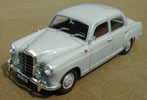
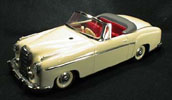
Scale models of the Mercedes-Benz Ponton four door sedans are not as common, and certainly more difficult to positively identify than the more abundant roadster, coupé and cabriolet models. Working only from a photograph of limited quality, it can be challenging to identify which Ponton sedan a scale model was actually made to represent.  I find it amusing to try and figure it out, without first looking at any annotations on the base plate. To my eyes, these two Ponton sedans appear to represent the Type 219 sedan.  Why?  First of all, they appear to have the longer front fenders and hood, which would make them one of the 6 cylinder Ponton sedans, either the Type 219, 220S or 220SE.  The high air intake vents on each side of the radiator shell appear to be missing, so that led to the conclusion that they are indeed one of the 6 cylinder models.  Now, focus on the treatment of the rear door windows to determine whether the model maker intended it to be a Type 219 or 220S / 220SE. On good quality scale models of Ponton sedans, this particular area includes a key design element which aids in distinguishing between the three 6 cylinder Ponton sedans. If it was meant to be a 219, then there will be no vertical strip indicating the reversed, fixed vent window that is found on the 220S and 220SE sedans.  From this photo, I could not see that detail.  However, if the model maker neglected to capture that detail, it becomes much harder to know what was used as a prototype. At that point, flip it over and read the base plate, if possible!

This model looks very similar to the two models above, but this one has the distinctive blinker lights mounted high on the front fenders near the A-pillar. That makes it a 4 cylinder Type 180/190 Ponton sedan. It is made by Wiking (Germany).  The scale is 1:87, and it is plastic.  Wiking (English pronunciation: "Viking") vehicles are very small, light weight, accurately detailed, and can be found on many H.O. scale model railroads in Germany and around the world.  Technically, H.O. is "Half Zero" (H.0.), not "H O" as it is commonly known, but that is a discussion better left for another web site. These photos are somewhat difficult to interpret, but I believe that the high air intake vents (at each side of the radiator shell) are present on this scale model.  If you are familiar with Wiking toys, you will notice that this is an earlier offering based on the color of the wheels.  Early Wiking vehicles had gray wheels.  They began using more authentic looking black wheels sometime around the early 1980s.  I have an article on the history of Wiking that I need to un-earth (perhaps in an old "Mercedes-Benz in Aller Welt" magazine) before I can be more specific about the dates. I believe Wiking began making miniature model cars in 1948.

This might be a color variation of the same 1:87 scale Wiking Type 180 Ponton sedan (above).  It may also be an example of the Elegant Miniatures series Type 180 sedan by the ELM toy company of China (see below).  The air intake vents (at each side of the radiator shell) are a little more obvious in this photo. Also note the side blinker lights.


Elegant Miniature series: Plastic Type 180 Ponton sedan (assortment No. HK. 6100) made by ELM toys in China.


Wiking (Germany) 1:87 scale plastic model of the Mercedes-Benz Type 180 Ponton sedan with "photo etched" metal grille star. Note the relative size of the ordinary pencil tip. The detail on these Wiking (English pronunciation: "Viking") vehicles is quite amazing. The tires also include the correct font and lettering which reads "Continental". This model was made during the 1990s.  Brekina is another German concern that produced a 1:87 scale Ponton sedan.  Photo courtesy: Jeff Miller


Brekina (Germany) 1:87 scale plastic Type 180 Ponton sedan with "photo etched" metal grille star.  The color appears to be an approximation of the Daimler-Benz color, Moss Green (DB226). Length of this model is approximately 50 mm (2 inches). Photographed at Roskilde, Denmark with the cathedral in the background. 

This shot was taken out of a desire to try something new.  My own tried-and-true methods (reference the 1:18 scale Revell and Sun Star models on this page) were becoming somewhat routine and standardized. I took a total of 42 experimental images to get this shot of the Brekina Type 180 with the Danish village as a backdrop. I deleted the other shots because there was something distracting about each of them. Not unusual odds in my experience. Whether its full-scale cars or scale models, I typically end up tossing about 35 images for every one that I keep. Once in a while a shoot goes a little better, but not always. I could have also used Photoshop to merge the scale model with the background, but I believe the lighting looks more natural when the model is part of the surroundings and it makes for a more realistic photo. Photo courtesy: Jeff Miller / June 19, 2005.


Miniflex (Hong Kong) Type 180 or 190 Mercedes-Benz Ponton sedan.
Rubberized plastic material, solid windows, black plastic tires on metal axles.
Approximately 1:43 scale.
Photo courtesy: Jeff Miller / July 24, 2007.


Wiking (Germany) 1:87 scale plastic model of the Mercedes-Benz Type 220S Ponton sedan. Wiking model number 104 "Streifenwagen" (police car) dates from about 1965, and is 52 mm long. The gray wheels distinguish it as an earlier Wiking offering. Larry Hansen paid $10.00 for it on August 3, 1985 at the Toy Show in Macungie, Pennsylvania. The original box was hand-colored by Larry. Photo Courtesy: Jeff Miller / October 6, 2007.


Brekina (Germany) 1:87 scale plastic Type 180/190 sedan with "photo-etched" metal grille star. This example measures 50 mm (2 inches) in length. Note the hubcaps were not painted on this example.

When the camera zooms in on an object of this size, tiny dust particles can appear large and out of scale. They become quite distracting and the subject begins to look much more like a replica and less like the real thing, but the accuracy is still very good on these miniature models, even up close.  The background setting is the Town Hall in Jever, administrational seat of the rural district of Friesland, Germany. Photos courtesy: Jeff Miller / June 20, 2005.


Approximately 50 mm long (2 inches), this is the 1:90 scale Schuco (Germany) "Piccolo" series solid die cast Mercedes-Benz Type 180 Ponton sedan. Black (DB040) variation. Photographed in Germany before a Lower Saxon farm in the "Alten Land" at the lower Elbe. These models can be found (brand new with box) at flea markets and in catalogs for about $10-$15.  Photo courtesy: Jeff Miller / June 19, 2005.


Schuco Piccolo series solid die cast Mercedes-Benz Type 180 Ponton sedan, 1:90 scale. Military green variation.


Mercedes-Benz Ponton sedan key chain fob. For the Ponton owner who has almost everything.


This is the Minichamps 1:43 scale Type 180 Ponton sedan.  The side blinkers are not completely accurate.  This model shows an amber bulb at the top of the blinker housing.  On the prototype, the top of the blinker housing is chrome.  Aside from that, the model looks quite good.


Mercedes-Benz Type 180 sedan (1:43 scale) with Webasto sliding sunroof.  Made by Waldorf. From the collection of Steffen Mueller / MuellerLage@aol.com / Berlin, Germany / December 4, 2004.


Altaya's 1:43 scale die cast metal representation of the 1960 Type 180Db Ponton taxi. This traditional taxi color scheme was used in Portugal through the early 1960s. The chrome trim on this model is plastic.

In the late 1980s, I had a professor who was originally from Portugal. Before I bought my 1957 Type 190 sedan, he was driving a 1980s vintage Mercedes-Benz Type W123 240D, which he bought new. I was impressed by the appearance of that car when ever I used to see it in the school parking lot. When I bought my black Type 190 sedan, I showed him a photo of it. This prompted him to tell me about how his family had owned a taxi business in Portugal and how they used brand new Mercedes-Benz Ponton diesels. First, they had to cut holes in the roof for the fitment of the TAXI sign, followed by a paint job in this (see photos) traditional color scheme. When the daytime driver finished his shift, he would keep the car running while the night driver took over. The car would run continuously until the each weekend when they would change the oil in the entire fleet.

Back in the full-scale world, Daimler-Benz offered a radio package for vehicles that were destined to become taxis. Included on the gasoline engine models were noise suppression devices for electric ignition interference. Diesels do not have conventional electric ignition systems but rather, the higher compression ratio of the engine is the catalyst for igniting the diesel fuel.  There are no spark plugs, distributor, cap or rotor on diesel engines. On the Ponton era diesels, the fuel enters the cylinders directly by a Bosch mechanical fuel-injection pump. The air is mixed with the fuel at that same moment.   Is this too much information for a 1:43 scale model?


Tinplate model of the Type 190Db Ponton sedan.

Tucher, Walther, Nbg. (Germany) Mercedes-Benz 190Db sedan (W121 Ponton) with wind-up motor and steerable front wheels. Note the steering lever protruding from the base of the radiator grille. The rear license plate reads, "TW-W651". Also printed just above rear bumper: "Tucher, Walther, Nbg. made in Germany". Tucher & Walther used old 1950s Blomer u. Schuler tooling and freshened up the lithography for this 205mm (8.5") long red sedan. As of 1998, this reproduction item was available through various specialty collector catalogs. It was also offered in dark blue. Price in 1998 was $83 including shipping.


Tekno (Denmark) model number 723.  A 1:43 scale die cast model of the Mercedes-Benz Type 180 Ponton sedan. Sitting on top of the original box.

Light Blue color variation of Tekno (Denmark) model number 723.  A 1:43 scale die cast model of the Mercedes-Benz Type 180 Ponton sedan.

Undercarriage of the Light Blue color variation of Tekno 723.

Metallic Blue variation of Tekno 723 - Mercedes-Benz Type 180 Ponton sedan. These can fetch a fair bit when in excellent condition with the original packaging.


Type 180 Ponton sedan slot-car racer by Bauer.  Appears to include a Webasto sliding sunroof and fog lamps.  Nice details.  Approximate scale, 1:65.


An attractive 1:43 scale die cast Type 180 Ponton taxi with roof rack. Manufacturer unknown. The grille appears to be modeled after the "early" (pre 1959) style 4 cylinder Pontons, while both bumpers are the later (post 1959) "b" style.

The tail lights should have a white section (for reverse) between the red and amber.  The paint looks so thick that it gives the appearance of porcelain instead of die cast metal.  Otherwise, the shape and scale of this model are quite realistic.


Revell #08973 (black) 1:18 scale die cast model of the Type W120 180 Ponton sedan. This model was released August 3, 2003. Needless to say, as soon as I saw these, I had to order one to take a closer look. I ordered one from the Netherlands on August 18, 2003 and it arrived in New York on October 2, 2003.

This view shows the original side valve engine (M 136.925) used in the first Type W120 models of 1953.  

I suspect these will be more popular, and available in Germany and Europe than in North America. As of October, 2003, one USA vendor that lists them is exoticar.com.  Photos courtesy: Jeff Miller / October 4, 2003.

Revell #08974 (light gray) 1:18 scale die cast model of the Type W120 180 Ponton sedan.  Photos courtesy: Jeff Miller / May 14, 2004.

Other than the rear view mirror, which seems to have an overly long stalk, the attention to detail is quite good on these models.

It takes Revell about one year to develop these appealing 1:18 scale models.  The development takes place in Hong Kong and in the Chinese province Chen Zhen at the cost of several hundred thousand dollars to the company.  The project moves forward only after members of a hundred-strong expert team measure and photograph the actual vehicles, 10,000 kilometers away in Germany.

An unusual color for the Revell Type 180 model.  This is "Mother of Pearl Green" (DB213). This particular example was ordered through MBUSA where it is referred to it as a Type 180D.  To order it (as of June 3, 2005) call 1-800-367-6372 and use MBUSA part number: B6 604 0357. Price is $42 plus freight.  Photos courtesy: Jeff Miller / June 3, 2005

Interior of the 1:18 scale Type W120 180D sedan. The dashboard is accurate down to the heater and ventilation controls. They even included the parking brake handle under the dash. It would have been extra sweet if they also included a miniature owner's manual, a few spare ceramic fuses, a canvas tool roll, and a set of fitted luggage. Revell, "Are you listening?"

What is there to say about this angle?  This is the unmistakable profile of the 4-cylinder Mercedes-Benz Ponton sedan. The tree in the background is becoming quite familiar to readers of the Pontonobilia page.

The stalk of the outside rear view mirror is not very accurate. How did they miss that detail? In general, it is hard to find fault with the execution of rest of the model.

Nice attention to detail.  Note the decal at the top of the radiator and the hand painting of the wires, brackets and hose clamps. On the other hand, the heater boxes should be black, not body colored.

Note the trunk lock is painted, but they must have forgotten about the "fuel" (diesel) door lock. This particular Revell model was a little pricey considering that the Black or Light Gray variations can commonly be found on Ebay for about $25 but the Mother of Pearl Green is so ugly I just had to have it!  Prior to MBUSA selling the green variation, the only place I saw them was through German Ebay vendors. This variation may end up being the most rare and hence the most valuable to future collectors.


From Larry Hansen's collection: Sun Star's 1:18 scale model of the 1958 Mercedes-Benz Type W128 220SE Ponton cabriolet and Revell's #08974 (light gray) 1:18 scale die cast model of the Type W120 180 Ponton sedan. Larry has amassed a staggering collection of Mercedes-Benz models, and recently I was able to spend some time visiting with him and photographing a handful (actually several hand's full) of the cars. He keeps a detailed inventory of the collection and displays the models arranged according to scale throughout his home.

Mercedes-Benz Type 300SL Gullwing coupé along side the Revell 1:18 scale Type 180 Ponton sedan. Two opposite ends of the spectrum in terms of models offered by Daimler-Benz in 1954. If your budget did not allow you to own the 300SL dream car, the Type 180 was a more affordable entry point into the family of Mercedes-Benz passenger vehicles. Photo of Larry Hansen's collection courtesy: Jeff Miller / July 2, 2005.


This is a remote control 1:18 scale tinplate model of the Type W180 220a Ponton sedan made by Mignon. The company had its origins in French occupied Germany, hence the name.  Condition of this example is poor.

"For years Mignon produced little railways. Later, in the early 1950s, they were taken over by R. und W. Link, Schwenningen. The new factory owners produced model cars like this nice 220a Ponton.  I have seen a Mignon VW Beetle offered at 375 Euro! You can see all types of model cars and other toys at: www.mignonbahn.de On the left side, you have to click on Autos."

Courtesy: Steffen Mueller / Berlin, Germany / February 9, 2005

Tinplate toys are typically more robust than their plastic counterparts.  However, this model is showing obvious signs of cruelty and neglect.  In most cases, the normal stress and strain of play does not result in this much damage.  There is not a lot here for the collector except perhaps a few spare parts to be used on the restoration of another example.

For every well preserved Ponton model found on this page, there were probably another hundred that looked like this before they were finally discarded.  There is nothing remarkable about this toy other than it is proportioned well (quite a good likeness of the 220a Ponton sedan) and it survived far longer than its original life expectancy.   January 30, 2005.


This is a remote control 1:18 scale tinplate model of the Type W180 220a Ponton sedan made by Mignon. The company has its origins in French occupied Germany, hence the name.  Condition of this example is not too bad.


Mercedes-Benz Type 220a (W180 I) (3/54-4/56). 1:14 scale, tinplate.  Made in Germany by Tipp & Co. Present day value (2004): approximately. US$ 3,200.  Photo Courtesy: Bernd D. Loosen (MBMC North-America). See the community page for MBMC website.


mb_220a_Tipp_1_14th_scale_red1.jpg (23677 bytes)

mb_220a_Tipp_1_14th_scale_red2.jpg (25303 bytes)

TCO 112:  Mercedes-Benz Type 220a (W180 I) (3/54-4/56). 1:14 scale, tinplate.  Made in Germany by Tipp & Co.  TCO (Tipp & Co.) was one of the largest manufacturers of tin toys in Nürnberg, Germany after 1922.  Red and black variation with electric headlights.  Battery compartment with swing out door is under car.  This is a particularly nice example with the windshield plastic, grille star and driver's figure (difficult to see in these photos) all intact.  December 4, 2004.


AHI (Japan) Type 220S sedan (blue variation) with original box. There are no windows or interior in this tinplate model, but it does have a friction motor.

The blue variation of the AHI Type 220S along side the AHI Type 300SL roadster.  Both original boxes are shown in this photo.


Detail of the AHI (Japan) tinplate Type 220S sedan (black variation) with friction motor.  Length is 100 mm, which makes it approximately 1:46 scale.  Photo courtesy: Jeff Miller


Red variation of the AHI (Japan) Mercedes-Benz Type W180 220S tinplate sedan with friction motor. Photo courtesy: Jeff Miller / August 7, 2005


Photo of Huki 220SE model and text courtesy: Bob Berman

Huki (Germany) Patent Electric 1:18 scale tinplate model of the Mercedes-Benz Type W128 220SE cabriolet with original packaging.

Located in Germany, Huki made cars and motorcycles primarily in the 1950s and 1960s. There were several other German makers who also made a nice, high quality Mercedes-Benz model during this period. These would include Gama, Seidel, Kellermann, Neuhieri, Arnold, Distler, and Tipp & Co. They tended to feature the Type 190, 220 and 300SL models. An excellent reference is "Tin Dream Machines" by Gerhard G. Walter (ISBN 1-8727-2713-1). The book's focus is on German tin toy cars and motorcycles from 50s and 60s. I also collect some of the motorcycles, they are pretty cool too.

Bob Berman
Rose Valley Pennsylvania
July 31, 2007

Photo of Tipp & Co. 220S courtesy: Jeff Miller

This model of the Mercedes-Benz Type 220S Ponton cabriolet was made by Tipp & Co. (Germany). The differences between this and the Huki Type 220SE model (above) are subtle. Note the windshields, and the chrome over the wheel wells. The Huki model does not have a back seat, and both models have similar, but different drivers. The Huki driver has his head pointed down and he is RACING. Huki, Tipp, and Seidel models all had some very similar aspects.

Bob Berman
August 1, 2007


In the 1990s, Faller made some very accurate 1:43 scale plastic models of the Ponton sedans. The series was called "Memory Cars".  This photo features two Type 220S sedans.


Faller's 1:43 scale plastic model of a Type 220S rally car.  This was part of the Faller "Memory Cars" series.


Mercedes-Benz Type 220S Ponton sedan in 1:43 scale by Minichamps.

Photos courtesy: Jay Joichi / April 20, 2005


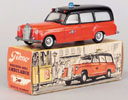
Tekno (Denmark) 1:43 scale die cast model number 731.  Mercedes-Benz Type 220S Ponton ambulance / Copenhagen Fire Department livery.  This particular variation includes amber warning lights on either side of a die cast siren above the windshield.  The rear windows of this model have been fogged out, as was common practice in the "real", full-scale world.

Compare the siren (center of the roof, above the windshield) on this variation to the others in this photo collection.  This one does not appear to be made from a separate die cast piece.  Perhaps the black paint makes it look like it is part of the body casting.

Original packaging for Tekno model number 731 Mercedes-Benz Type 220S ambulance.

The illustrations on this box are far more quaint and intriguing than today's clear plastic packaging, you'll agree.  An entire industry of commercial artists was lost when this style of packaging became unfashionable.  As mentioned elsewhere on this page, the value of original packaging (when in excellent condition) can surpass that of the item itself.

This Tekno 731 variation includes a die cast siren, red warning lights and a blue light on the roof.  The value of certain scale models can be surprising. When an older model, like this one, is found in excellent condition and includes the original packaging, the seller can ask just about any price they want.  The abbreviation among collectors for this condition level is "MIB", which stands for "Mint, In Box", or "mint condition, and in the box".

White variation of the Tekno 731 Type 220S ambulance.   I believe the yellow flags are available as reproductions.  Note the die cast siren and red warning lights.

Tekno 731 Type 220S ambulance / white variation.

Tekno 731 Type 220S ambulance / black variation.


Ace mechanic, "Fritz Teulholder". He is not much of a talker, but knows how to fix a broken Mercedes fast.  Photo courtesy: Jeff Miller / August 30, 2003.


The French toy manufacturer CIJ produced this 1:43 scale Type 220a Mercedes-Benz Ponton sedan. It is rare to find old toys with their original packaging.

Blue variation of the CIJ Type 220a sedan.

Gray variation of the CIJ (France) Type 220a sedan.

No windows or interior, just the basic Ponton shape.  The trunk star appears to be upside down.

Surprising that the grill star is intact.

Gray variation of the CIJ (France) Type 220a sedan.


The Bandai toy company (Japan) model number 733 in the "Automobiles of the World" series is a tinplate Mercedes-Benz Type 219 Ponton sedan. The model includes numerous variations which can keep Pontonobilia collectors busy today. This particular model is about 1:18 scale and features a friction motor and colorful plaid interior. It is very unusual to find this model with the original box. The packaging for these toys was probably designed to only survive the trip from the factory to the wholesaler or retailer, and finally, to the home to the proud new owner. I imagine in many cases, the box was discarded immediately after opening it. In the realm of collecting these antiques, the original packaging can be worth as much, if not more than the item itself.

Although not very authentic in appearance, Bandai did a nice job on the lithography. This interior view may be where the dream of owning and driving a Mercedes-Benz originated for many children of a particular era. Did Daimler-Benz ever consider offering a green steering wheel? Note the various colors of the steering wheel in the other photos.

The Mercedes-Benz model designation (219) of this Bandai toy is embossed on the base plate, but is somewhat misleading because it appears more like a 2/9 than a 219. It probably was embossed with a 2-slash-9 and not a 219, so the error goes all the way back to the original tooling. When these models show up in online auctions, it is common to see the seller mistakenly refer to the model as a "2/9", however; Pontonobilia spotters now know the truth.

This shows the base plate embossed with the misleading "2/9". In fact, this toy was modeled after the Type 219 sedan.

The interesting thing about tin toys is that when they get banged up from play, they begin to take on the appearance of a real car that has seen much use (and occasional abuse).  Some collectors try to get each color variation of the same model. Anyway, this photo shows the dark blue variation. Some of the known color variations of this Bandai Type 219 Mercedes-Benz sedan include green, dark blue, black and red. Many of them are missing the grille star up front.

This black variation of Bandai model number 733 has a few dings on the roof but is one of the few that is not missing the grille star.

The tail lights are not 100% accurate, but to the child with a vivid imagination, this model provided far more than the basic ingredients for an enjoyable play session on the kitchen floor. 

Red variation of the Bandai Type 219 sedan.

Missing the hood ornament.

Two Bandai 733 tinplate models of the Mercedes-Benz Type 219 Ponton sedan along side the IPOG (International Ponton Owners Group) "large" coffee mug. The radio in the background is a Grundig Type 2066 PX (AM/FM/SW) from 1958-1959. Note: If you have a source for reproduction plastic grille stars for these Bandai models, please contact editor@mbzponton.org. Photo courtesy: Jeff Miller / February 16, 2005.

Another variation of this Bandai model includes an unusual four door cabriolet. Again, missing the grille star. Daimler-Benz never produced a Type 219 four door cabriolet, but that did not stop the Bandai toy company from making one.

The steering wheel has been worn down to a green nub. Play on!

mb_219_Bandai_blue_cabrio_box.jpg

This original Bandai carton is marked with model number 733 of the "Automobiles of the World" series.  The model itself is missing the grille star.

Another color variation of the same four door cabriolet model by Bandai.

Black variation of the Bandai Type 219. Green steering wheel intact. Missing grille star.

Note that these Bandai models have a gas filler door on both the left and right rear fenders.  On the full scale Pontons, the door is located on the right rear fender only.

Bandai model number 733.  The dubious Type 219 four-door cabriolet (which never existed outside the Bandai toy factory) with white paint and intact grille star. This particular example looks almost too good to be true. 

Original packaging for the Bandai Type 219 four-door cabriolet.


Model #717 in the Schuco Piccolo series (1:90).  A solid die cast Type 220S Ponton coupé.  This particular model is a rare survivor from an original issue.  Schuco has since reproduced many of the models in the original Piccolo range. 


Sun Star #3553 (black) 1:18 scale die cast model of 1958 Type W128 220SE cabriolet. This model was released in 2002.

Very nicely detailed, including the interior.

 Photos courtesy: Jeff Miller


Detail of the Sun Star 1:18 scale die cast model of 1958 Type W128 220SE coupé with its distinguished "C-pillar" and rear window. The reflection in the fender is from the Exoticar model of the1955 Type 300c Adenauer. Photo of Larry Hansen's collection courtesy: Jeff Miller / July 2, 2005.


220S cabriolet / Schuco #5308 / "Elektro-Control-Car" remote control / tinplate

220S cabriolet / Schuco #5308 / "Elektro-Control-Car" remote control / tinplate

220S cabriolet / Schuco #5308 / "Elektro-Control-Car" remote control / tinplate


220S cabriolet / Schuco #5308 / "Elektro-Control-Car" remote control / tinplate.  From the collection of Steffen Mueller / Berlin, Germany / December 4, 2004.


Schuco #5720 "Elektro Hydro Car".

Interior view. Nice attention to originality.

This 1:18 scale model is a tinplate metal representation of the Mercedes-Benz Type 220S cabriolet. It features a clockwork wind-up motor and a multi speed fluid transmission. The fluid reservoir can be seen from the bottom.

In 2000, I saw this Schuco Elektro Hydro Car model at an antique toy show and the asking price (excellent condition, including the original box) was $4,000 USD. As stated previously on this page, when the model is in excellent condition and includes the original packaging, the sky is the limit. Actual selling prices may be much less. In June 2007 another example of this Schuco model sold for $950.

Light green variation of the Schuco #5720 "Elektro Hydro Car".

Original packaging for the Schuco #5720 "Elektro Hydro Car".

The area under the back seat reveals the secret workings of the fluid transmission!

Instead of suitcases, the Schuco #5720 Elektro Hydro Car stows two C size batteries in the trunk, presumably to power the headlights.

Interior of the Schuco #5720 Elektro Hydro Car with red upholstery.

Schuco #5720 "Elektro Hydro Car" green variation, complete with original box.

Red variation of the Schuco #5720 "Elektro Hydro Car".


Schuco #1085 Rollfix.  Modeled after the Type 220S Ponton coupé.  Produced by Schuco from 1959 until 1965.

The Schuco #1085 Rollfix is the most valuable of the three similar models shown on this page which include the Schuco #5308 Control Car and Schuco #5720 Hydro Car.

This example is in A-1 condition.

A pair of Schuco #1085 Rollfix tinplate toys in excellent condition including the original packaging.  In 2004, these would be worth up to several thousand dollars each. 


Schuco (Germany) model number 1085 "Rollfix". Mercedes-Benz 220S coupé.

Schuco (Germany) model number 1085 "Rollfix". Mercedes-Benz 220S coupé.


Schuco "Remote Control Car 2095". Tinplate 1:18 scale replica of the Type 190SL roadster-cabriolet.  Features a wind up clockwork motor and "remote control" steering (via cable).  The kit also includes yellow and red pylons so navigational skills can be tested on the "KFG" (Kitchen Floor Gymkhana).


This was a new car made by Schuco for 2002. Corresponding to the former "Remote Control Car 2095" this popular car now re-appears in the Schuco range. Partly produced from original tools, the cabriolet features a strong spring drive, an automatic stop lever and a remote control device. This is a large car - the length is 25cm. A silver Mercedes-Benz 190SL. The Schuco model number is 1870. This is a clockwork toy that runs only when the car is on the ground. It has a steering control cable and the set comes with posts to maneuver the car around. Completely new car in box with key. Comes in a nice lithograph presentation box.


190SL / Schuco #5503 "Elektro-Phänomenal" remote control / tinplate


This is a battery powered tin toy from the Schuco factory in Western Germany. The Schuco #5503 model was produced between 1955 and 1969. The gearshift has a forward, neutral and a reverse position.


Battery powered tinplate Type 190SL coupé. Manufacturer unknown.


1955 190SL by Maisto (1:18 scale) with a 1961 Type 190SL prototype by Daimler-Benz (full scale) in the background . The Maisto model is die cast metal with plastic trim elements. Very detailed and realistic as this photo illustrates.

Owner of both cars: Farouk El-Khalil / Beirut, Lebanon.


Made in Germany by JNF (Josef Neuhierl, Fürth).  Model of the Type 300b "Adenauer" (1951-1962) limousine.  Neuhierl was founded in Fürth in 1920 and produced this tinplate model from 1952 to 1960.  The replica measures 230mm long.

Features either a clockwork (wind-up), friction, or battery operated motor.  Luxury editions feature extra chrome and electric headlamps. Also has functional steering.

There are several known color variations including green (seen here),  red, black, light blue-turquoise, green metallic, silver, medium blue, white and black. The lithographed tin interior features a plaid pattern. 

A stately limousine in approximately 1:18 scale! Recently (August 6, 2005) I saw a mint condition example of this model at the toy show in Macungie, Pennsylvania for the asking price of $325. It was the same color, but also included the grille star. It had no original packaging or original key. If it had included these items, the temptation to make an offer would have been greater.

Metallic Green variation of the JNF Type 300b limousine.

White variation of the JNF Type 300b limousine.

Black variation of the German-made JNF (Josef Neuhierl, Fürth) Type 300b Adenauer limousine. Unfortunately the grille star is missing on this example. If it were a real 300b, it would present no problem, but being a toy makes it considerably more difficult to source a new one. Note the artwork on the original packaging.

Medium blue variation of the JNF (Josef Neuhierl, Fürth) Type 300b sedan. Note metal trim around windows and the plaid interior.


This die cast Mercedes-Benz Type 300 sedan was made in Germany, (US and British Zones) in the 1950s by Prämeta Koelner Automodelle.  Approximate scale, 1:43.  It originally included a "chauffeur" key.  Update: July 9, 2004: They may have been made by Bauermann & Co. in Cologne.  I need to get clarification on this point.

It has a wind-up clockwork motor with three forward speeds, reverse, and a lever for (according to the base plate annotations) "automatic curves" or "non automatic" straight ahead forward drive.

Prämeta Koelner Automodelle Type 300, red variation with original packaging.

Prämeta Koelner Automodelle's Type 300 sedan (which is also known as the "Adenauer" limousine).  A rare, blue variation, with key, and original box.

Prämeta Koelner Automodelle Type 300 limousine, chrome variation, with chauffeur key.  The chrome variation seems to be the most widely available.  The blue color variation is the most unusual, based on my "unscientific sampling" of on-line auctions.


From the Ricko Prestige series, this is model number R32102B, a 1955 Mercedes-Benz Type W186 300c "Adenauer" limousine from Larry Hansen's 1:18 scale die cast collection. This is an appealing model which has some very realistic appointments. It includes a Webasto sliding sunroof (in the "closed" position), the upholstery was made to look like sumptuous velour (as originally offered), the dash fascia looks like real wood and there is a tiny "high mileage" grille badge on the radiator shell.

The first Chancellor of West Germany, Konrad Adenauer (1949 - 1963) was chauffeured in one of several of these motor-carriages owned by the government. It was this association which led to the nickname of the car. The Type 300 limousines may also have been a source of some frustration for the mechanics who serviced them. Being technically advanced cars in their day, they were sometimes referred to as "Add An Hour" ($$$) to the bill.

All four doors and the engine hood open, as does the trunk (revealing two spare tires). The trunk lid also has a "D" badge (country of origin) above the license plate. The only thing missing is the jar of Grey Poupon® for the bratwurst picnic in the east garden.

It takes a manufacturer like Ricko about a year to develop and produce a model that involves this much detail. In 2005, the Type 300c limousine was being marketed in the USA through Exoticar by number 32102 and could have been ordered from www.exoticar.com (1-800-exoticar) for $29.95 plus freight. Photos of Larry Hansen's collection courtesy: Jeff Miller / July 2, 2005.

Update: This model became part of Jeff Miller's collection on November 2, 2007.


Mercedes-Benz Type 300SL "Gullwing" coupé. Made in Germany by Tipp & Co.  TCO (Tipp & Co.) was one of the largest manufacturers of tin toys in Nürnberg, Germany after 1922. This is Tipp & Co. model number TCO 956.

In less than perfect condition, this example still exudes a lot of charm.  The tinplate lithography includes details such as the personal effects on the rear parcel shelf. Note the hat box...I remember them, but many readers of this page may not. The wide parcel shelf is a design feature that the TCO toy company fabricated. The real 300SL had a stowage area behind the seats.

Missing the rear bumper, this would still be a nice addition to any vintage Mercedes-Benz tinplate model collection.

Undercarriage of the Tipp & Co. model number TCO 956.


Ponton era LKW (Lastkraftwagen = truck) made by Kellerman (Germany). This large scale model represents one of the many LP-series LKWs that were made by Daimler-Benz during the 1953-1962 time frame.  Kellerman was founded in Nuremberg in 1910 and went out of business in 1979. Kellerman is sometimes referred to by the name, "CKO" or "CKO Toys" because of their trade mark logo.

The Kellerman "CKO" trade mark logo is embossed on the base plate. Also note the "D.B.G.M." (Deutsches Bundes Gebrauchs).


Kellerman (Germany) tin plate Mercedes-Benz "LKW" (truck) made in the 1950s. This one is suffering from what looks like some normal wear and tear.  The truck is in "played with" condition, and so it should be.  These toys were never bought as investments, they were given to young lads to enjoy!  Maybe this toy helped launch a career in construction, engineering, mechanical repair, or even toy design. One thing is for sure. This model will get you hooked on Mercedes-Benz trucks.

Update: I originally thought this model was perhaps 1:18 scale but I saw the real thing for sale in Macungie, Pennsylvania on August 6, 2005 and it was much smaller. In actual fact, it is about 1:43 scale.

Kellerman model number 410. Mercedes-Benz fire truck with rotating extension ladder. Red with plated decking and extension ladder and friction drive. Approximately 1:43 scale.


Kellerman model number 381, Mercedes-Benz Coach. Mint condition with original packaging. As previously mentioned on this page, a model such as this can be worth quite a bit when the scarcity is factored into the equation. This model has a lot going for it. Note the Kellerman trade mark "CKO" logo on the end of the box.


This is obviously not a Ponton model, but it is a passenger vehicle made by Mercedes-Benz during the Ponton era. This is a Bandai (Japan) tinplate model of the Type O 319 bus. The O is for Oël Motor (diesel). Roughly 1:18 scale.

This view accentuates the sliding sunroof made for the passengers on their journey to...Lilliput, perhaps.  The first Type O 319 minibus was presented by Daimler-Benz in 1956.


Model number 541 (1:43 scale) in the Dinky (produced in both England and France) series, modeled after the Mercedes-Benz Type 319 utility van and passenger bus. The real Type 319 was made from 1956 until into the early 1960s which includes it in the Ponton era. The window configuration of this mini bus indicates its primary function was to carry passengers. They were common as airport shuttles at the time. This model includes a suspension, windows and interior fittings. Photo courtesy: Jeff Miller

Another photo of the Dinky number 541 model with the original box.

The value of the model increases a great deal when it is in mint condition and includes the original packaging. Note the dual rear wheels.


This is a 1:43 scale Type L319D truck with a removable tarp over the cargo bed. The L319D was a speedy forward-control (no extended engine hood) light duty delivery vehicle which had a payload of 1.75 tonnes. Introduced in 1956, it was part of the second phase of Daimler-Benz's postwar truck development. It carried DB through the early 1960s in the light van class and offered either a 68-bhp gasoline engine or a 50-bhp diesel.

Hartwig Mueller of Dortmund, Germany recalls the full scale vehicle from his days as a Mercedes-Benz salesman in Bremerhaven:

This special blue-grey "Pritsche" meaning "Pick Up" would have belonged to the "factory fleet" of Daimler-Benz Untertuerkheim during the late 1950s and early 1960s showing the corporate identity of the vehicle. This scale model is still available (as of June 5, 2005) with authorized Mercedes-Benz agents. The L319 was produced in Sindelfingen where the passenger vehicles were made. Following an invitation, I had the chance to visit the manufacturing facility of this nice little truck, belonging in Germany to the category of "Eindreivierteltonner": "One and three quarter tons vehicle". It really moved almost like a normal passenger car and had all goodies of our sedans like Kugelumlauflenkung, shifting from the steering wheel, soft connection between engine and chassis (the famous sub-frame or so called, "Fahrschemel"), same steering wheel, same gear shift, almost the same pedals and very good characteristics on the road. A problem: The diesel engines had very little power, yet I never noticed anybody buying a "Benziner" meaning gasoline engine.

Editor's note: According to Mercedes-Benz Classic magazine (Issue: 2-2004) 6% of the Type 319 trucks were non-diesel.

This handsome 1:43 scale model was sold through an authorized Mercedes-Benz agent (in Dortmund-Unna Germany) and was manufactured by "Premium Classixx". Photos and text courtesy: Hartwig Mueller June 5, 2005.


Mercedes-Benz Type L319 Kasten / box van, "fire-brigade". Produced by NZG / Premium Classixx at 1:50 scale. NZG model number 11054. The brilliance of the Daimler-Benz design is seen by comparing this model to the photos of the blue-grey Type L319D "Pritsche" (pick up) provided by Hartwig Mueller. These vehicles were designed on a single platform which could be called into any number of configurations depending on the customer's wishes. The most significant option came from the catalog of Daimler-Benz engines with a wide range of  power outputs. Versatility was the name of the game.


Dinky (produced in England and France) model number 821.  A 1:43 scale die cast replica of the Mercedes-Benz UNIMOG Type 404S.  This appears to be a troop carrier similar to the ones used by the Swiss Army.  The Type 404S was a Ponton era UNIMOG.  The Dinky model was made from 1960 to 1970.  The actual UNIMOG Type 404S was made by Daimler-Benz from 1956 to 1980.


A Mercedes-Benz LKW (articulated tractor-trailer) of the Ponton era.  This is model #742 in the Schuco Piccolo series.  This tiny (1:90 scale) solid die cast truck makes a nice addition to any scale model collection.  Photo courtesy: Jeff Miller / June 5, 2004.


Model number 740 in the Schuco Piccolo (1:90 scale) series. A Ponton era Mercedes-Benz coach.  The prototype for this model may have been the Type O 321 "Omnibus".


Color variation on the Schuco Piccolo number 740 Mercedes-Benz coach.


Heras package number 2070, "Modellstrassenfahrzeuge". 

Notice the large three pointed star in the center of the grille on the illustration.  Neither the prototype (Mercedes-Benz Type O 6600 H "Omnibus") or the Heras model includes this detail.

This bus is at the center of the Heras package number 2070, "Modellstrassenfahrzeuge".  It includes this motorized, 1:87 scale Mercedes-Benz coach and 8 sections of track.  A nice detail is the luggage roof rack at the rear.  The base plate reads, "HERAS Made in Germany Nr. 1070".  

Inspiration for this model may have been the Mercedes-Benz Type O 6600 H "Omnibus" produced by Daimler-Benz starting in 1951. 

Prototype Mercedes-Benz Type O 6600 H "Omnibus"

The center of the grille on the prototype features a single fog light. The traditional three-pointed star is located higher up, under the windshield. 

The Mercedes-Benz Type O 6600 H used a pioneering design which placed the engine in the rear of the bus.  This was a more efficient use of space and reduced the noise level in the interior.


This Matchbox die cast metal toy was made in 1965 by Lesney, in England. It is number 68, "Mercedes Coach". The turquoise color variation (known as "green" in the Matchbox reference guides) is rare and boosts the value of this particular model by 10 X over the later orange color variation. Approximate scale: 1:64.

The box alone (illustrating the green Matchbox "Mercedes Coach") can be worth $20-$50 depending on condition and who is in the market.

Lesney (England) Matchbox model number 68 (of 75) "Mercedes Coach".  The orange color variation is quite common.  The original Matchbox model (with green paint) was released by Lesney in 1965.  

Mercedes-Benz Type O 321 H "Omnibus"

I believe that the prototype for Matchbox model 68 may have been the Mercedes-Benz Type O 321 H "Omnibus". The O 321 H was first produced in 1954 by Daimler-Benz in Mannheim. I am not yet 100% certain which full-scale bus the Matchbox model was made to represent, but by 1965, when Lesney first released the Matchbox model, Daimler-Benz was already using a more modern (angular) grille and body design on their busses, such as the Type O 302, which featured rectangular head lights.  Length of the Matchbox toy is 73 mm. The Type O 321 H bus was 9.2 m.  So the scale of the Matchbox is approximately 1:64.  From Latin, "Omnibus" can be translated to: "transport for all". The Type O 321 H (where O = Oelmotor = diesel and H = heck = rear = rear engine) was the first Mercedes-Benz bus to have a self supporting (frameless) body. It also has a rear engine and hence a flat front. As a result, the interior is more spacious, comfortable and quiet because you are constantly "driving away from" the engine noise.  Previously, busses were designed from existing truck platforms which resulted in a louder, less comfortable ride. The O 321 H was designed from the outset as a comfortable riding coach including a custom suspension, which, according to one brochure of the day allowed passengers to read a newspaper while in transit, an activity that would not have been possible with the earlier truck suspensions. The original O 321 H had a 5.1 liter, 110 hp diesel engine.  Engine displacement and power were increased later, but not by much. Almost 30,000 units were sold until 1964.  It was very popular in Europe, the Middle East, Africa and South America. Reference: Mercedes-Benz Classic magazine. Issue: 1-2003. If any readers have more specific information about which bus may have been used to create the Matchbox toy, please contact editor@mbzponton.org.


The German concern CMC made this 1:18 scale die cast replica of the 1954 Type W21 Mercedes-Benz "Silver Arrow" race car transporter.   The prototype included certain Ponton parts such as the cabin of a Type 180 sedan (modified to be a bit wider), headlights, doors, turn signals and more. The chassis of the original was from a Type W188 300S.  Here, Graham van Heerden (Cape Town, South Africa) shows us the model 300SLR (number 104, Targa Florio) being loaded onto the back of the transporter. 

Surprisingly, the original transporter (shown here) was dismantled and scrapped by Daimler-Benz in the 1960s.

In the late 1990s, DaimlerChrysler decided to build a new full scale transporter.  They had to use archive photographs of the original because all of the blueprints and drawings were unavailable.  The original used a de-tuned (198bhp) 3 liter in-line 6 cylinder engine from the Type 300SL "Gullwing" coupé which was able to propel the transporter to 170 km/h (105 mph).  The photo above shows the full scale reproduction Type W21 transporter as it appeared at the Goodwood Festival of Speed (UK) on July 8, 2001.  It includes the Type 300SLR "Uhlenhaut" coupé.  Photo courtesy: Mark Gussin.

Back to the 1:18 scale model again.  The W21 transporter and the W196 "Silver Arrow" race car were sold as individual pieces by CMC.  The models are quite detailed and true to the originals.  The doors are inscribed with, "Mercedes-Benz Rennabteilung". The rear fenders are inscribed with, "Max. Speed 105 m.p.h.".  The license tags are inscribed with, "W21-6568".  Photos of the CMC model courtesy: Graham van Heerden / Cape Town, South Africa / November 28, 2003.


Another photo of Larry Hansen's collection. Even though the 300SLR is the only exact replica from the 1955 Mille Miglia (1,000 mile open-road race), all three of these Mercedes-Benz vehicles were champions from their respective class in the race. Foreground: 1:18 scale version of the W196-S 300SLR Streamliner (Racing Sports Car Class), overall winner of the race.  The driver was Sterling Moss and his navigator was Denis Jenkinson. The pair won the race in 10 hours, 7 minutes, and 48 seconds, at an average speed of 97.96 mph, a record which was never broken. Incidentally, Sterling Moss practiced the race course in a Type W180 220a Ponton sedan before he was allowed to drive the 300SLR on the Italian roads.  After the initial familiarization and testing period, when he took the 300SLR on the roads, Mercedes-Benz racing manager Alfred Neubauer said the speed was to be kept under 170 miles per hour and night driving was forbidden!

Background: Revell 1:18 scale Type 180 Ponton sedan, and a 1:18 scale 300SL Gullwing coupé.  A black 300SL Gullwing (number "417", departed the Mille Miglia start line at 04:17) driven by American John Fitch with German navigator Kurt Gesell won the Standard Sports Car Class.

Two photos of the "04" 180D in the 1955 Mille Miglia.

Finally, the Type 180D Ponton sedan (40 bhp), driven by Helmut Retter and navigated by Wolfgang Larcher, won the Diesel Class of the historic 1,000 mile Italian race (coming in 201st overall) at an average speed of 58.81 mph. The diesel sedan left the start point (Brescia) at 00:04 and thus had the number "04" on the doors. The light colored car (possibly "light gray") had round fog lights, no hubcaps and louvered blinds in the rear window. Photos of the 180D Mille Miglia Ponton courtesy: Larry Hansen / July 15, 2005

A reader of this page contacted the editor on March 29, 2008 and reported that the color of the "04" 180D is "dullish gray" and is still the same color after all these years, and has not been resprayed. It is currently in the Mercedes-Benz Museum in Stuttgart.

Number 722 signifies the time of the morning on May 1, 1955 that Sterling Moss and Denis Jenkinson started the race. Photo of Larry Hansen's collection courtesy: Jeff Miller / July 2, 2005.


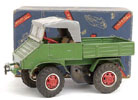
Mercedes-Benz UNIMOG Type U411, tinplate.  Made in Germany by Tipp & Co.  TCO (Tipp & Co.) was one of the largest manufacturers of tin toys in Nürnberg, Germany after 1922.  December 5, 2004.

Side view of Tipp & Co. Mercedes-Benz UNIMOG Type U411.

Tipping Lorry - orange, red hubs, removable plastic cab roof, clear plastic fold-down windscreen, levers in cab operate motor and tipping mechanism, hinged rear tailboard, with key.


Color variation of the Mercedes-Benz UNIMOG Type U411, tinplate.  Made in Germany by Tipp & Co.  TCO (Tipp & Co.). Note the original packaging and the location for the key just ahead of the rear wheel.

For more on the history and development of the Mercedes-Benz UNIMOG, visit the UNIMOG Overview (1953-1962) page.


Corgi (England) model number 409, "UNIMOG Rear Dumper".  A 1:43 scale die cast model of a Mercedes-Benz UNIMOG "tipper" (dump truck). Although this model was made by Corgi from 1971 to 1975, which was several years after the 1953-1962 Ponton era, the photo serves to illustrate how a model car collection can keep growing.  Original, pre-modified self-portrait of the editor taken in December, 1993.


Created: June 20, 2001 / Jeff Miller
Last Update: March 29, 2008
© www.mbzponton.org
Return to the Ponton Photo Gallery

Return to the Mercedes Ponton page