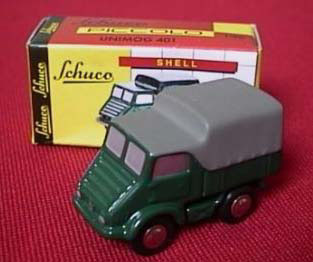
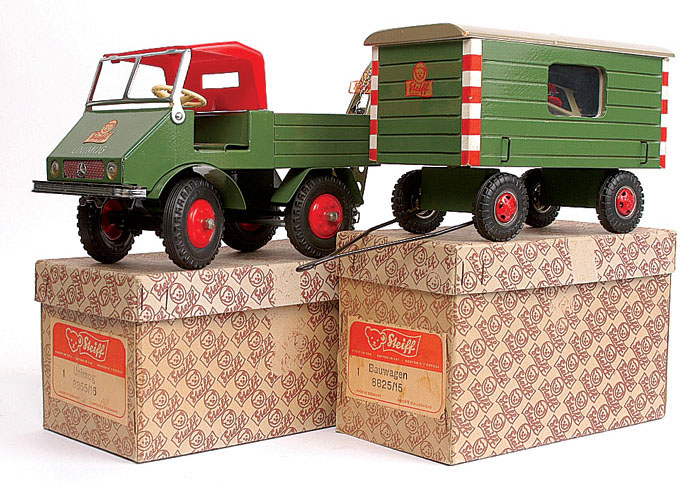
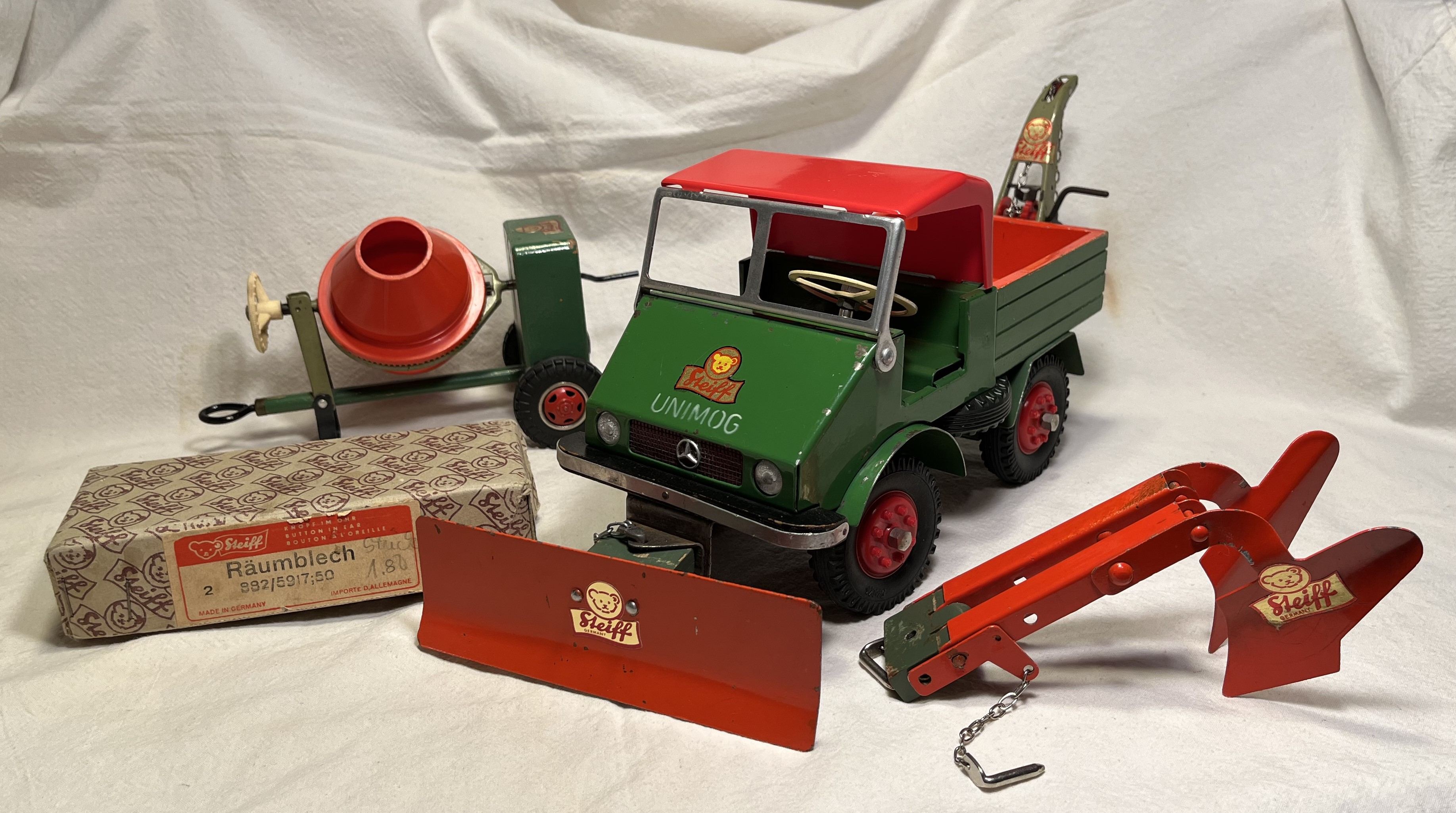
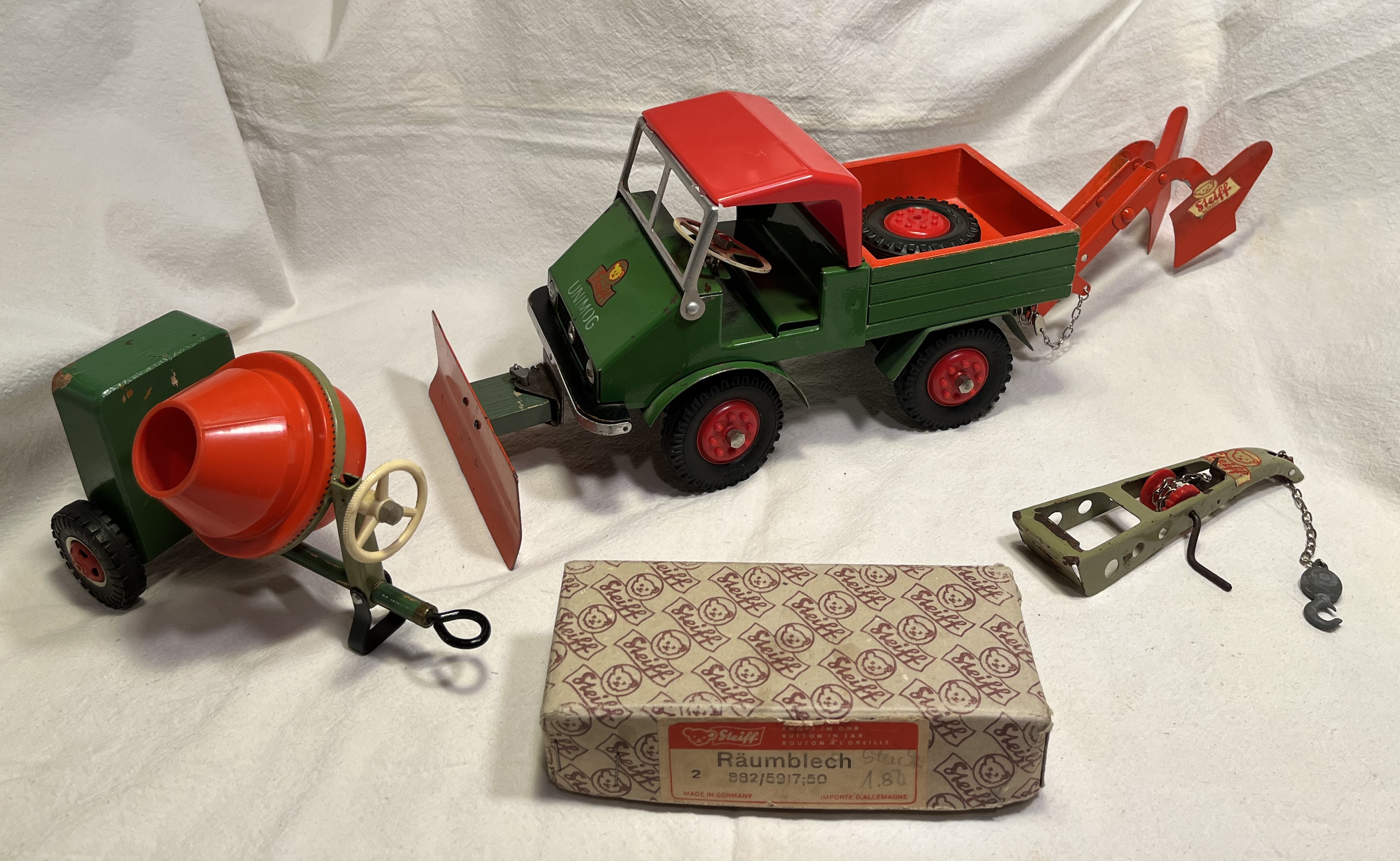
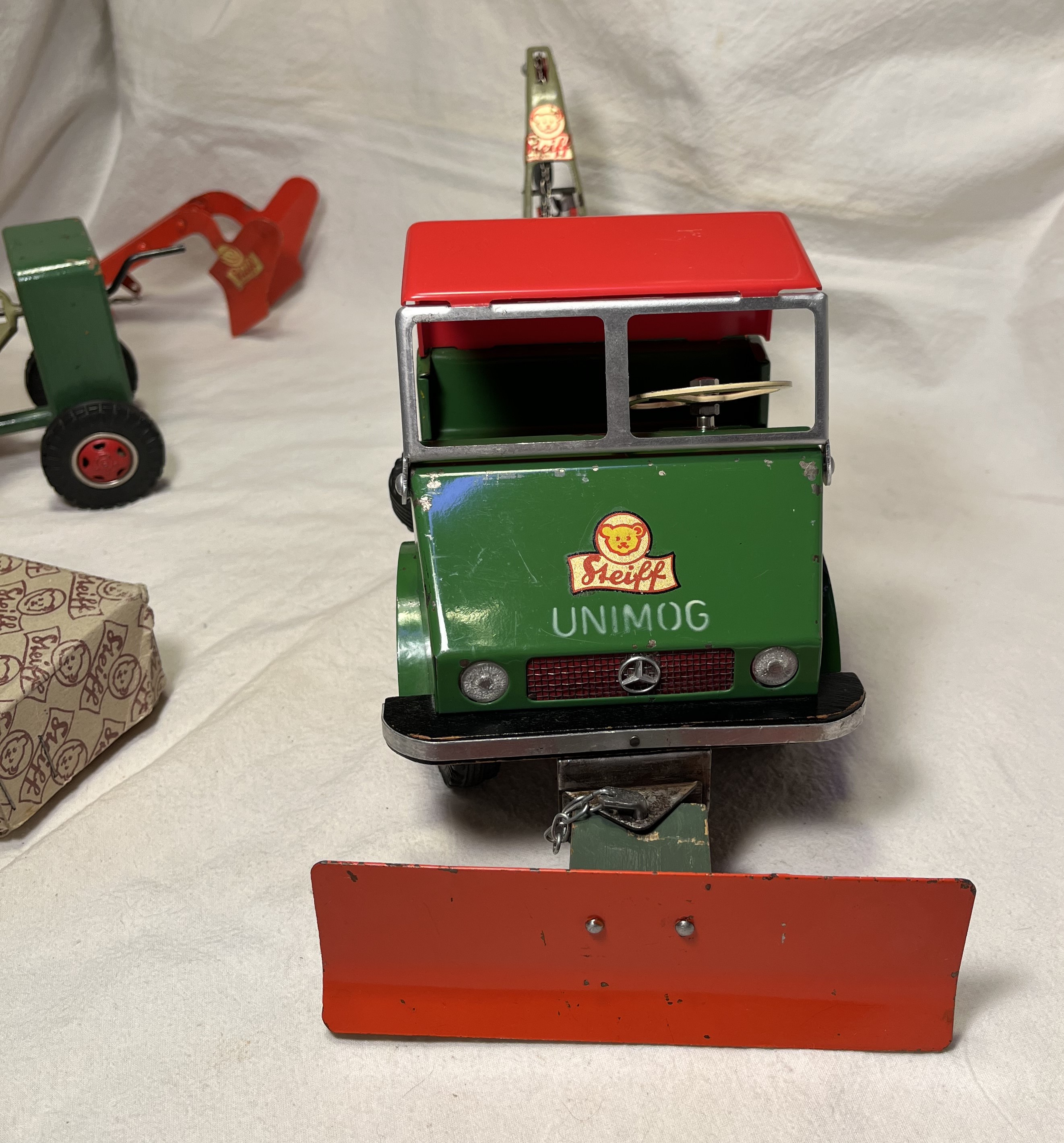
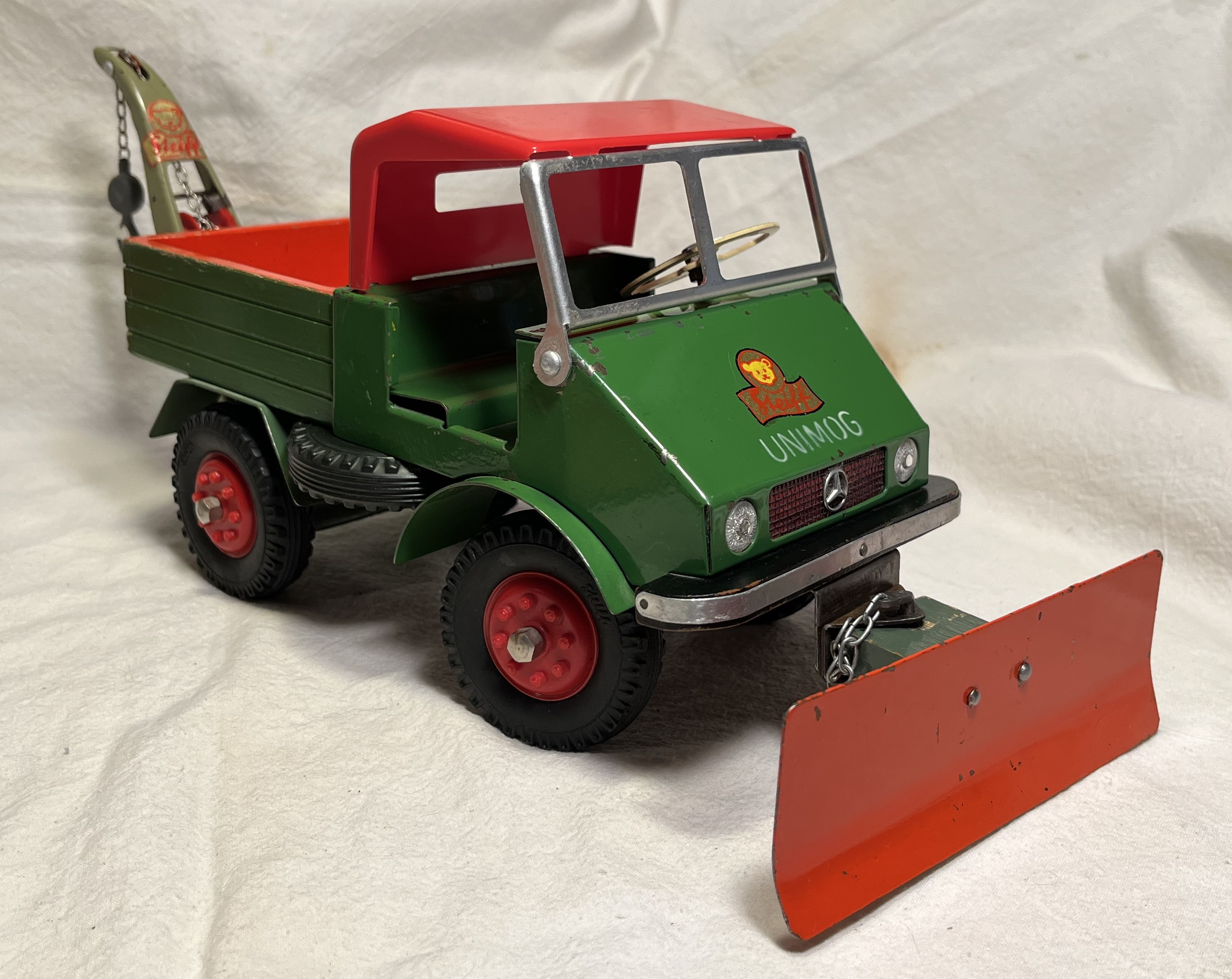
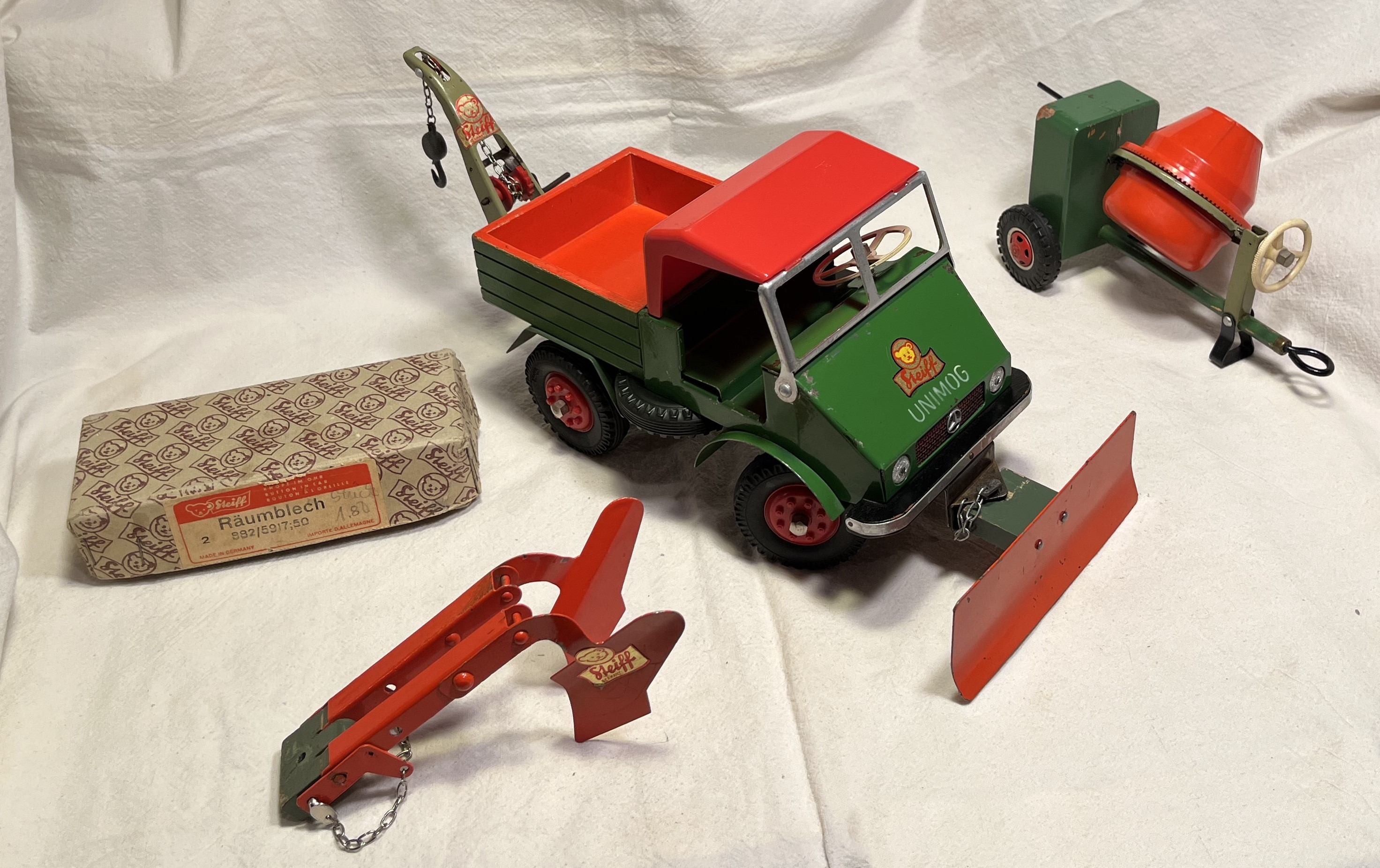
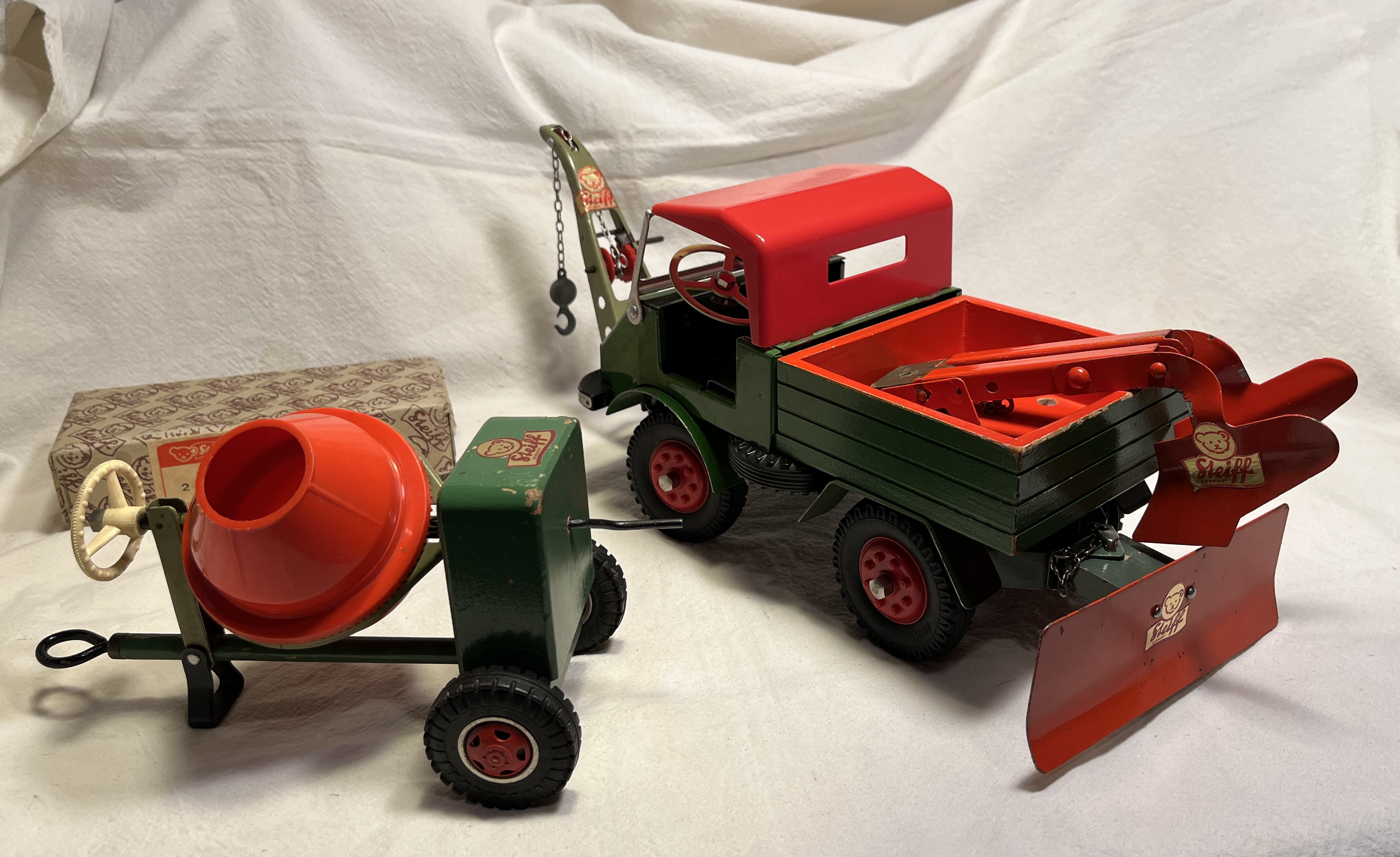
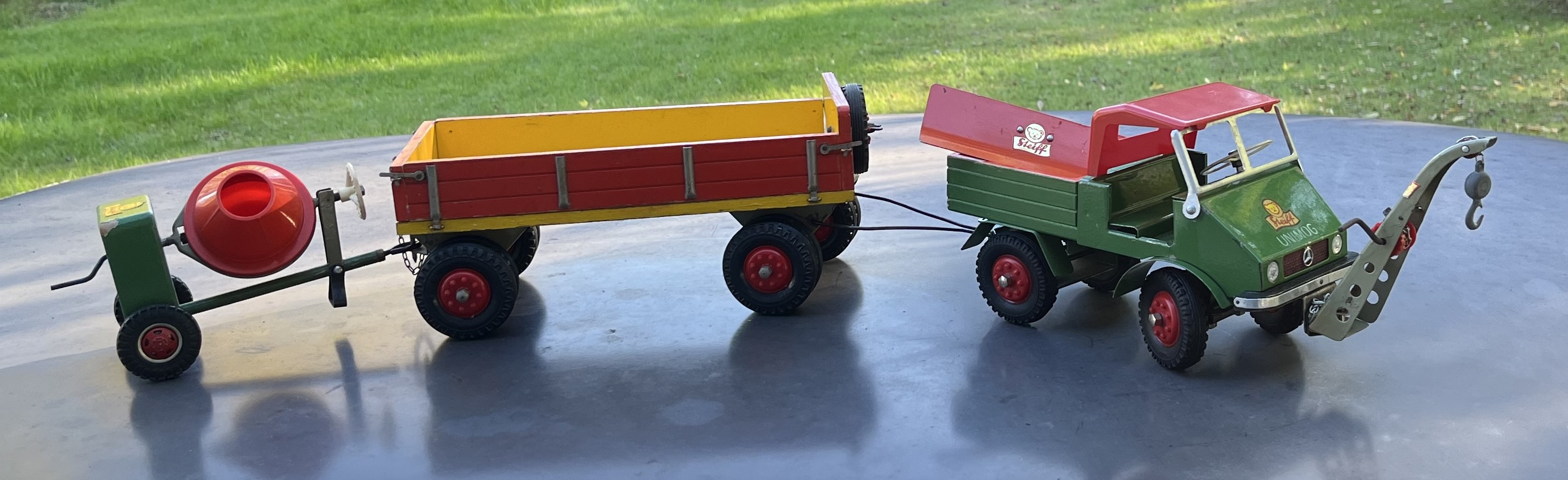
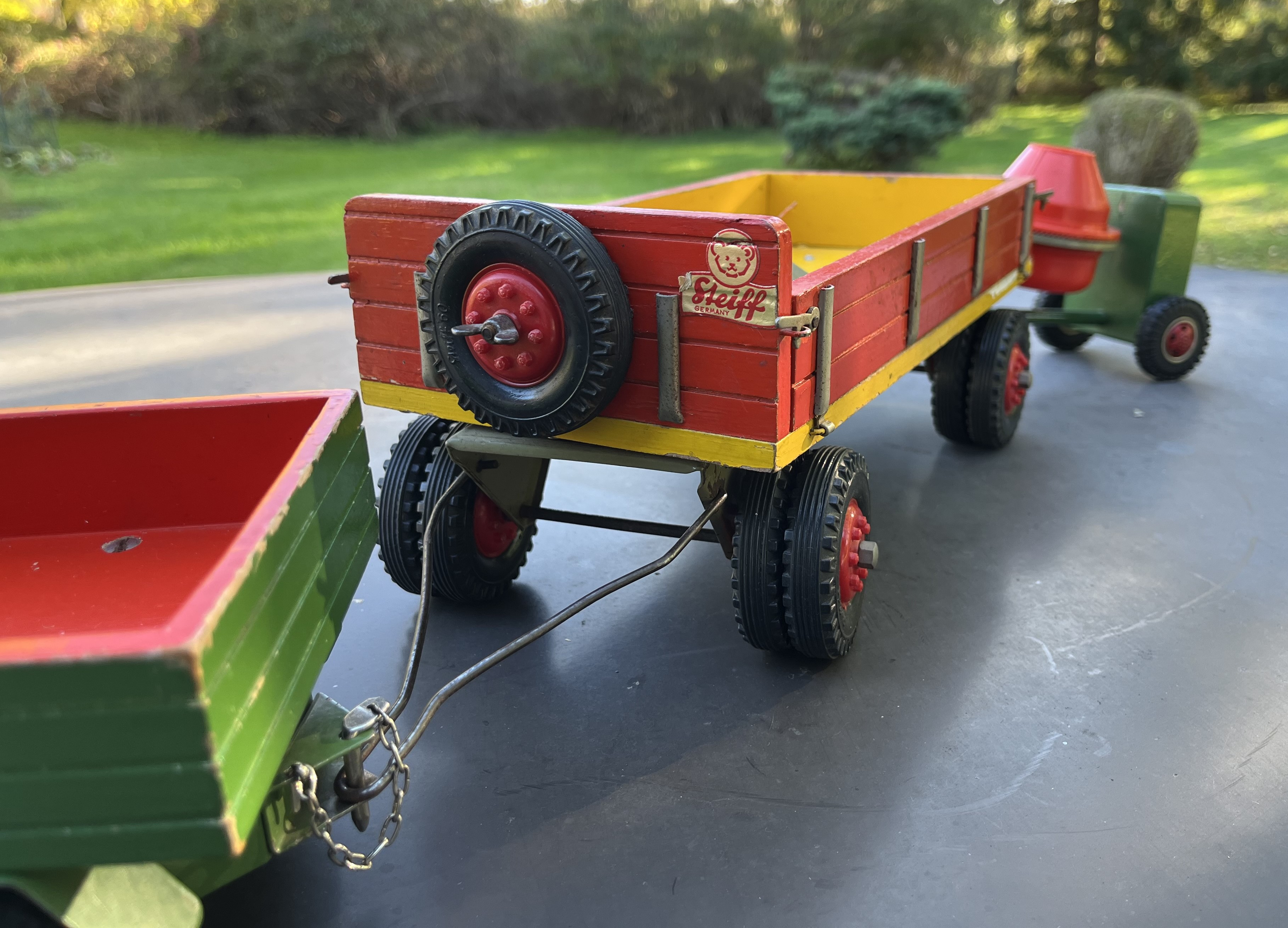
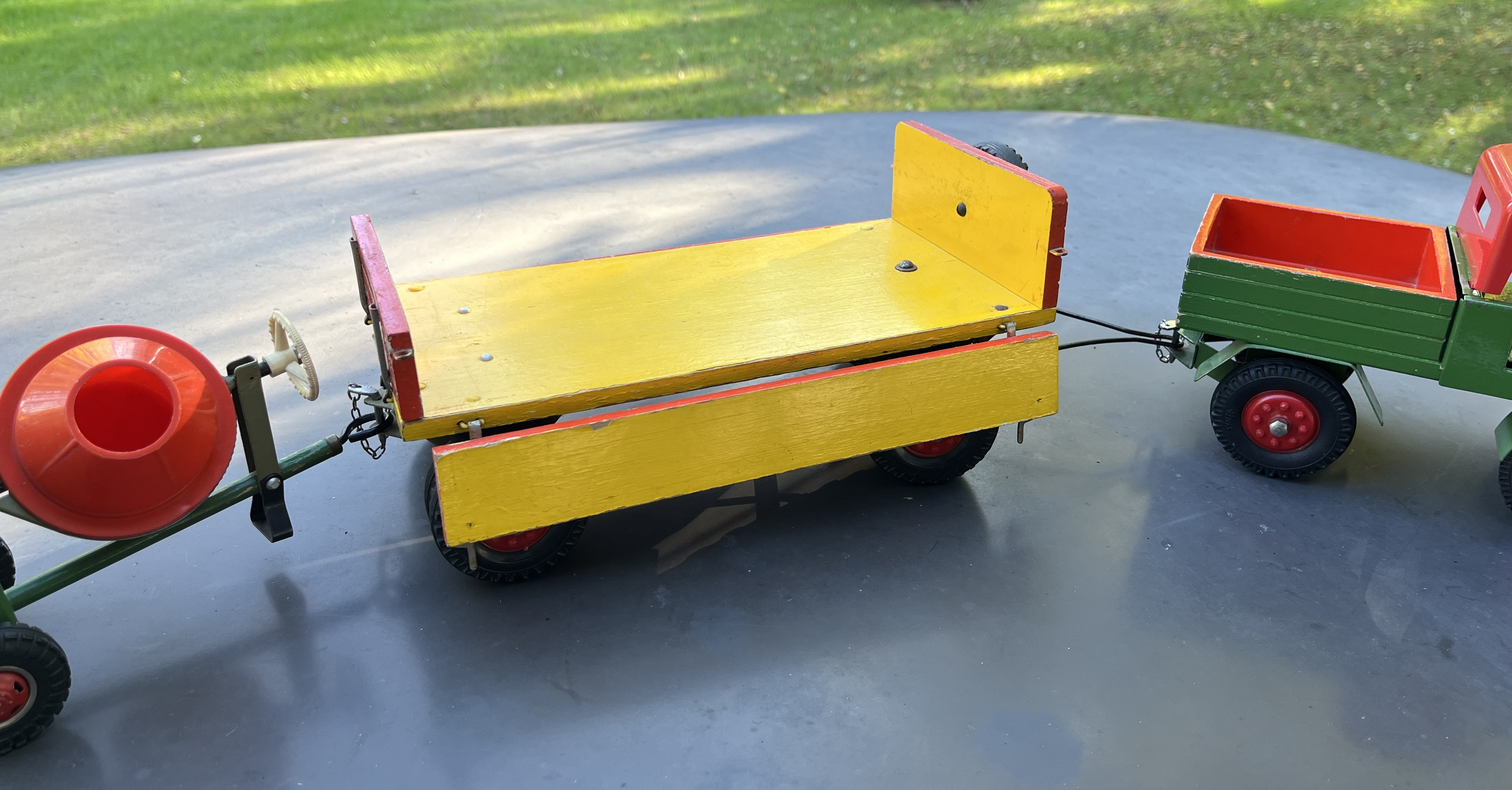
Margarete Steiff (24 July 1847 – 9 May 1909) was a German seamstress who in 1880 founded Margarete
Steiff GmbH, more widely known as Steiff, a maker of toy stuffed animals.
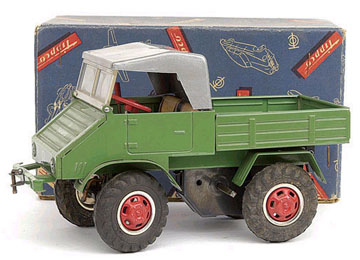
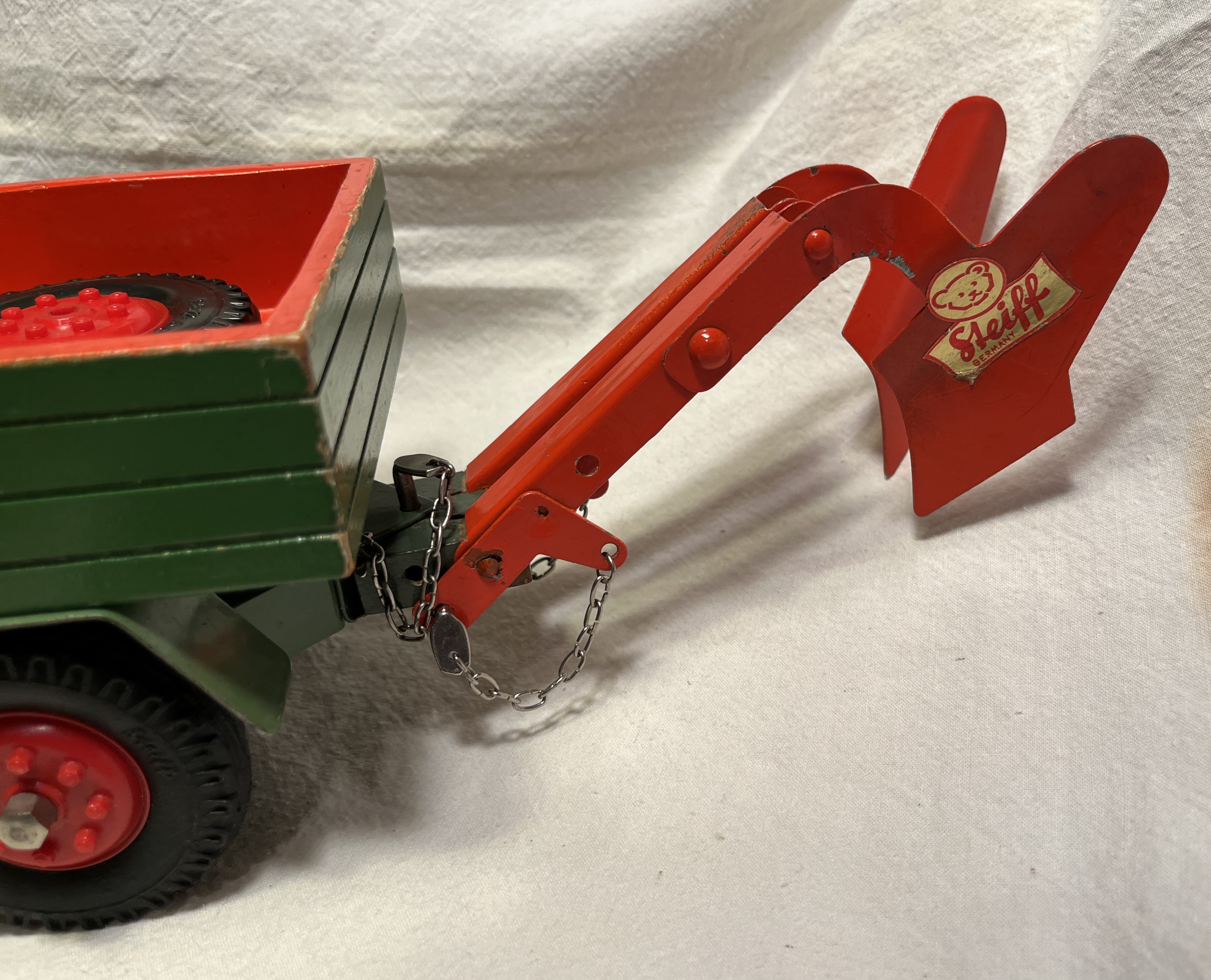
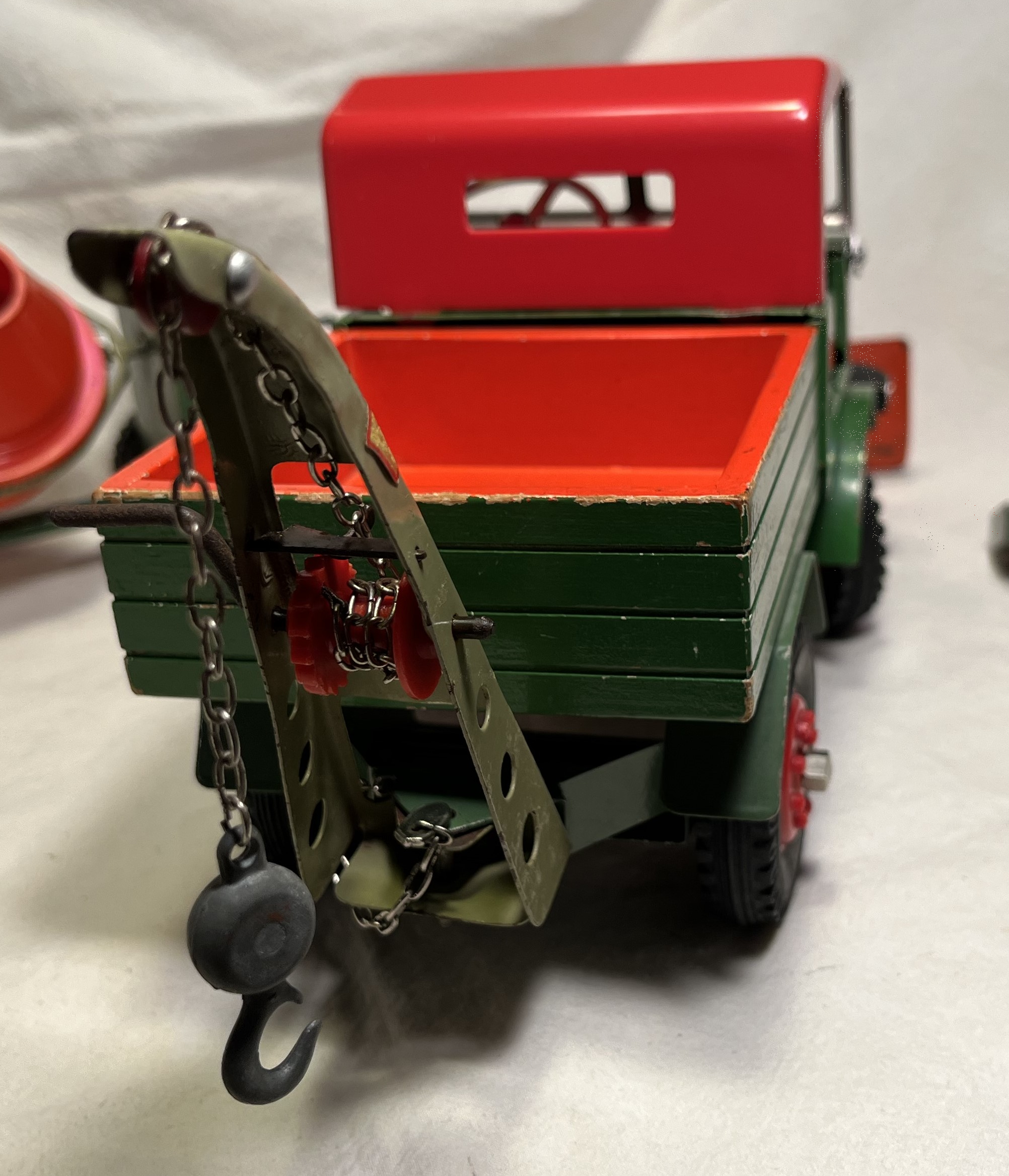
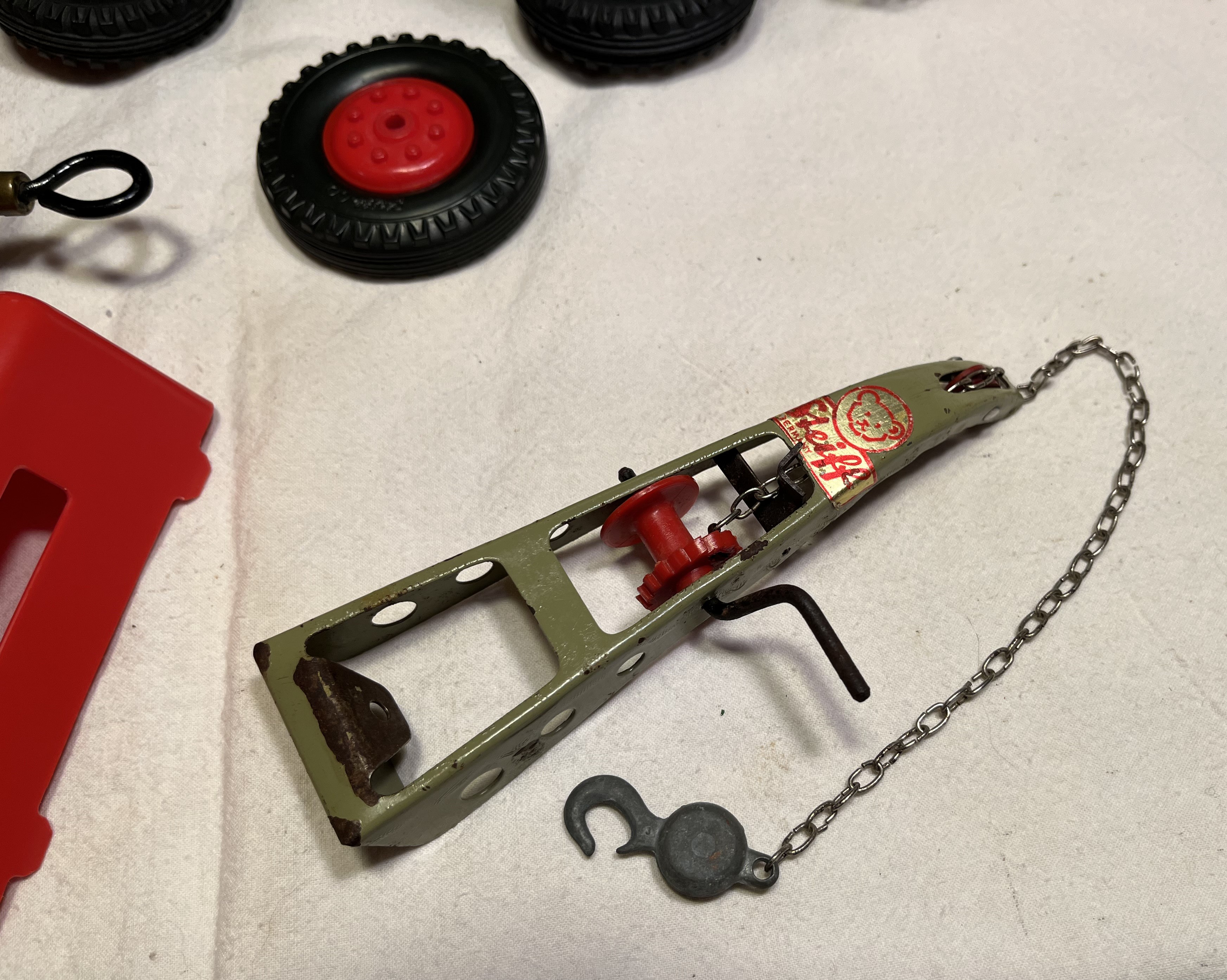
In addition to the world-famous stuffed toy bears (button in the ear), and
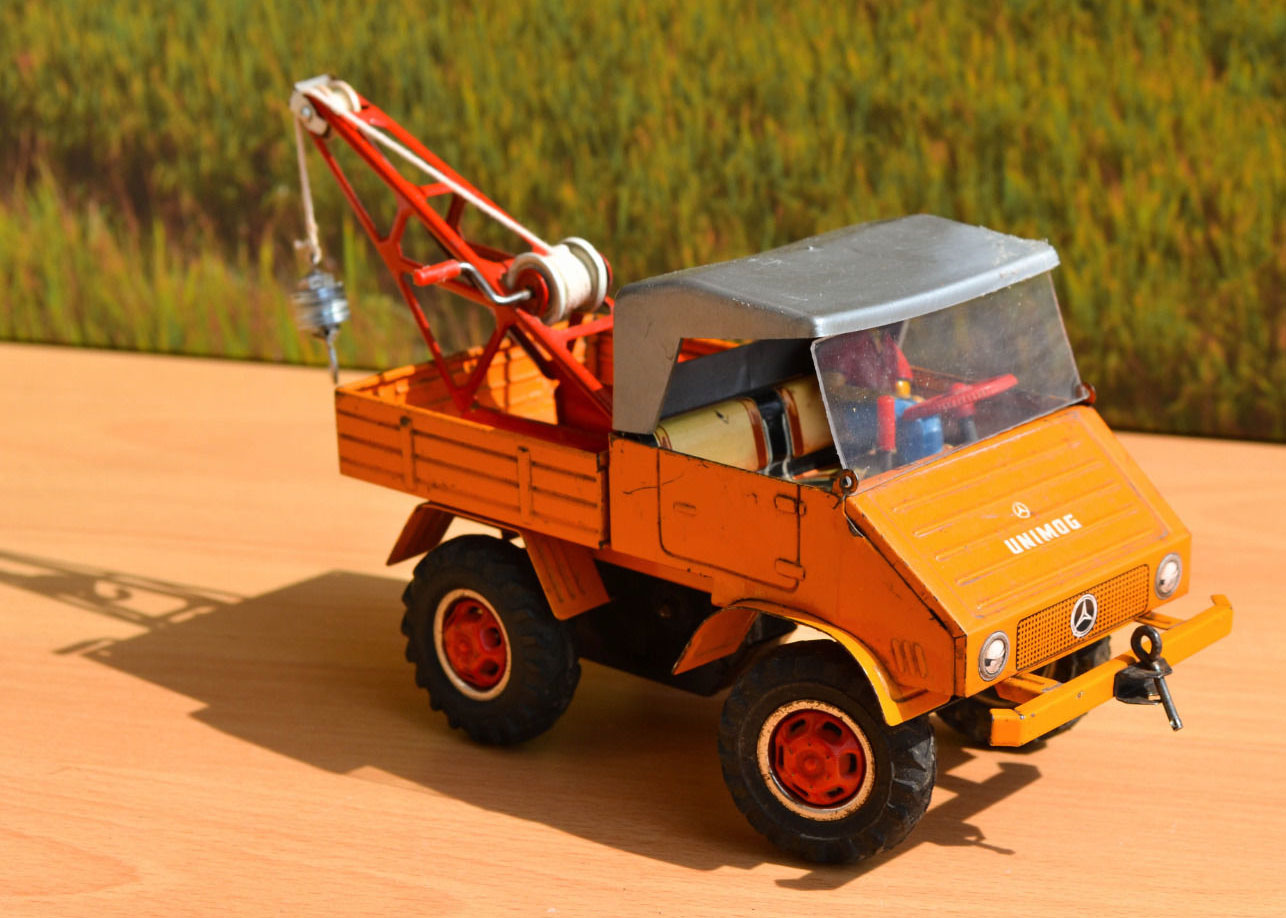
assorted other cuddly critters, Steiff also made a range of toy trucks, and
associated implements from the early 1950s to the 1980s. These pieces were
comprised of pressed steel, wood, rubber, aluminum, and plastic.
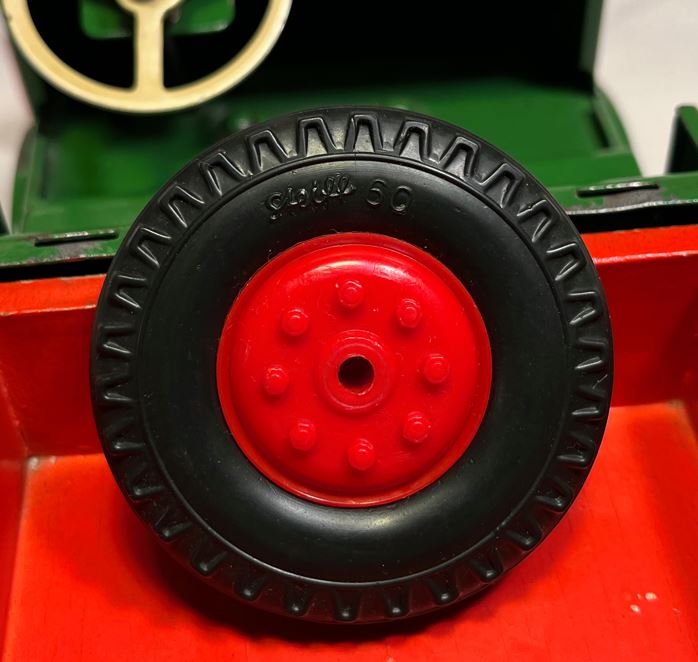
Photos of agricultural trailer with folding sides: Jeff Miller / October 18, 2024 / iPhone 13
Photos uploaded October 27, 2024
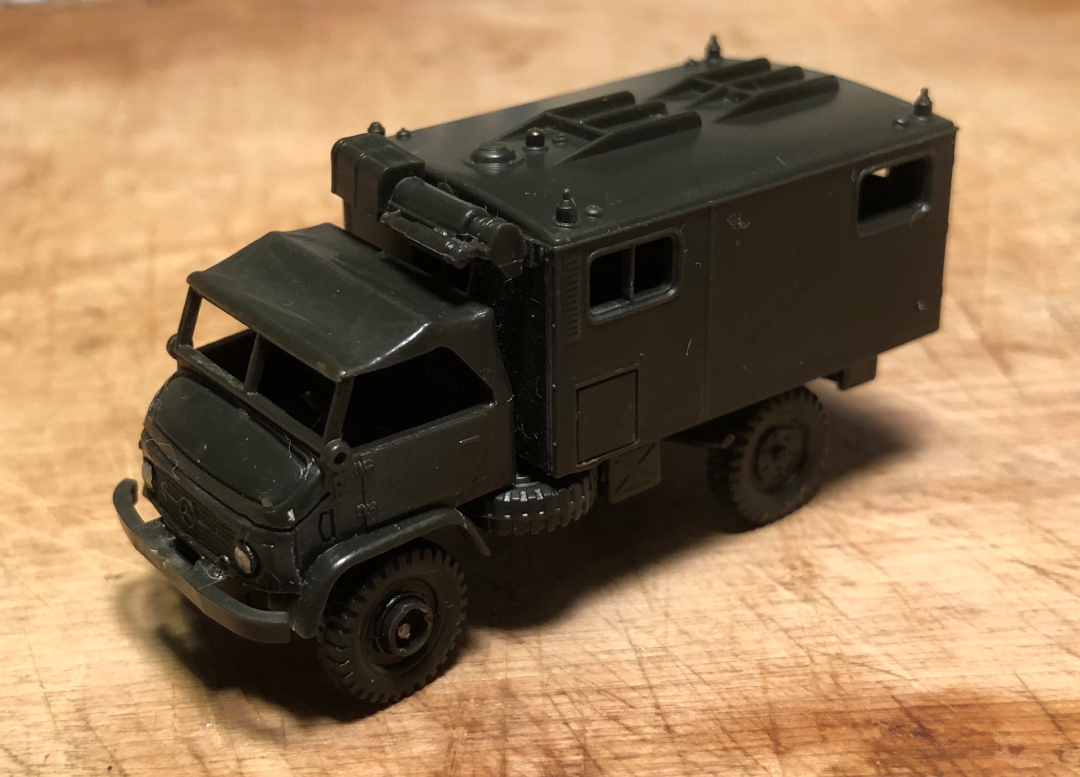
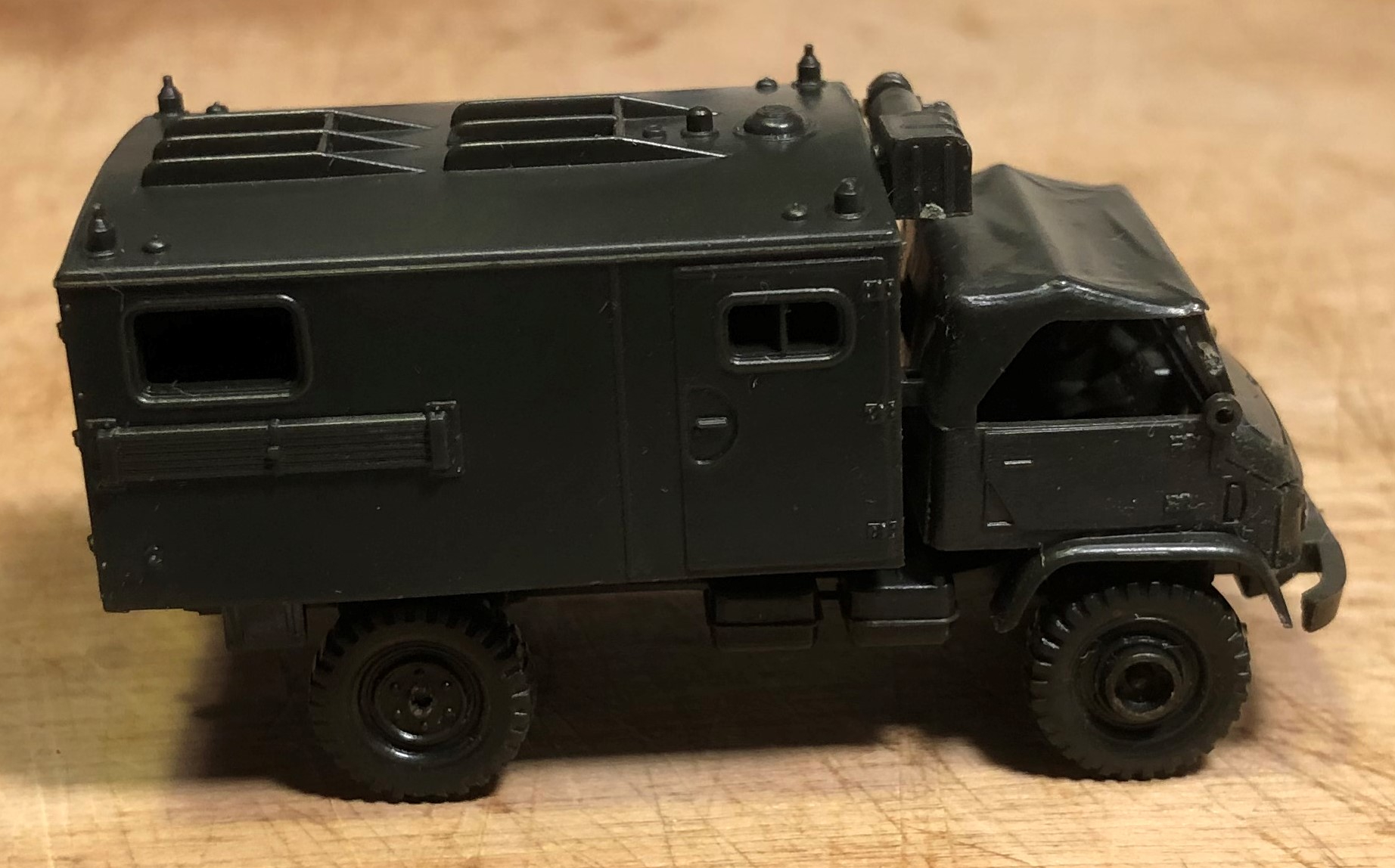
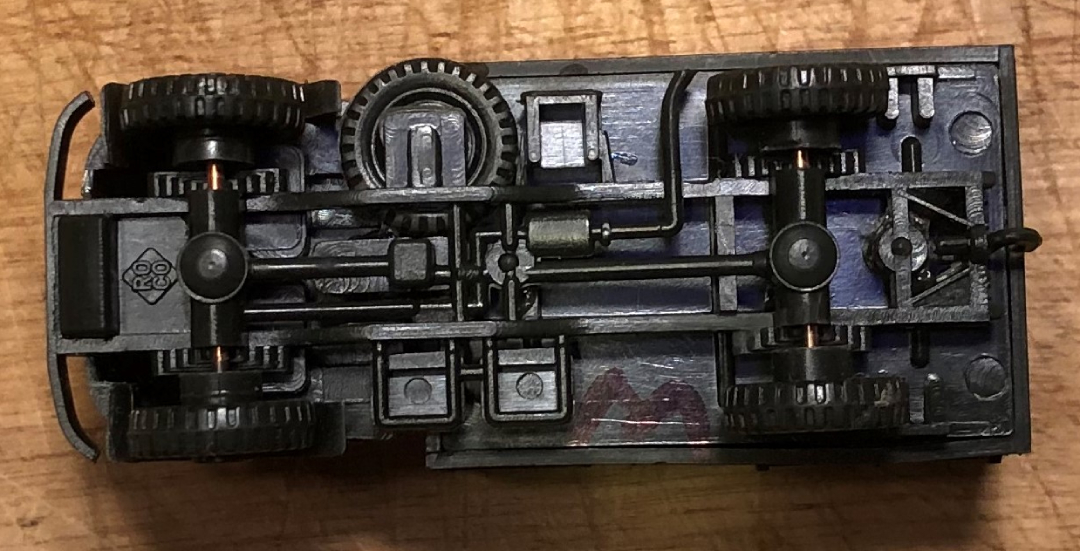
Roco (Austria) № 242 (1:87 scale) – UNIMOG Nachrichtenwagen (literally,
"news van", or radio communication truck)
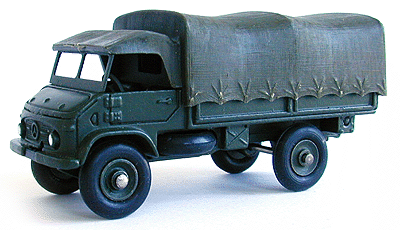
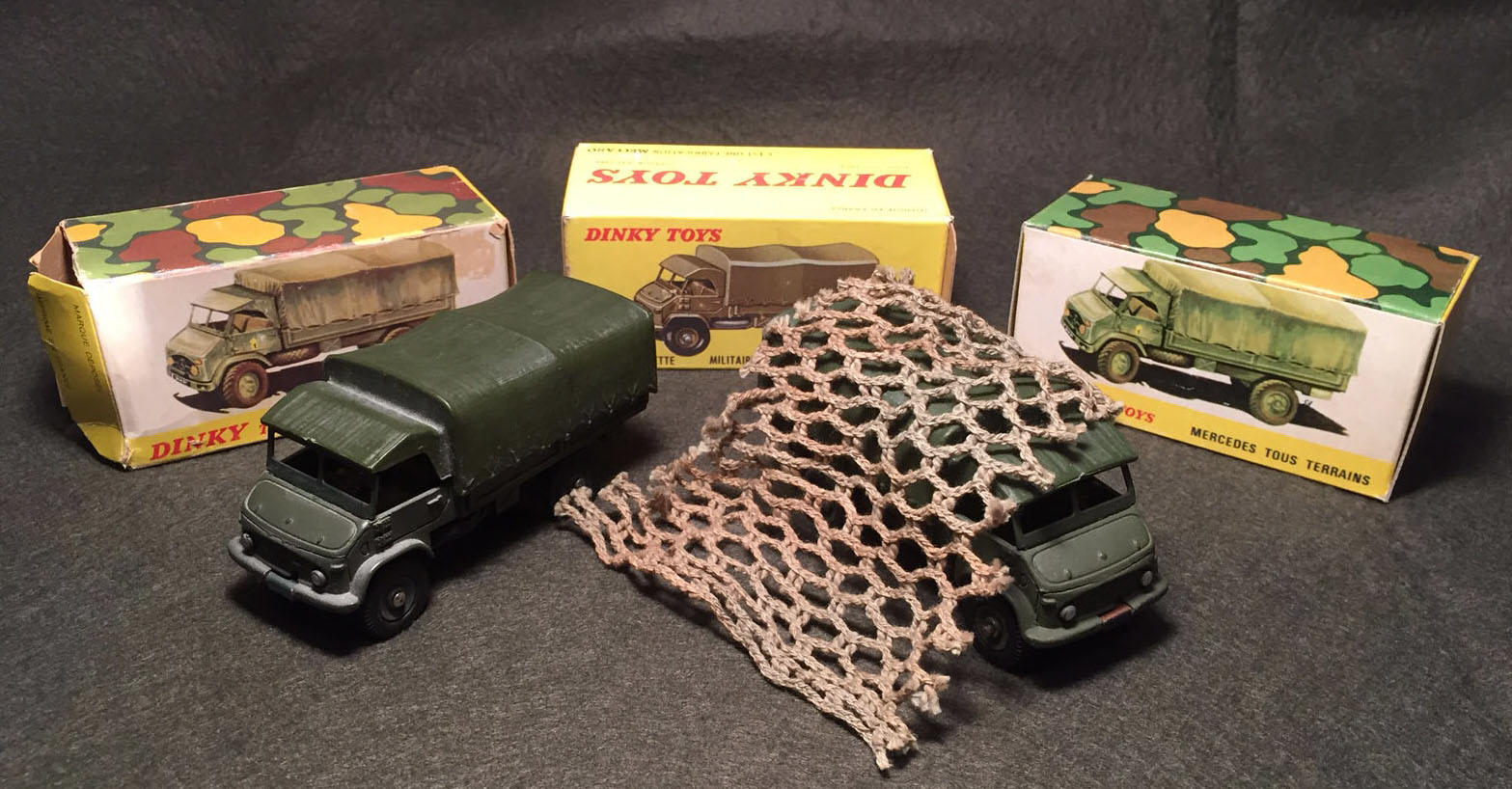
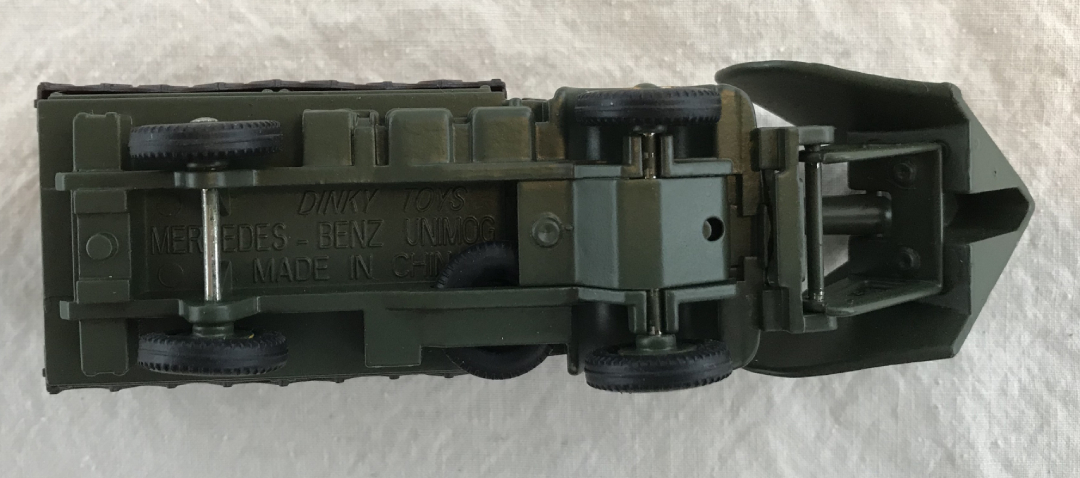
Two Dinky UNIMOG 804 models and original camouflage netting. Boxes – left to right:
804 camouflage (original), 821 no camouflage (original), 804 camouflage
(reproduction). These models originally came with camouflage netting.
This photo includes the only example of the netting the editor had seen up to this
point. Photo courtesy: Jeff Miller / iPhone 6 / December 17, 2014
The reason for taking the photo was the non-camouflage box was a new
addition to The Closeum. The UNIMOG with the netting (goes with box at far left) was procured at the York, Pennsylvania
toy show November 30, 2014. Didn't realize how dusty the 'Mog on the left was until seeing
the photo.
The quest then shifted to developing a win-the-future strategy by engineering a right-sized framework
to spearhead a data-driven integration of a pre-1973 "821" example to successfully
fill the empty, non-camouflage box. 
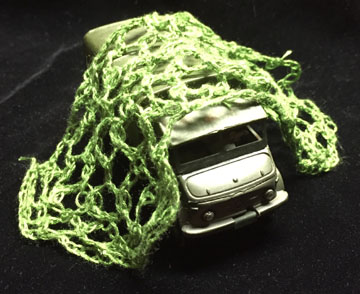
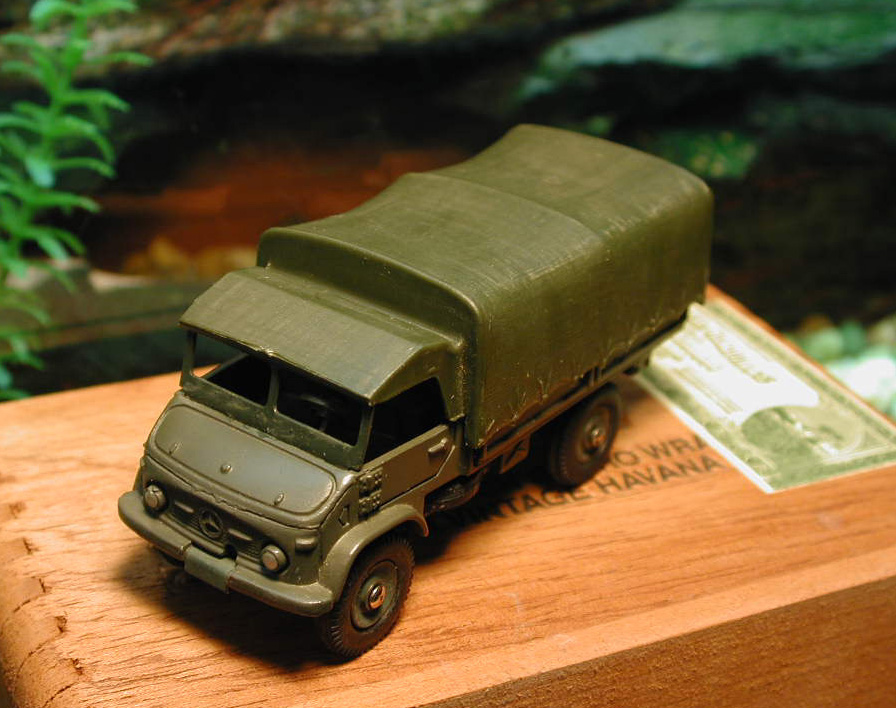
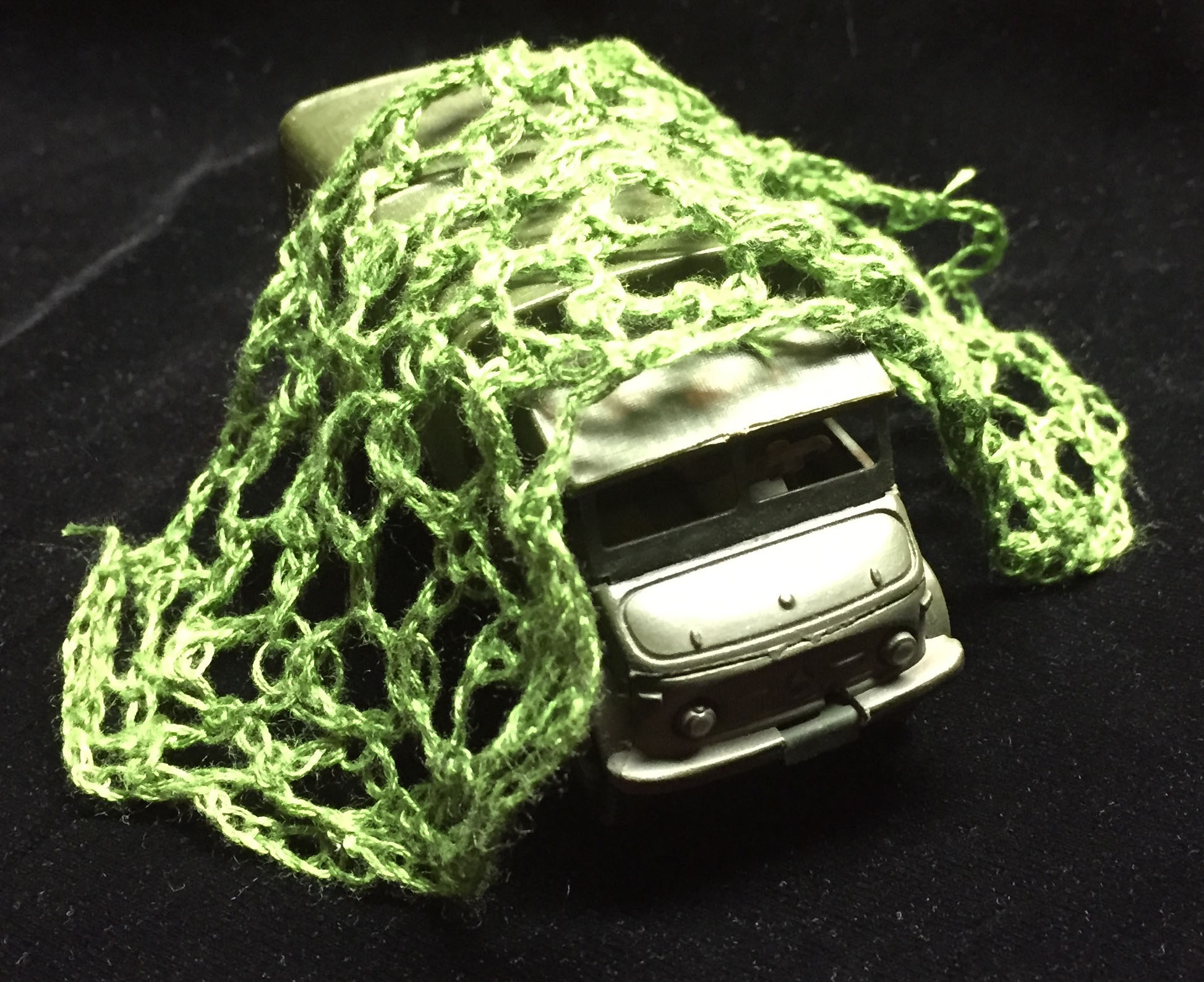
Dinky UNIMOG 804 (released 1973) with home-made camouflage net based on original pattern
Photo courtesy: Jeff Miller / iPhone 6 / January 4, 2015
Home-made camouflage net. This project took longer than expected
due to delays sourcing suitably sized thread to fit inside the back of the
carrier. This was the second attempt. The first thread was too bulky, and would not compress
sufficiently.
Pontonobilia Detectives: There were several variations in packaging.
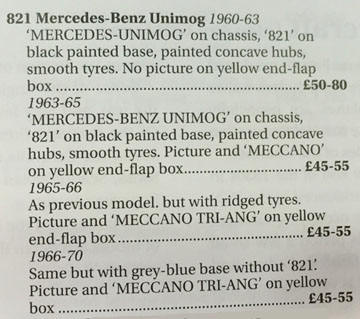
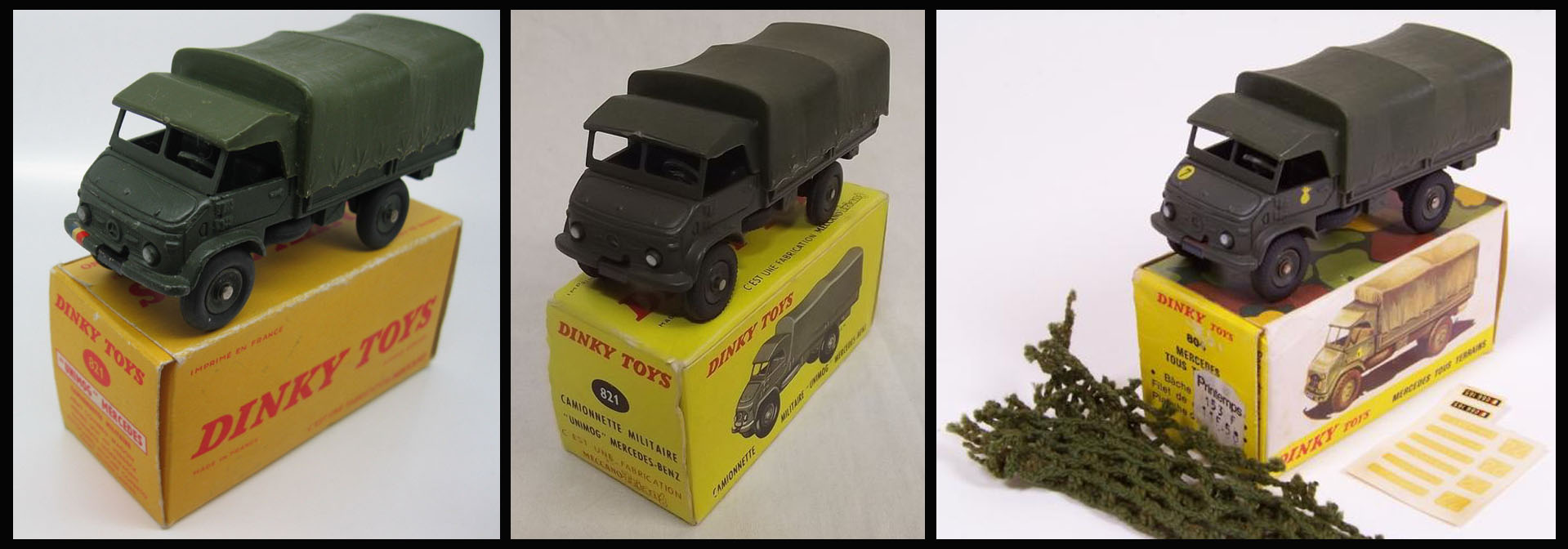
Dinky Toys № 821/804 UNIMOG Box Evolution
|
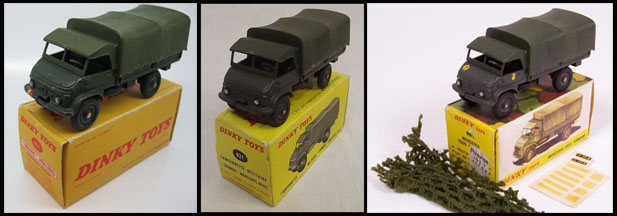
Dinky 821/804 box photos compiled and uploaded December 27, 2014 |
| Position |
Model |
Evolution |
Description |
Lettering |
Graphics |
| Left |
821 |
early |
orange-yellow box |
large red lettering |
no illustration |
| Center |
821 |
later |
bright yellow box |
small red and black lettering |
plain olive drab vehicle
illustration |
| Right |
804 |
1973 onward |
bright yellow box |
small red and black lettering |
olive drab vehicle
illustration with yellow highlights |
Dinky Toys (France)
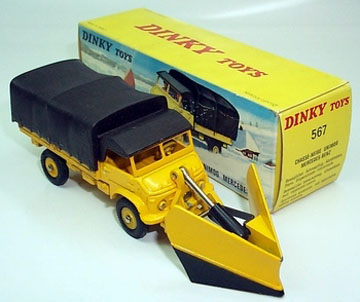
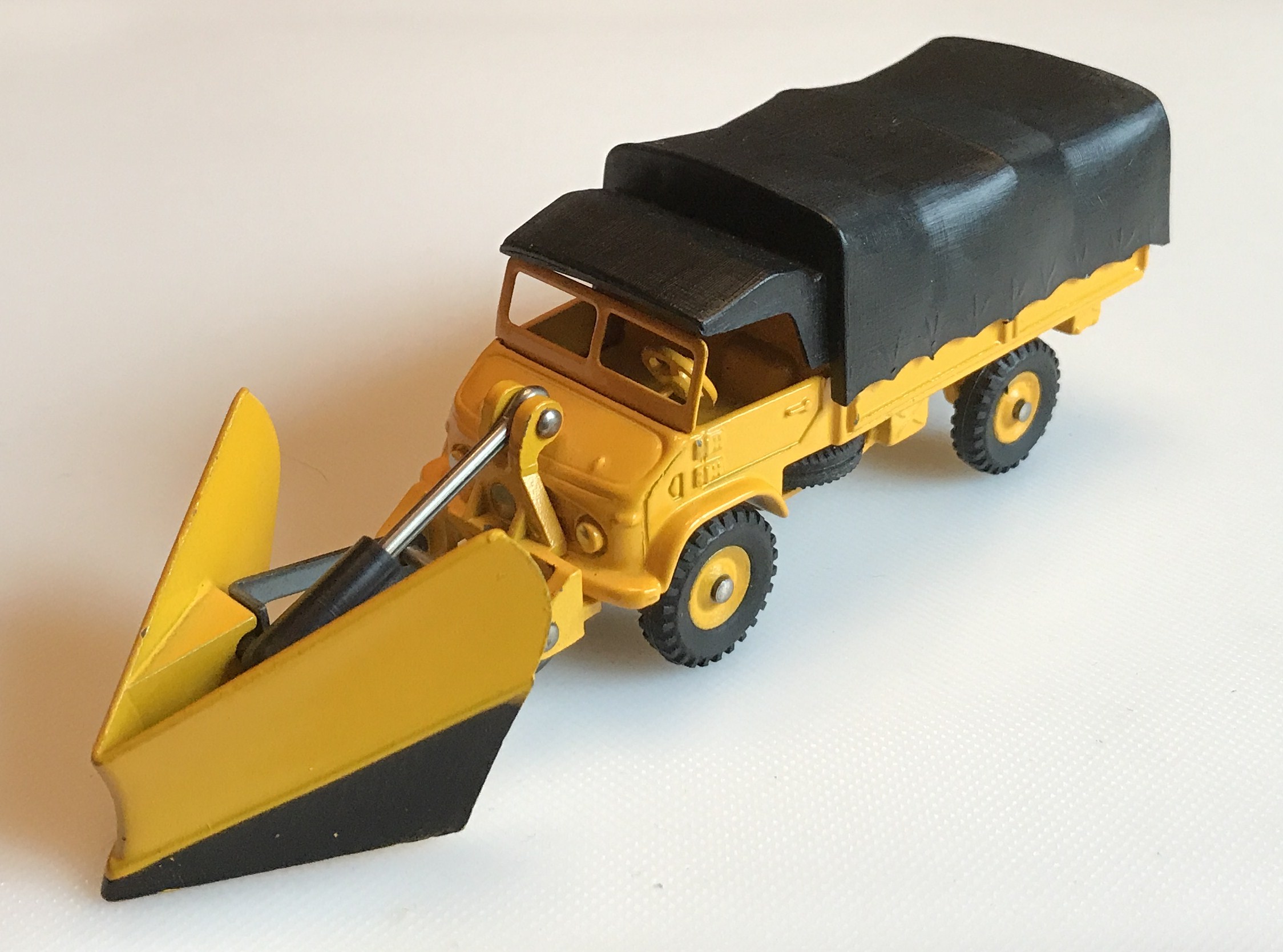
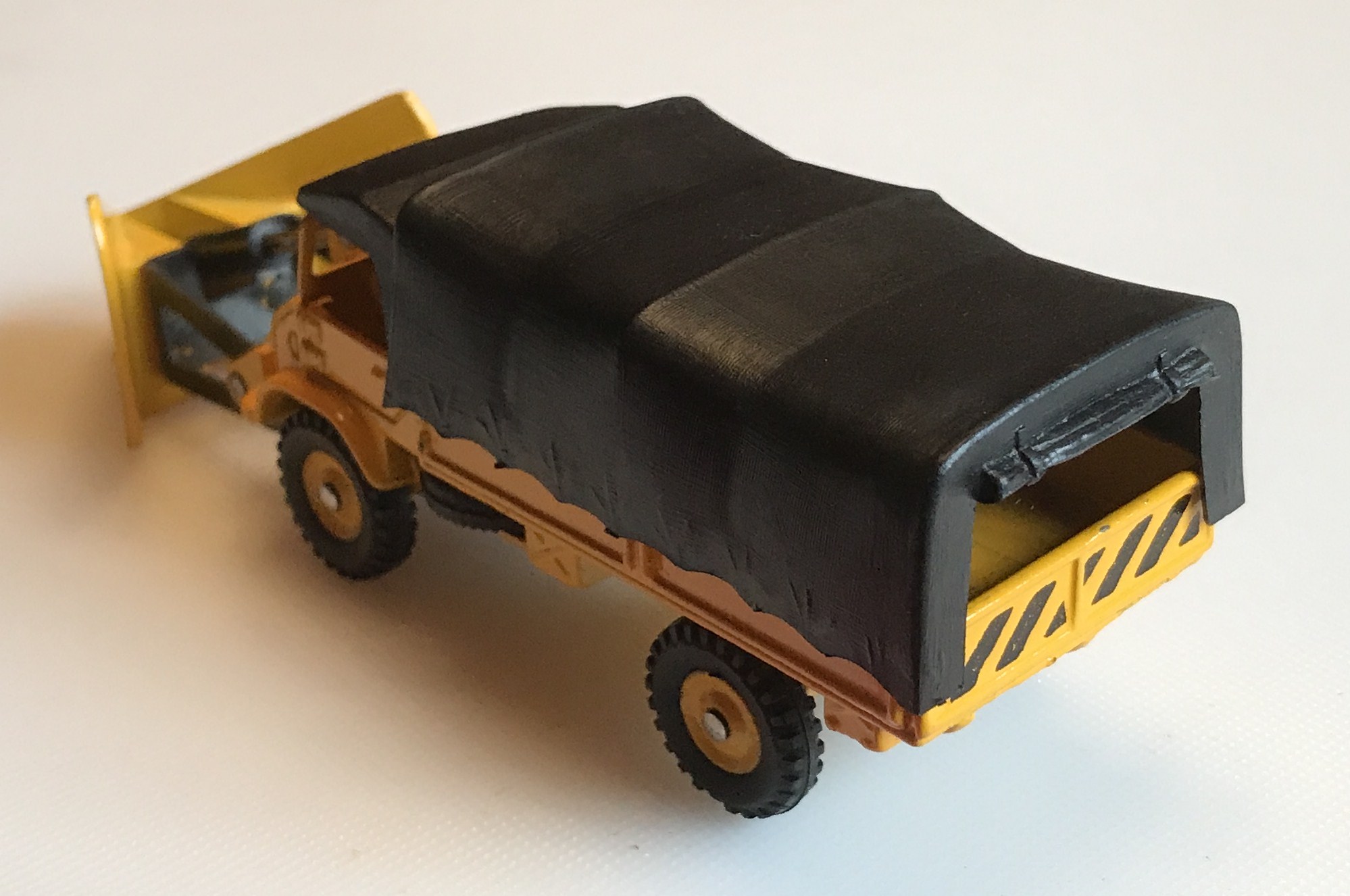
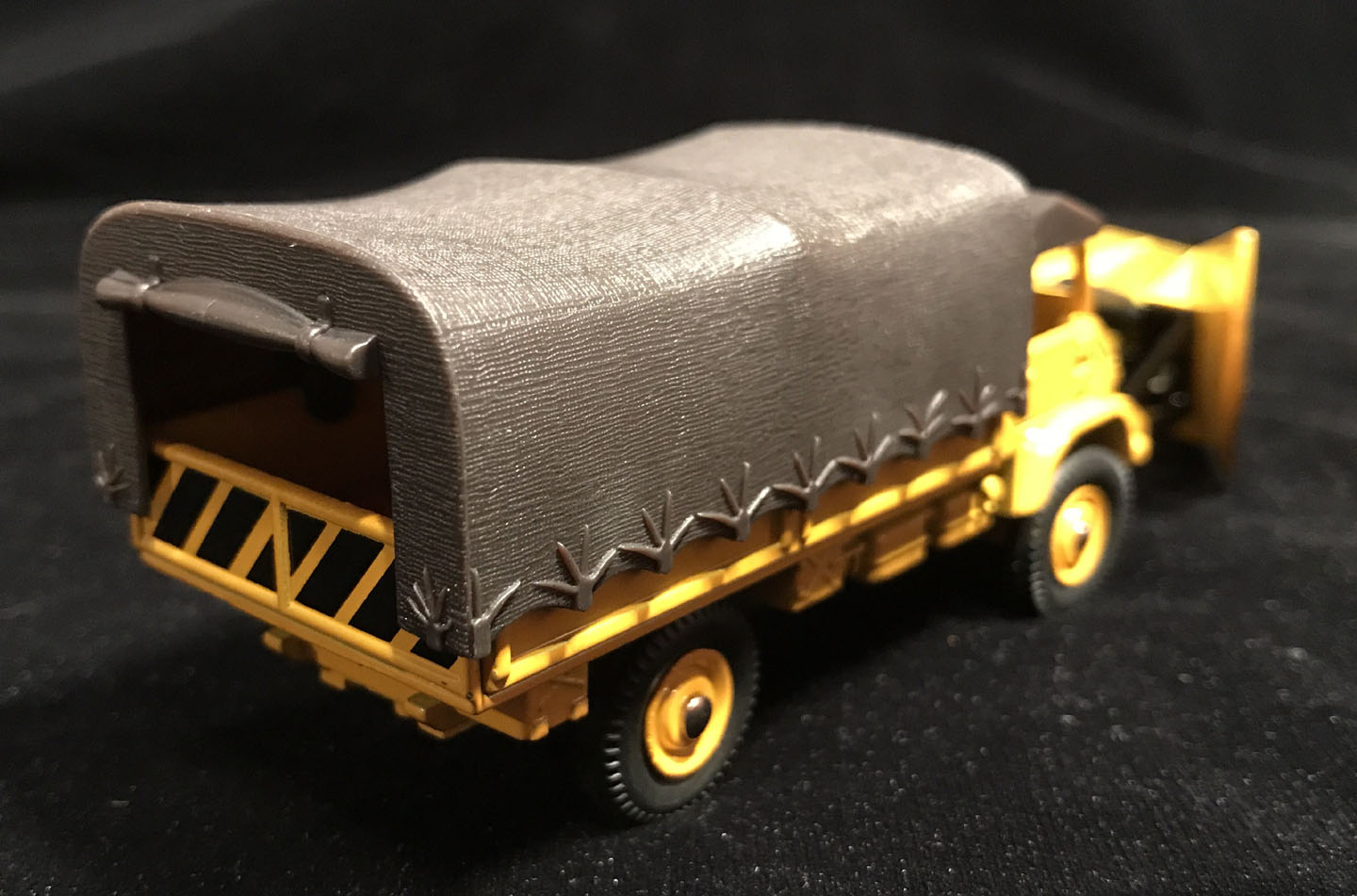
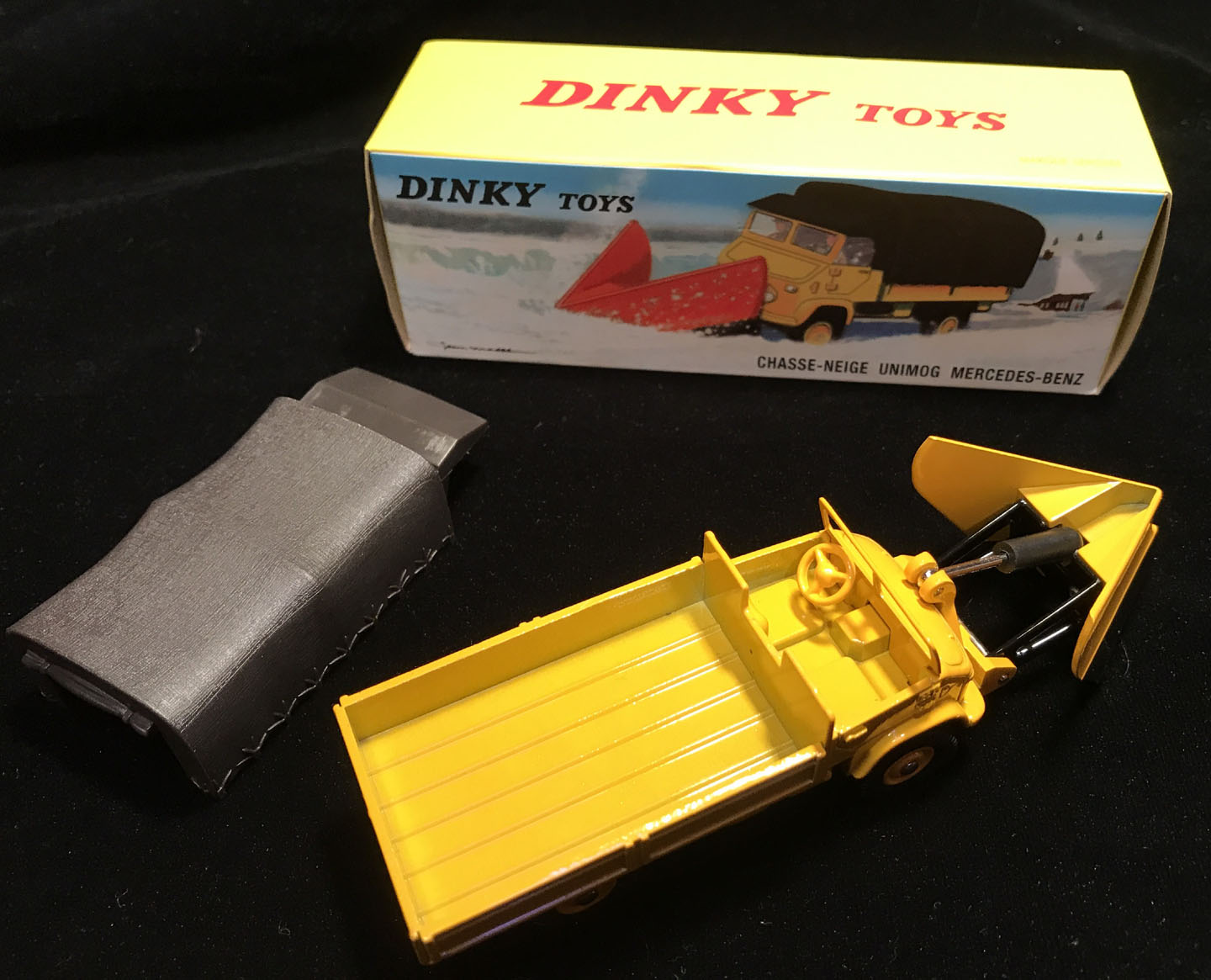
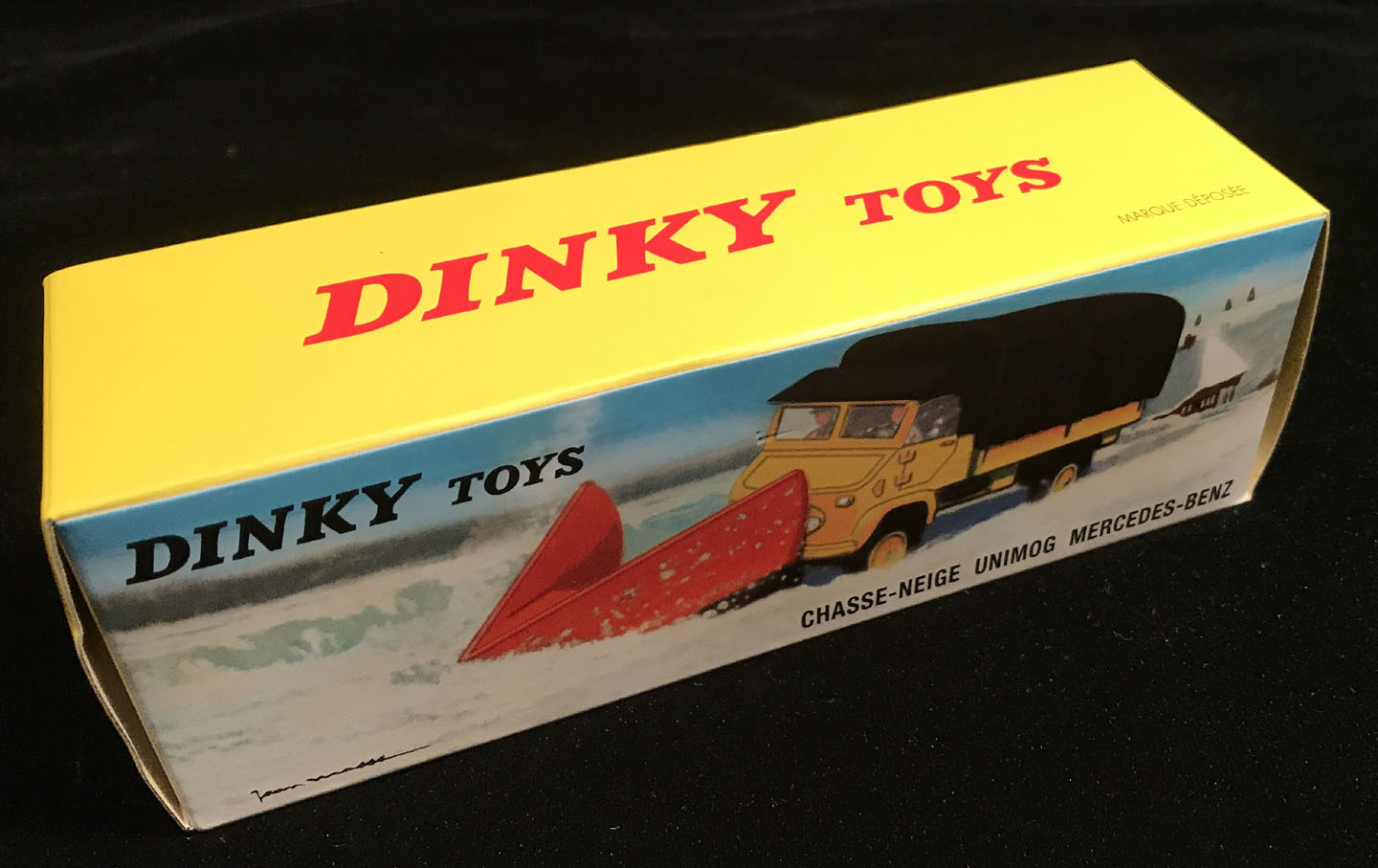
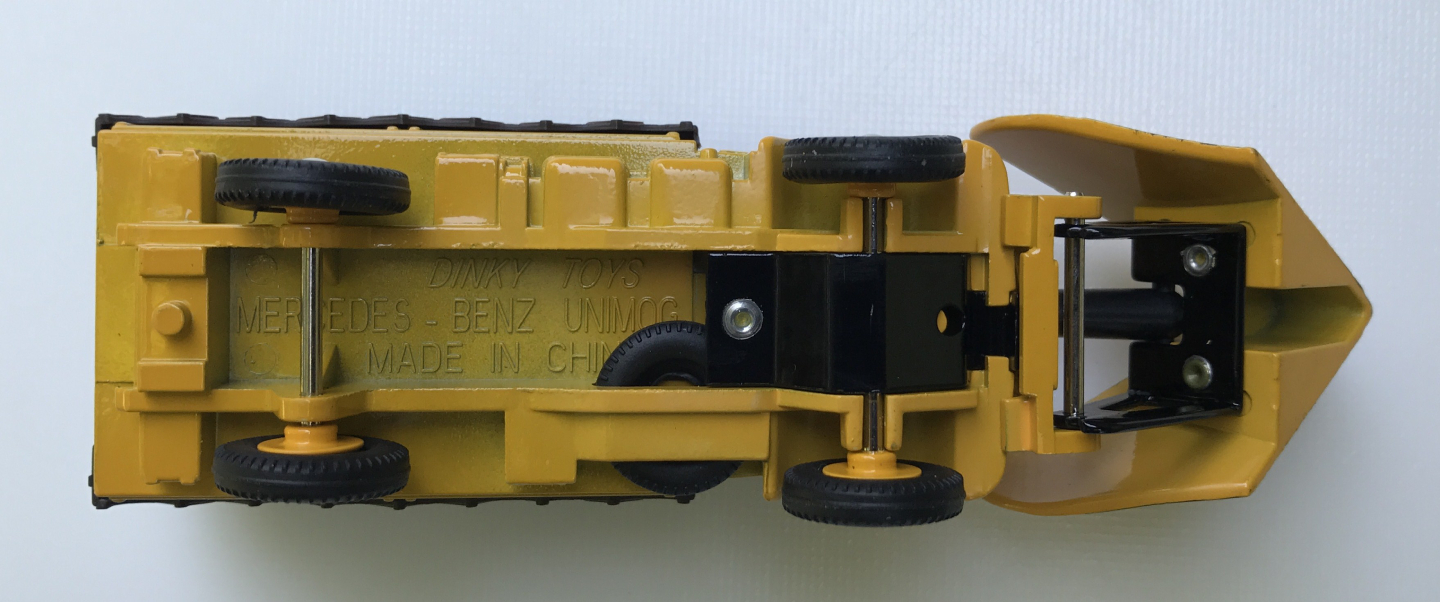
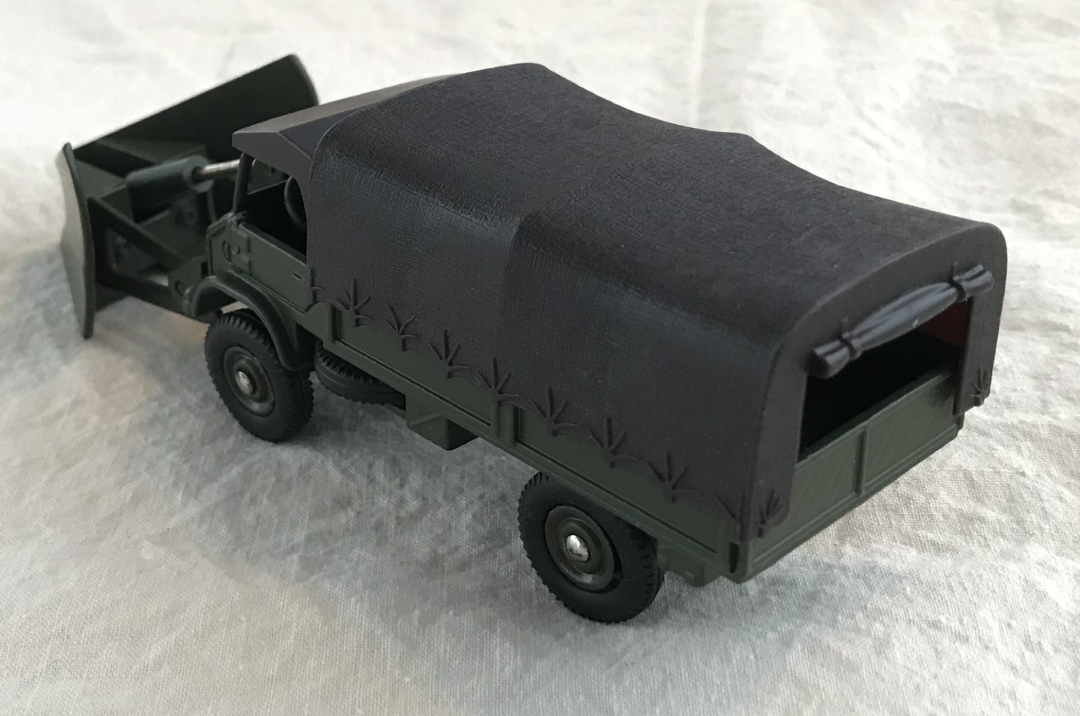
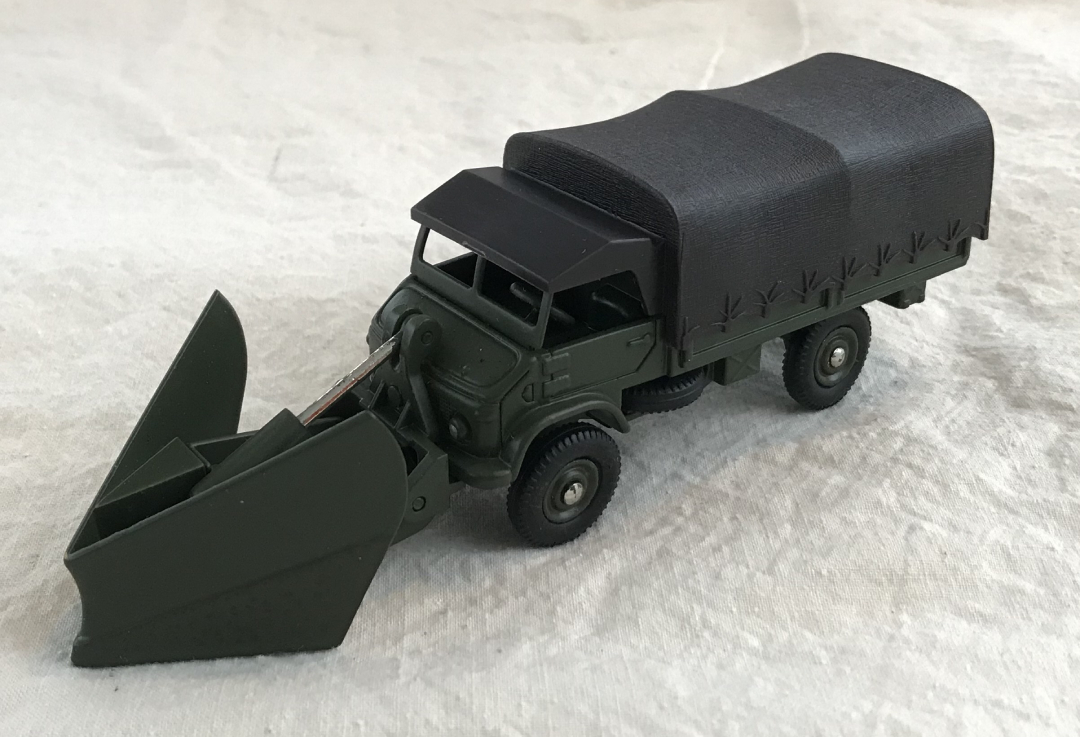
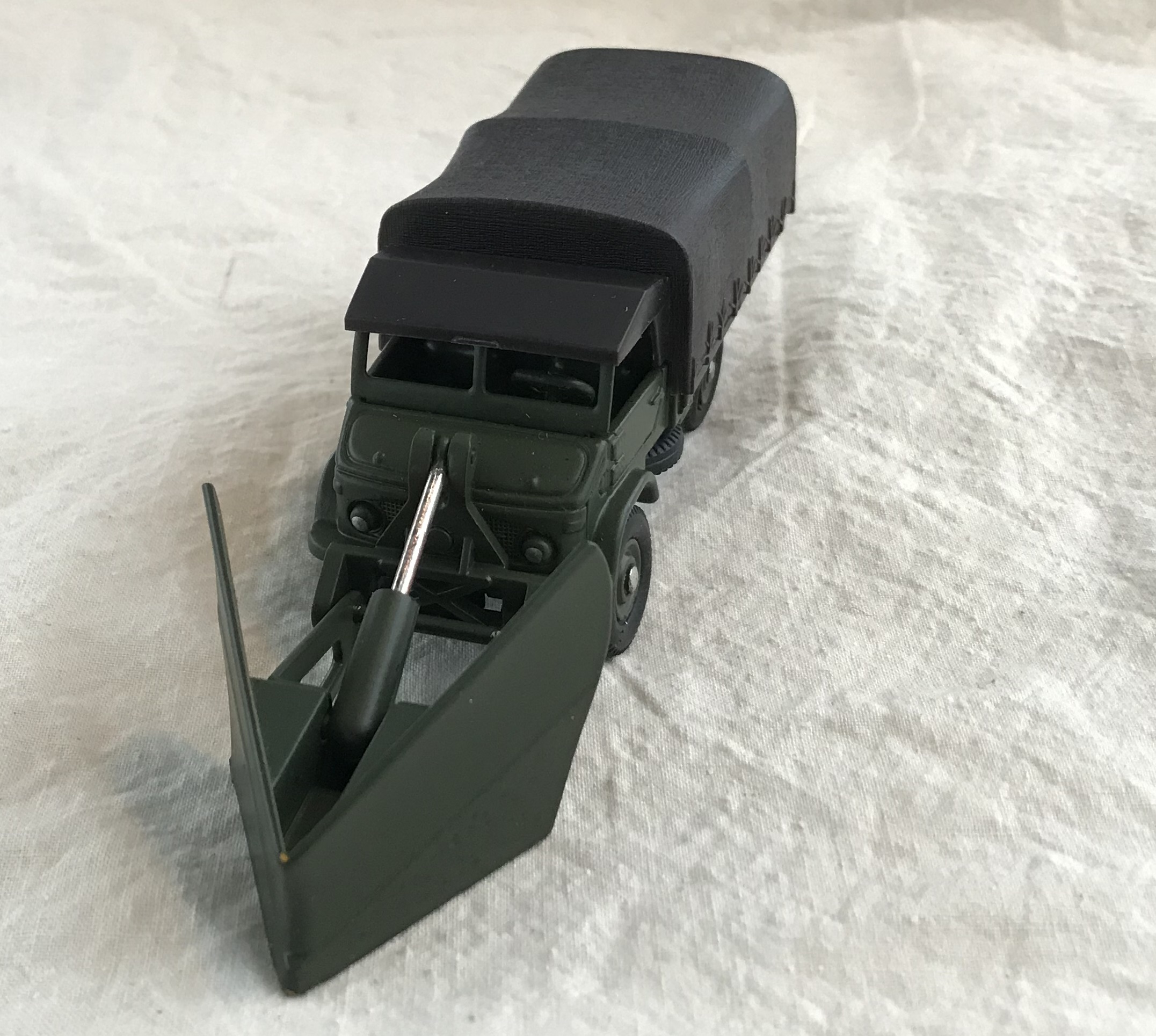
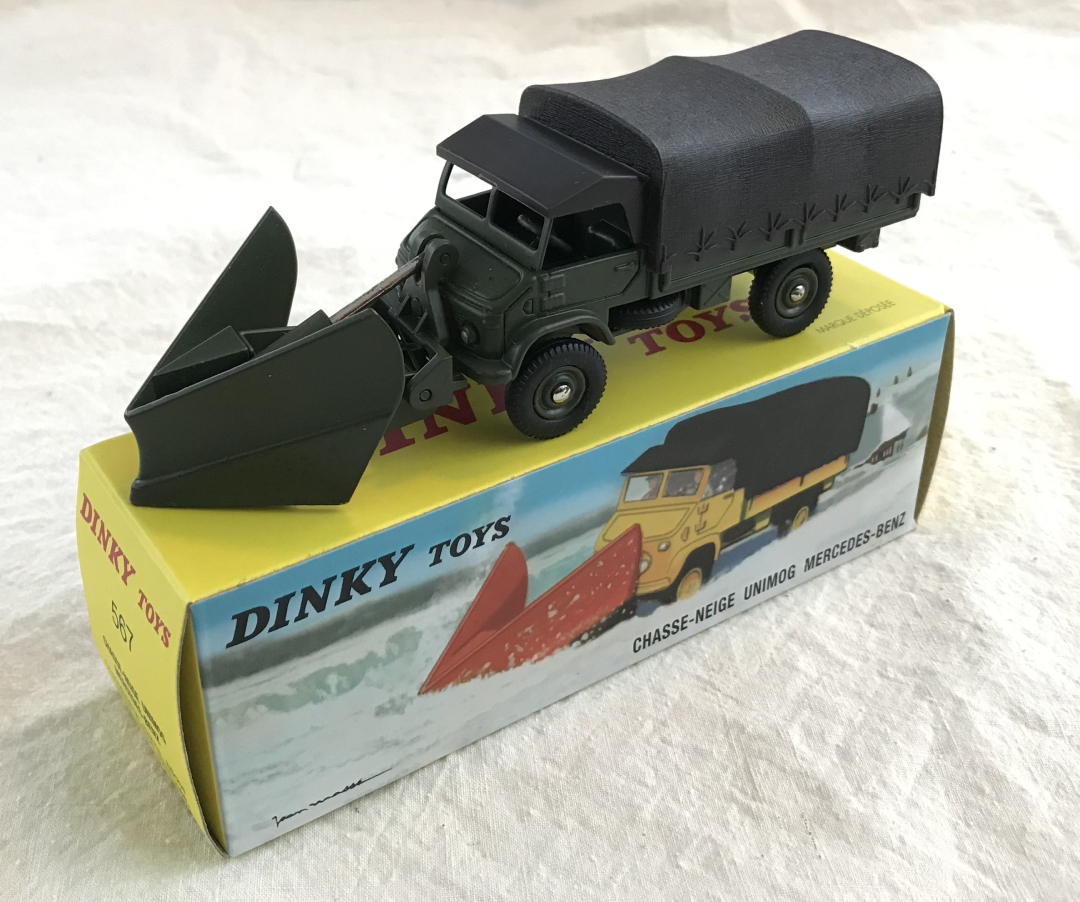
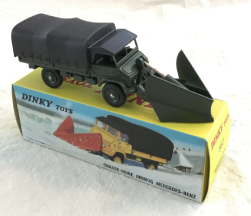
Original Dinky (France) № 567 1:43 scale die-cast UNIMOG Type 404S troop carrier with snow plow
The French-made Dinky Toys model was originally released in 1967.
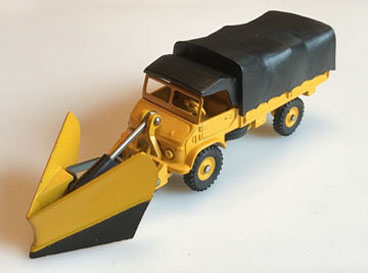
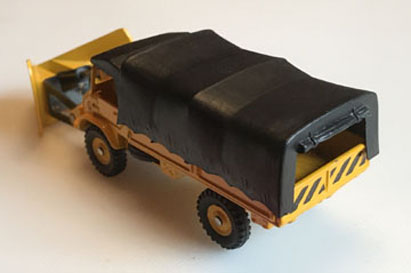
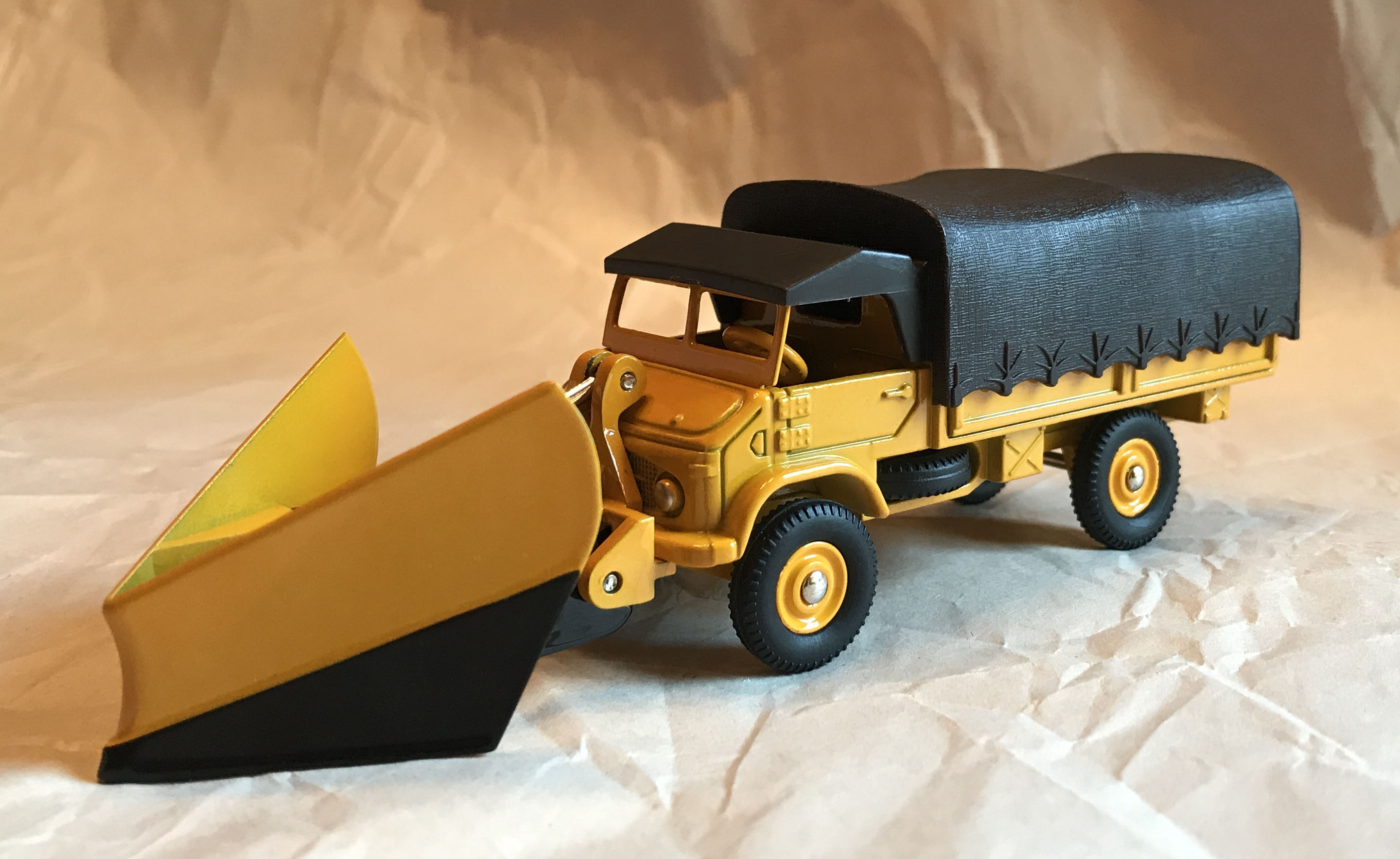
Original (Meccano/France) Dinky № 567
1:43 scale die-cast UNIMOG Type 404S troop carrier with
"chasse-neige" (snow plow)
The black canopy on this example is
a reproduction.
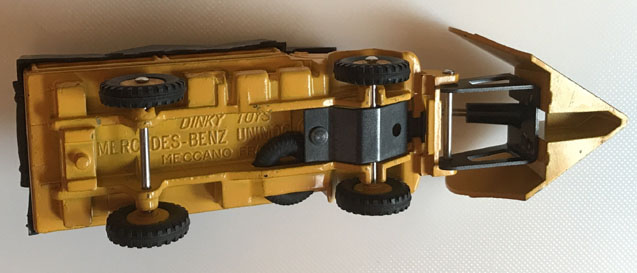
Tires on this example may not be original (compare with the spare underneath).
Photos: Jeff Miller / May 7, 2018 / iPhone 7
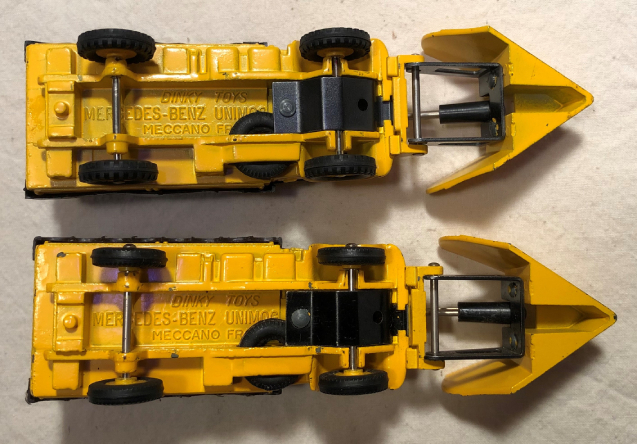
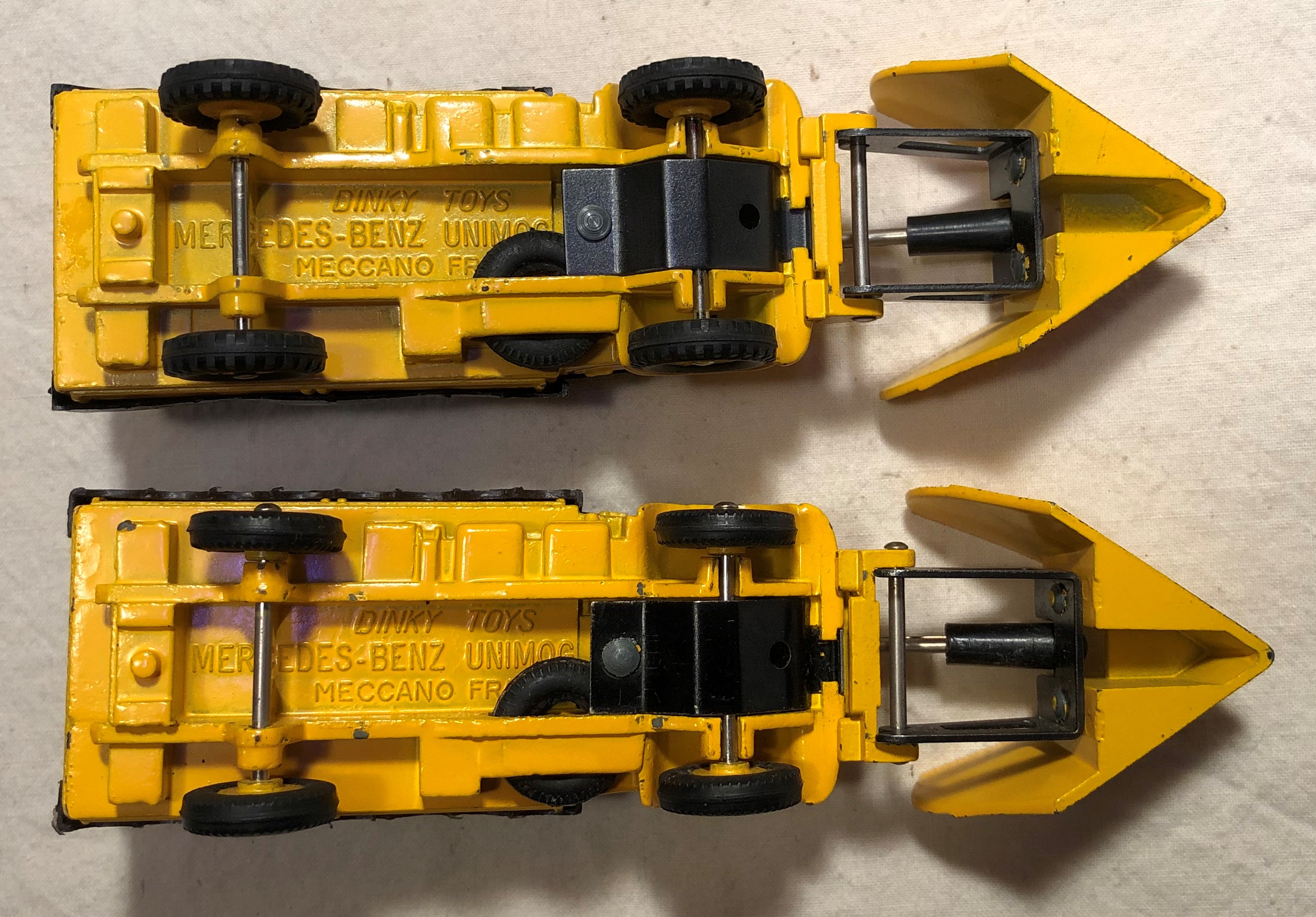
Original (Meccano/France) Dinky № 567 tire comparison.
Top
example acquired April 7, 2018. Bottom example acquired November 2,
2021.
Tires on top example
are suspected to have been replaced (compare with bottom example).
Photo: Jeff Miller / November 5, 2021 / iPhone 8
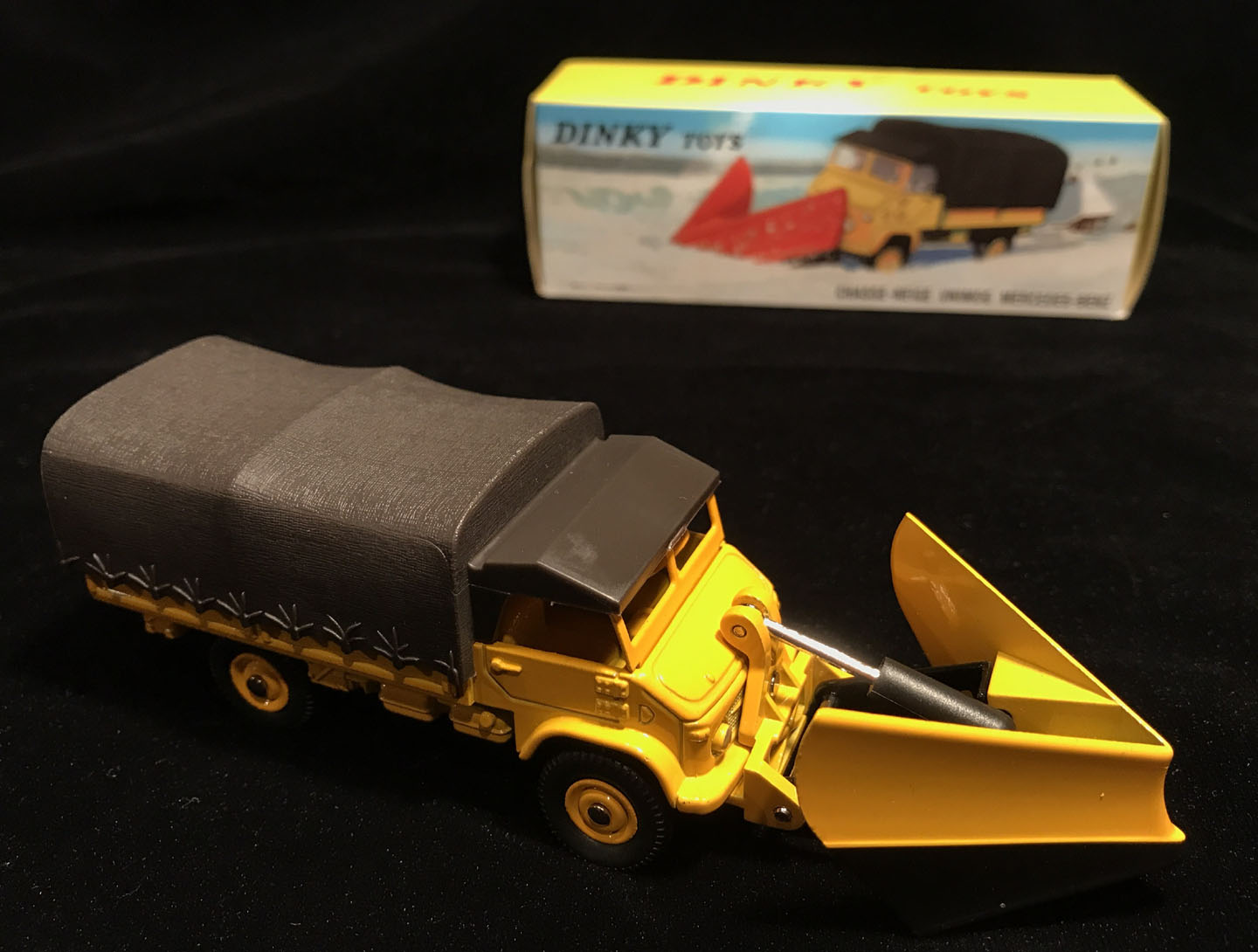
Dinky Toys Editions Atlas (China)
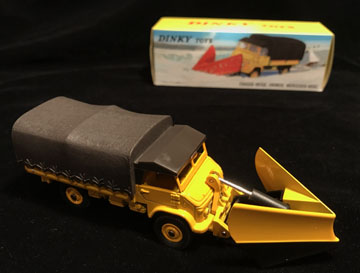
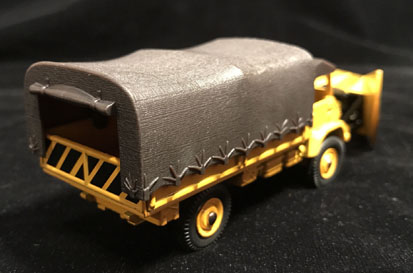
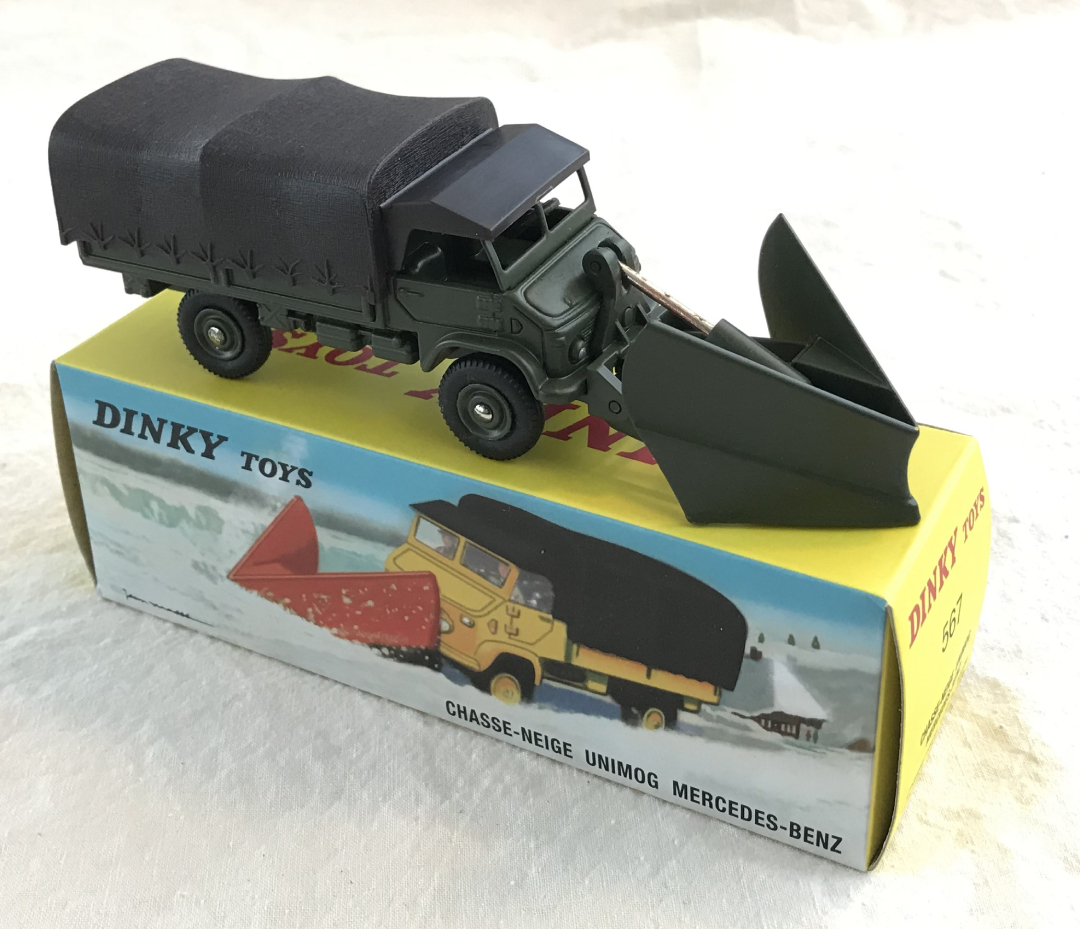
Reproduction of
Dinky № 567 1:43 scale die-cast UNIMOG Type 404S troop carrier with
"chasse-neige" (snow plow)
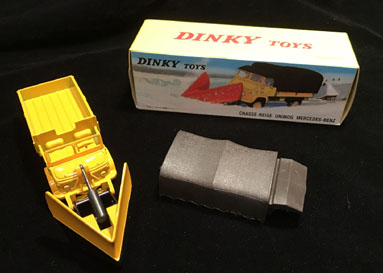
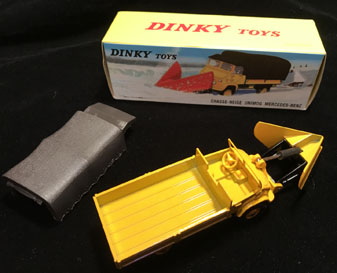
Reproduction (Atlas / Mattel / China) / Photos: Jeff Miller / August 16, 2017 / iPhone 7
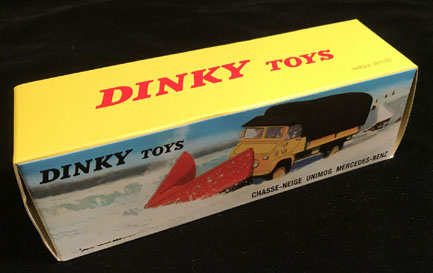
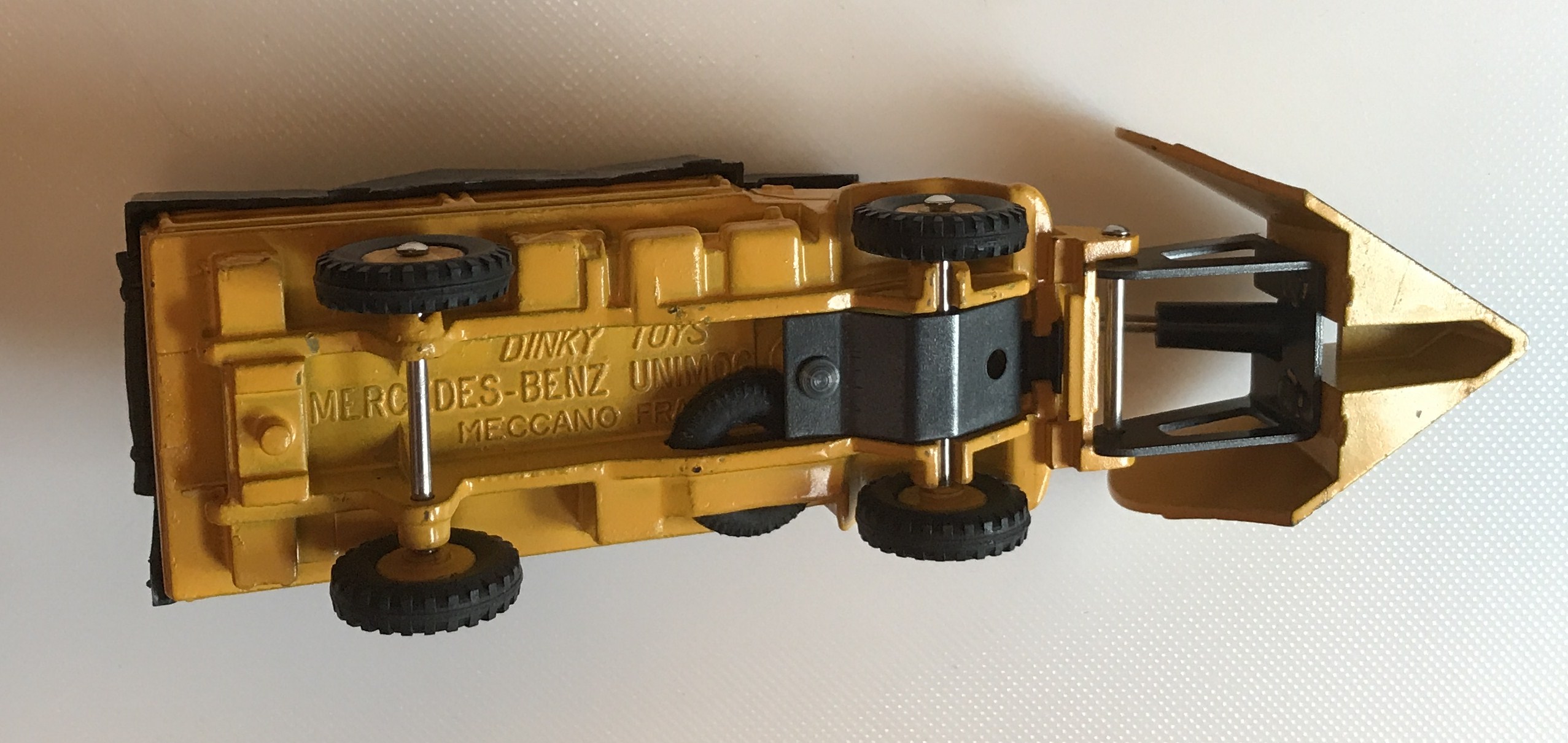
The reproduction is faithful to the original, including the box.
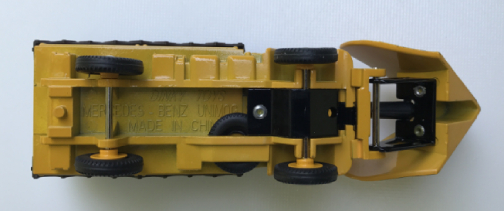
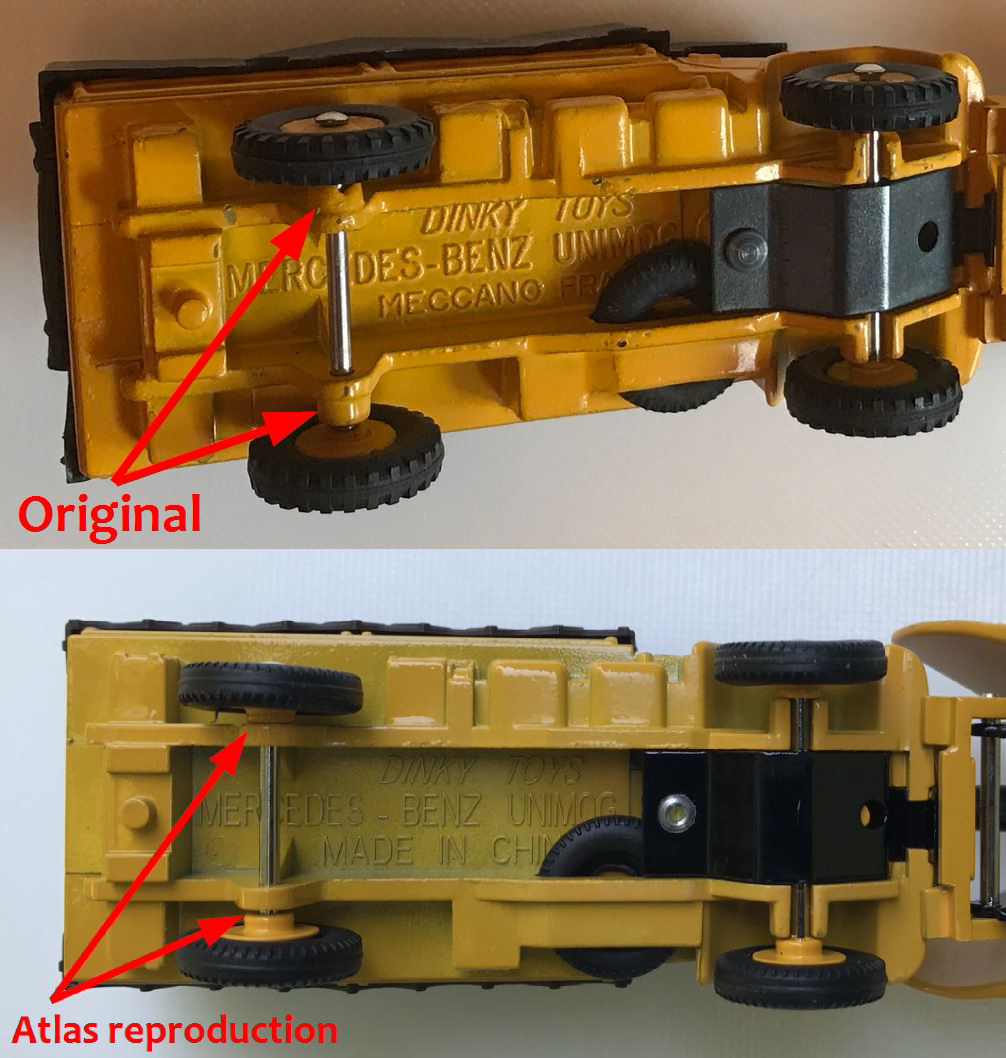
Notice the width of the rear axle on the Atlas reproduction.
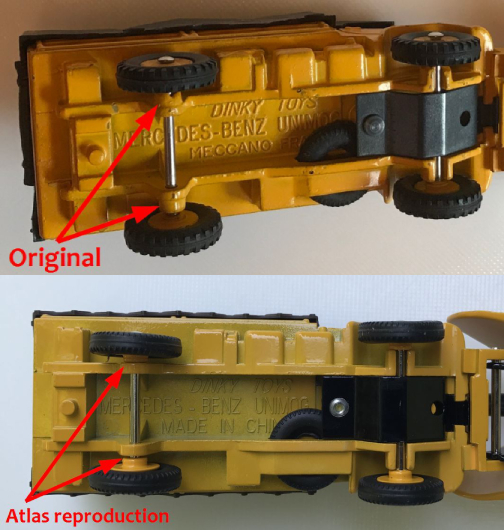
The rear axle of the Atlas reproduction is not as wide as the original
French-made example.
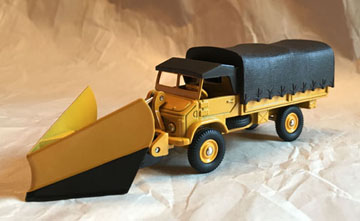
Reproduction (Atlas / Mattel / China) Dinky № 567
Courtesy: Jeff Miller / January 25, 2018 / iPhone 7
Overall, the quality of Atlas reproductions is admirable, but the rear axle of
Dinky № 567 is not as wide as the original. Note the original had a type of spacer built into the casting that forced the rear axle to be wider (i.e. the same width as the front axle). That
feature is absent on the Atlas reproduction.
Fortunately, it does not visually detract when displayed on the shelf. You'll Agree.™
Dinky Toys Editions Atlas (China)
Reproduction of
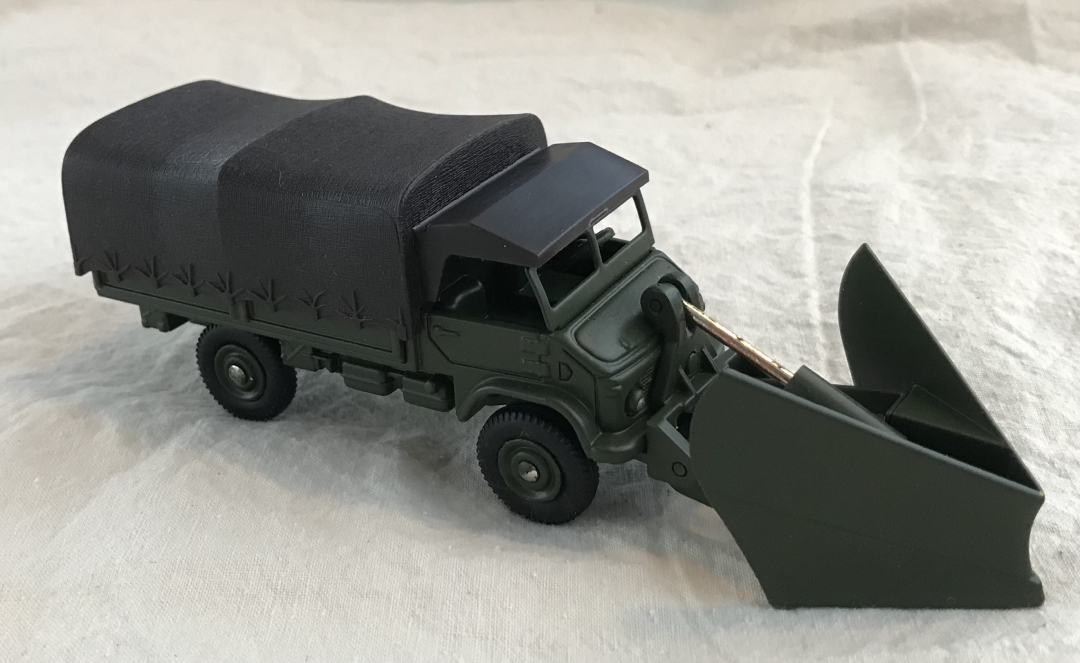
Dinky (France) № 567 in custom olive drab
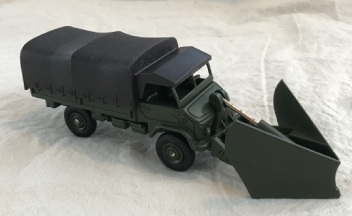
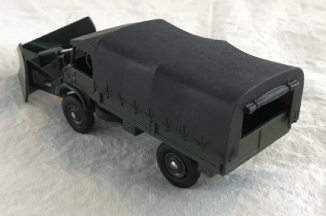
Reproduction (Atlas / Mattel / China) Dinky № 567
1:43 scale
die-cast UNIMOG Type 404S troop carrier with "chasse-neige" (snow plow)
This
Editions Atlas reproduction, which ironically came from France
(via eBay), features a custom military-style
olive drab paint job, and green canopy. Dinky never produced № 567 in this
color scheme, but it suits the model quite well. You'll
Agree.™
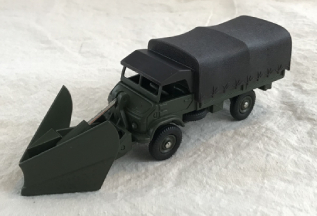
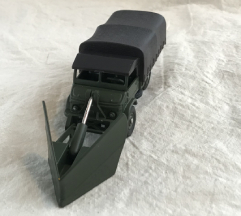
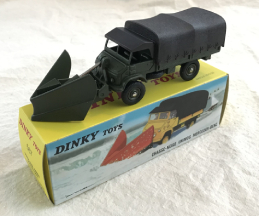
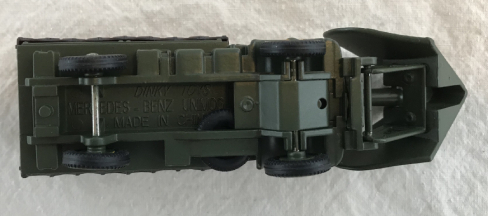
Once again, note the
rear axle of the Atlas reproduction
is not as wide as the original French-made example.
Photos: Jeff Miller / iPhone 7 / March 2, 2019
Kellerman (a.k.a. CKO) (Germany)
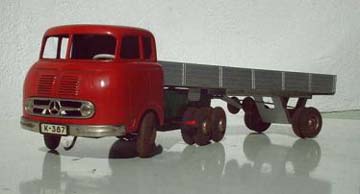
Ponton era LKW (Lastkraftwagen = truck) made by Kellerman (Germany). This
model represents one of the many LP-series LKWs that were made by Daimler-Benz during the
1953-1962 time-frame. Kellerman was founded in Nuremberg in 1910 and went out of business in
1979. Kellerman is sometimes referred to by the name, "CKO" or "CKO Toys" because of their
trademark logo.
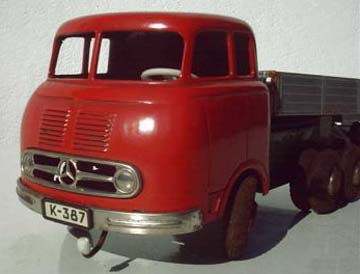

The Kellerman "CKO" trademark logo is embossed on the base plate.
Also note the "D.B.G.M." (Deutsches Bundes Gebrauchs).
Kellerman (a.k.a. CKO) (Germany)
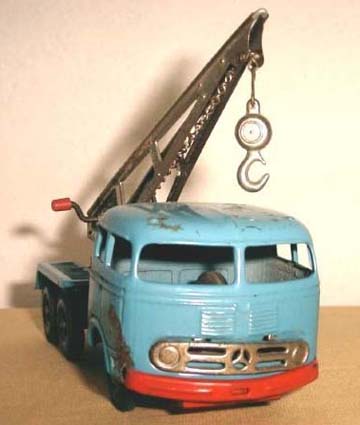
CKO Kellermann № 409 Mercedes-Benz tow truck crane
Kellerman (Germany) tinplate Mercedes-Benz "LKW" (truck)
made in the 1950s. This one suffers from what appears to be normal
wear and tear. The truck is in "played with" condition, and so it
should be – originally, these toys were never bought as investments, they were given
to young lads to enjoy! Maybe this toy helped launch a career in construction,
engineering, mechanical repair, or even toy design. One thing is for
sure. This model will get you hooked on Mercedes-Benz trucks.
Based on the photo, I originally thought this model was perhaps 1:18 scale, but I saw
the real thing for sale in Macungie, Pennsylvania on August 6, 2005 and it was much
smaller. In actual fact, it was about 1:43 scale.
Kellerman (a.k.a. CKO) (Germany)
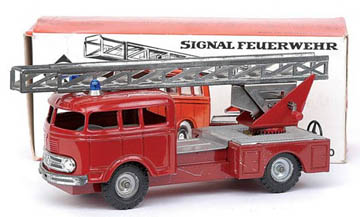
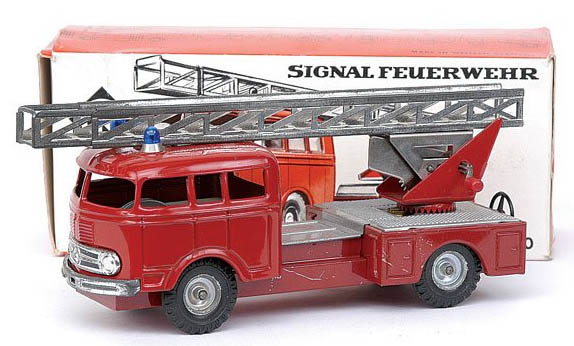
Kellerman model № 410. Mercedes-Benz fire truck with
rotating extension ladder. Red, with plated decking, extension ladder, and friction drive.
Approximately 1:43 scale.
Kellerman (a.k.a. CKO) (Germany)
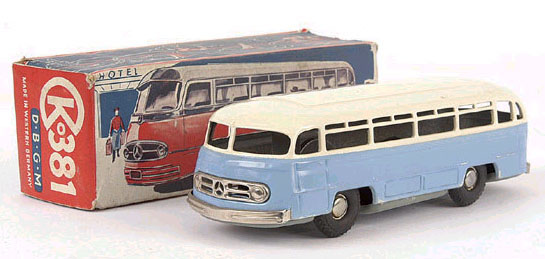
Kellerman model number 381 – Mercedes-Benz Coach. Mint condition with original
packaging. As previously mentioned on this page, a model such as this can be worth quite a bit when
the scarcity is factored into the equation. This model has a lot going for it. Note the Kellerman
trademark "CKO" logo on the end of the box.
Norev (France)
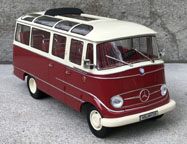
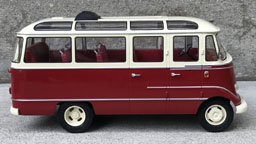
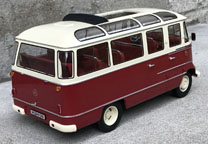
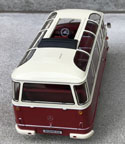
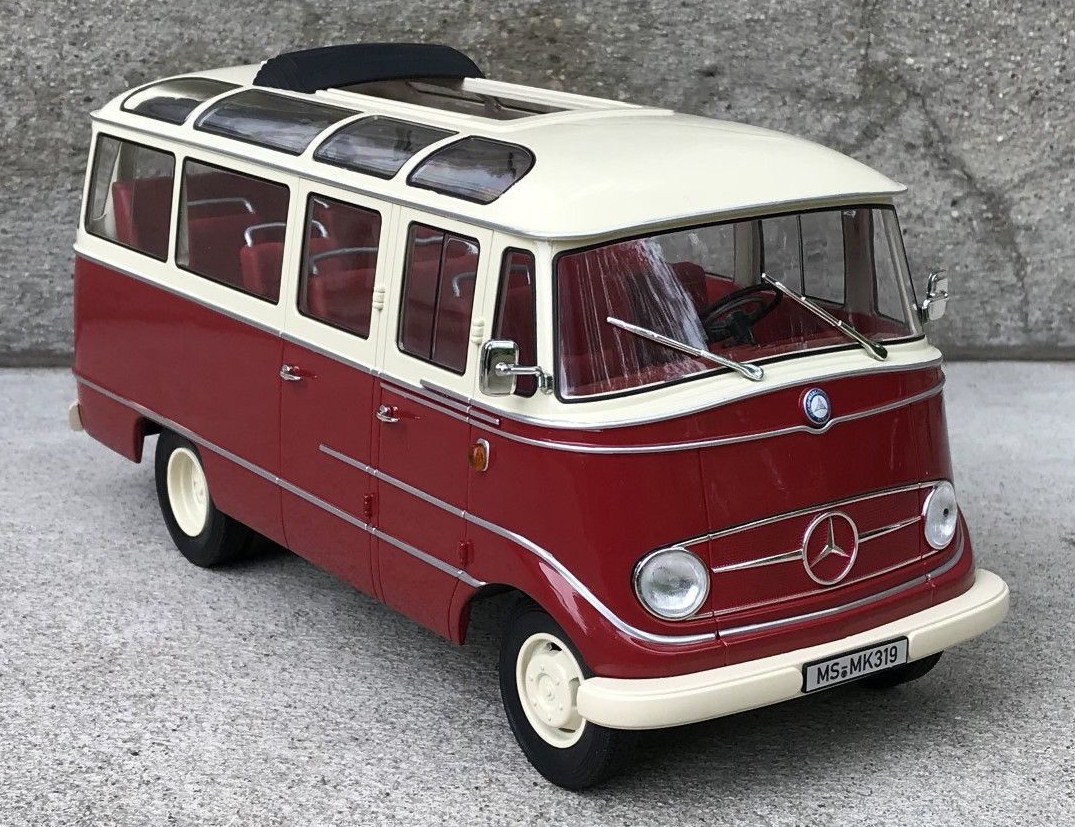
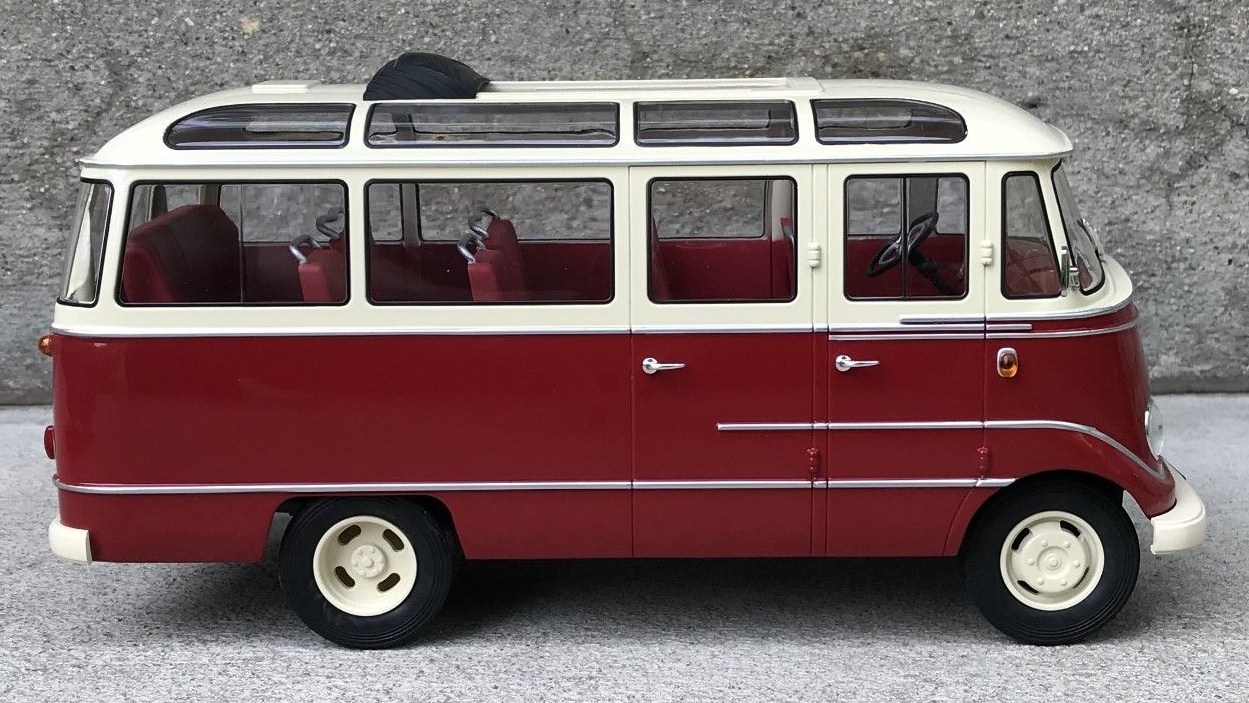
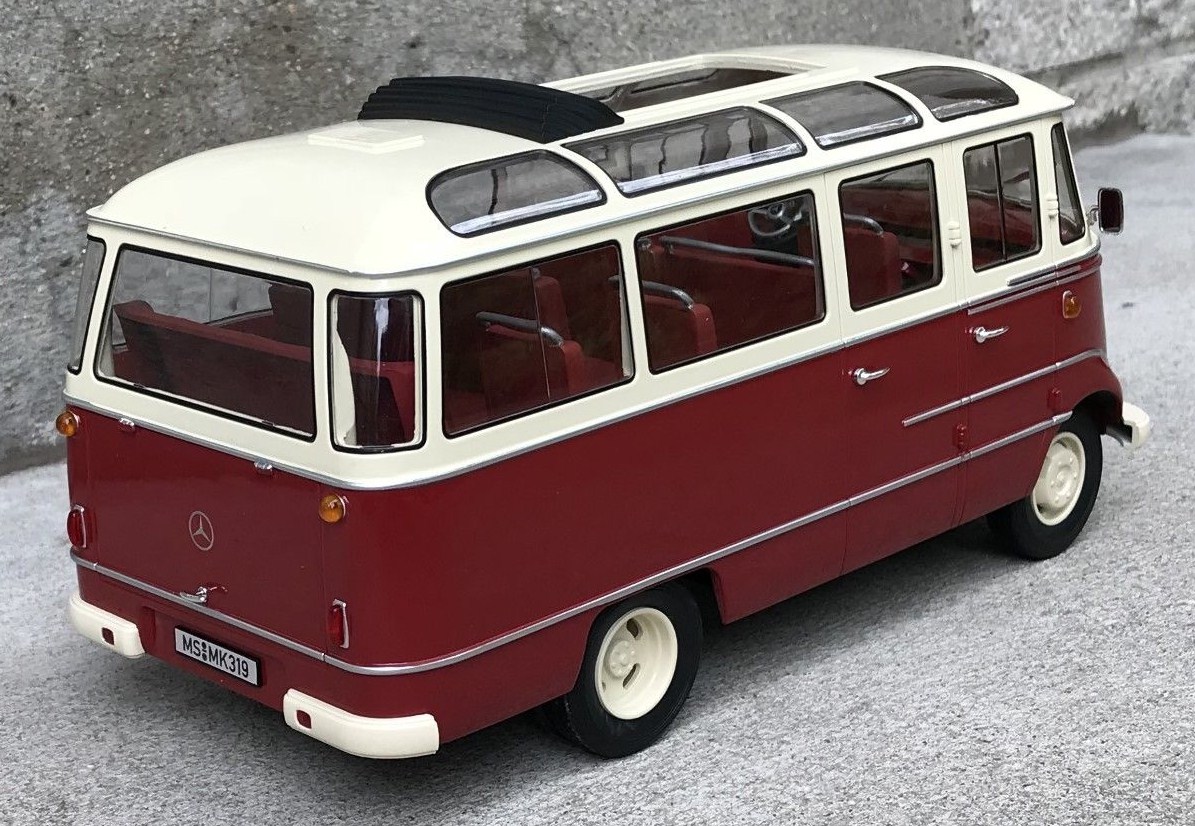
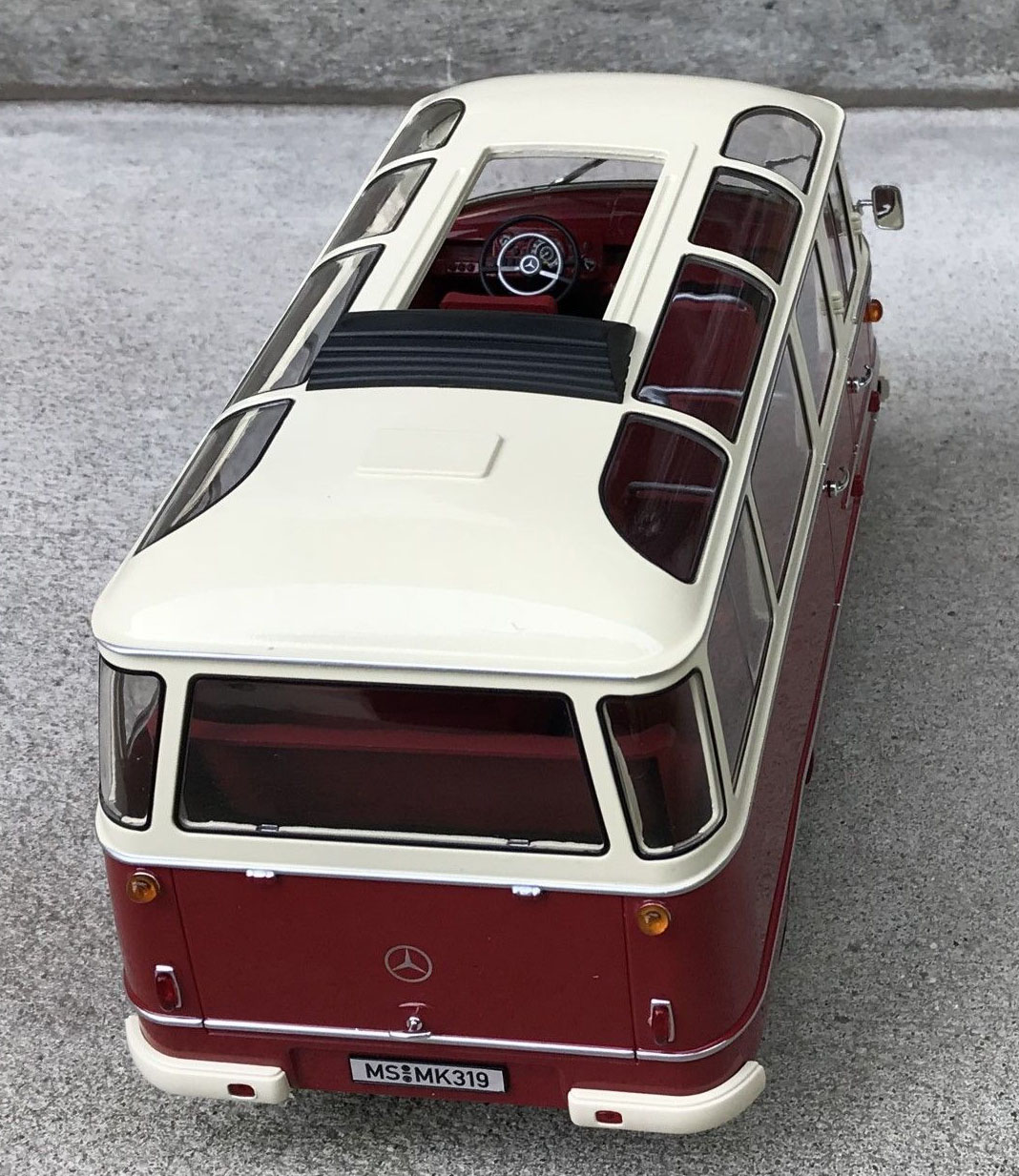
Norev (France) № 183410 –1:18 scale 1960 Mercedes-Benz Type O 319
"Omnibus" (panoramic windows)
Photos uploaded December 14, 2018
Bandai (Japan)
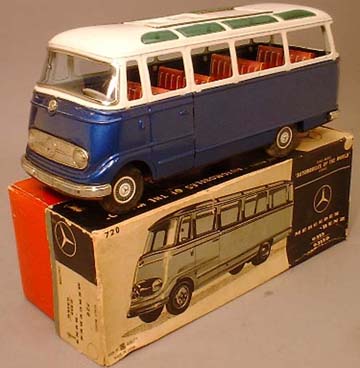
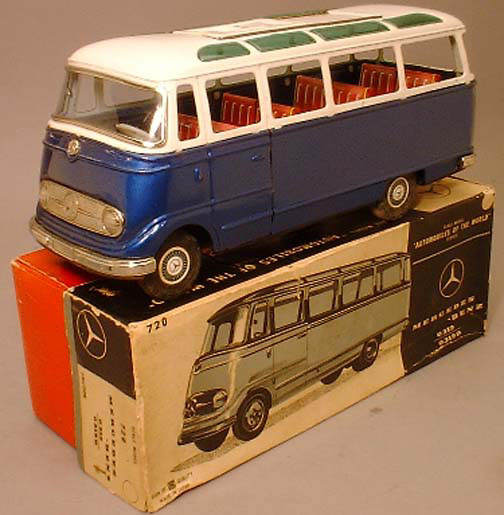
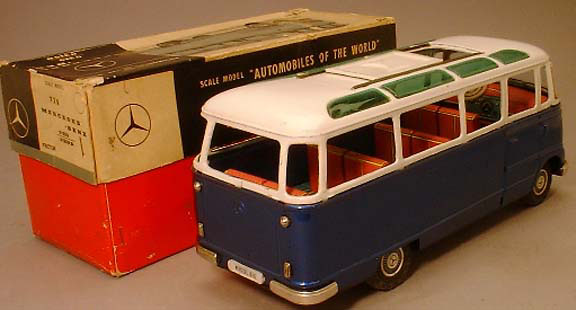
This is obviously not a Ponton model, but it is a passenger
vehicle made by Mercedes-Benz during the Ponton era. This is a Bandai
(Japan) tinplate model of the Type O319 bus. Model number 720 in the Bandai
tinplate series. The O is for Oël Motor (diesel). Roughly 1:18 scale.
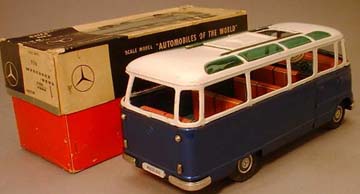
This view accentuates the sliding sunroof made for the passengers on their
journey to...Lilliput, perhaps. The first Type O319 minibus was presented by Daimler-Benz in 1956.
Dinky Toys (France)
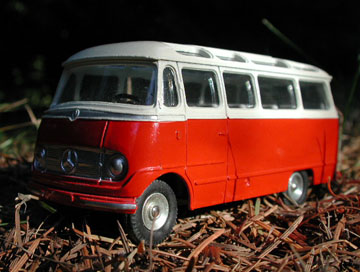
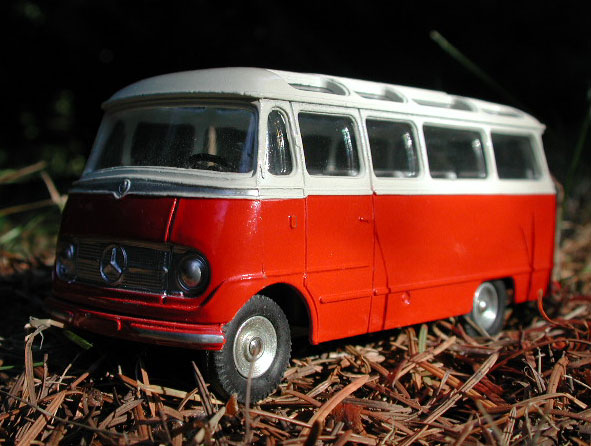
Dinky № 541 (1:43 scale) was released in 1963. Made in
France by Meccano until 1971*, and modeled after
the Mercedes-Benz Type 319 utility van and passenger bus. The real Type 319 was
made from 1956 until 1968, which includes it in the
Ponton era.
The "Omnibus" window configuration of this mini bus indicates the primary function
was to carry passengers. They were common as airport shuttles at the time. This
Dinky includes a suspension, glazing (windows) and interior fittings.
*Histoire des Dinky Toys Francais 1933-1978 / Jean-Michel Roulet
/ p. 241
Photo: Jeff Miller / Nikon Coolpix 990 / summer 2001
Dinky Toys (France)
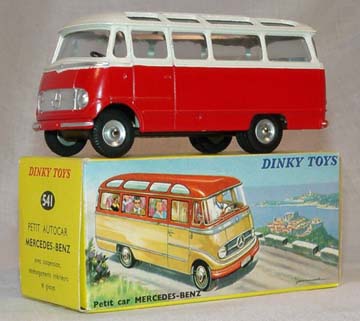
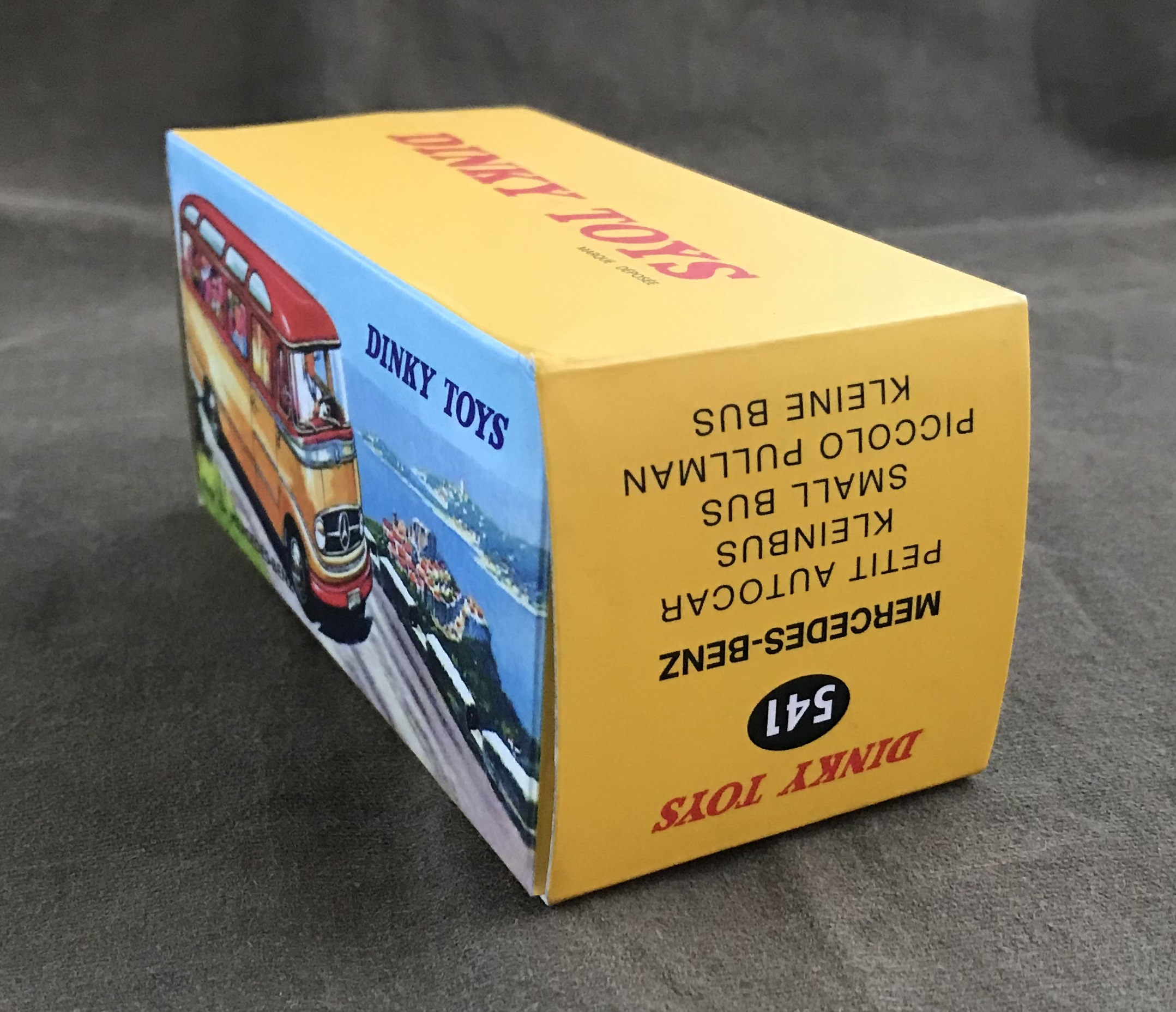
Dinky (Meccano / France) № 541 with the original box. Note the dual rear wheels.
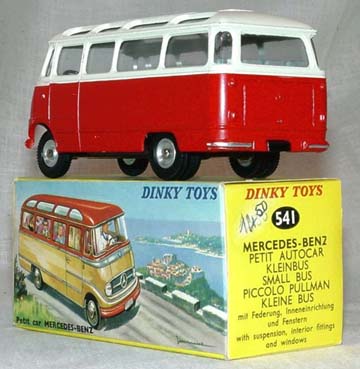
Value increases substantially when a model is in mint condition and includes the original packaging.
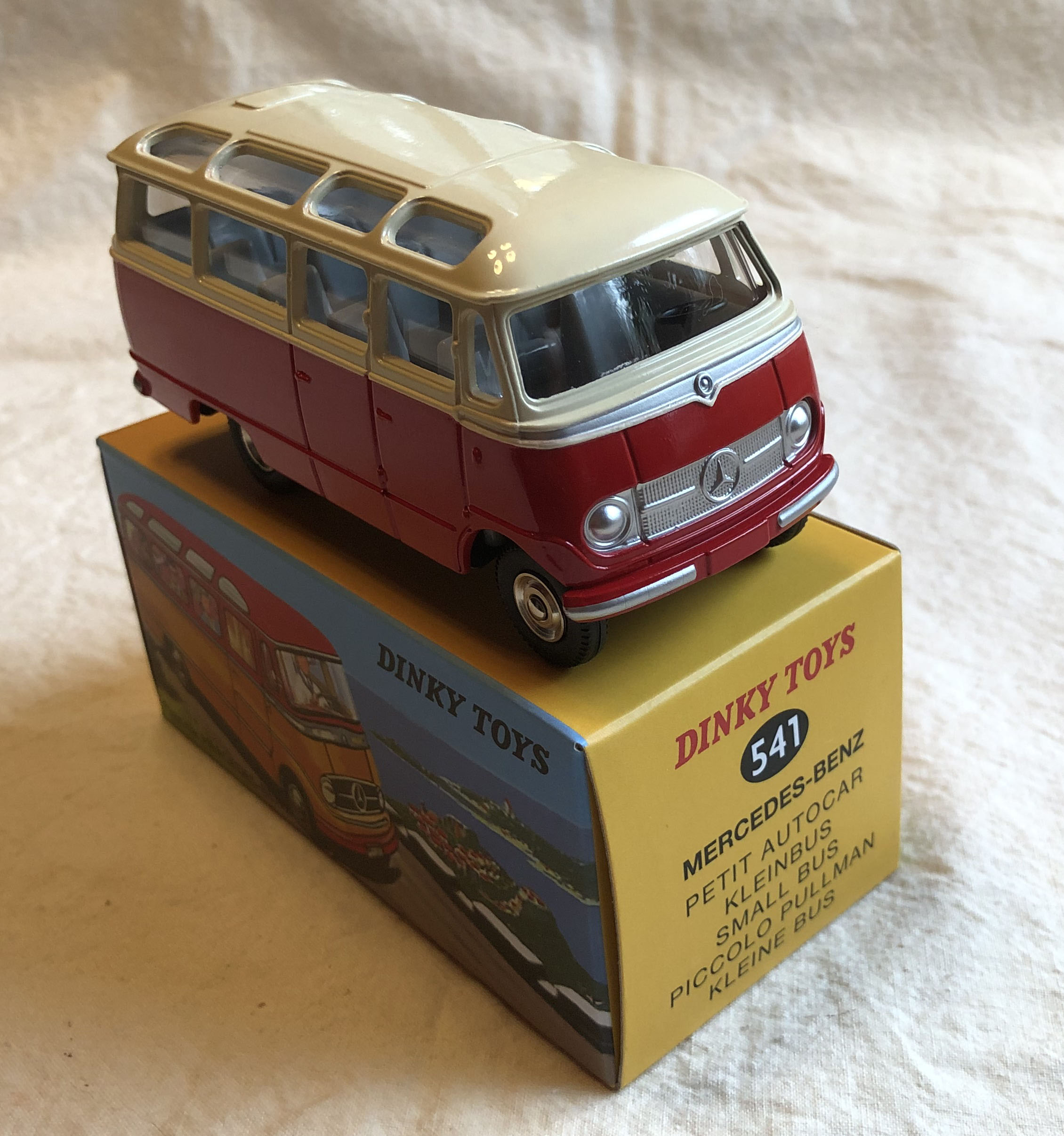
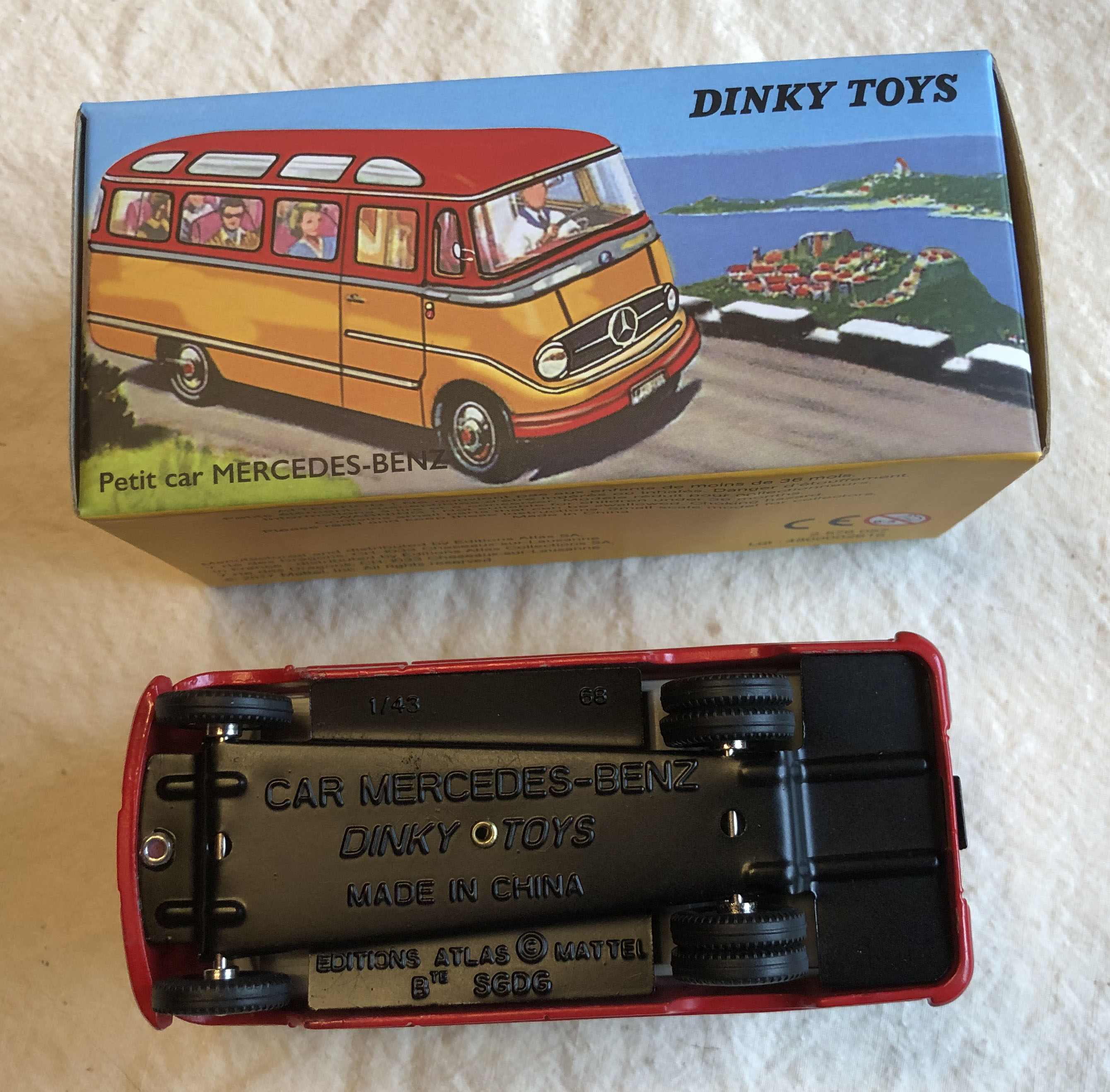
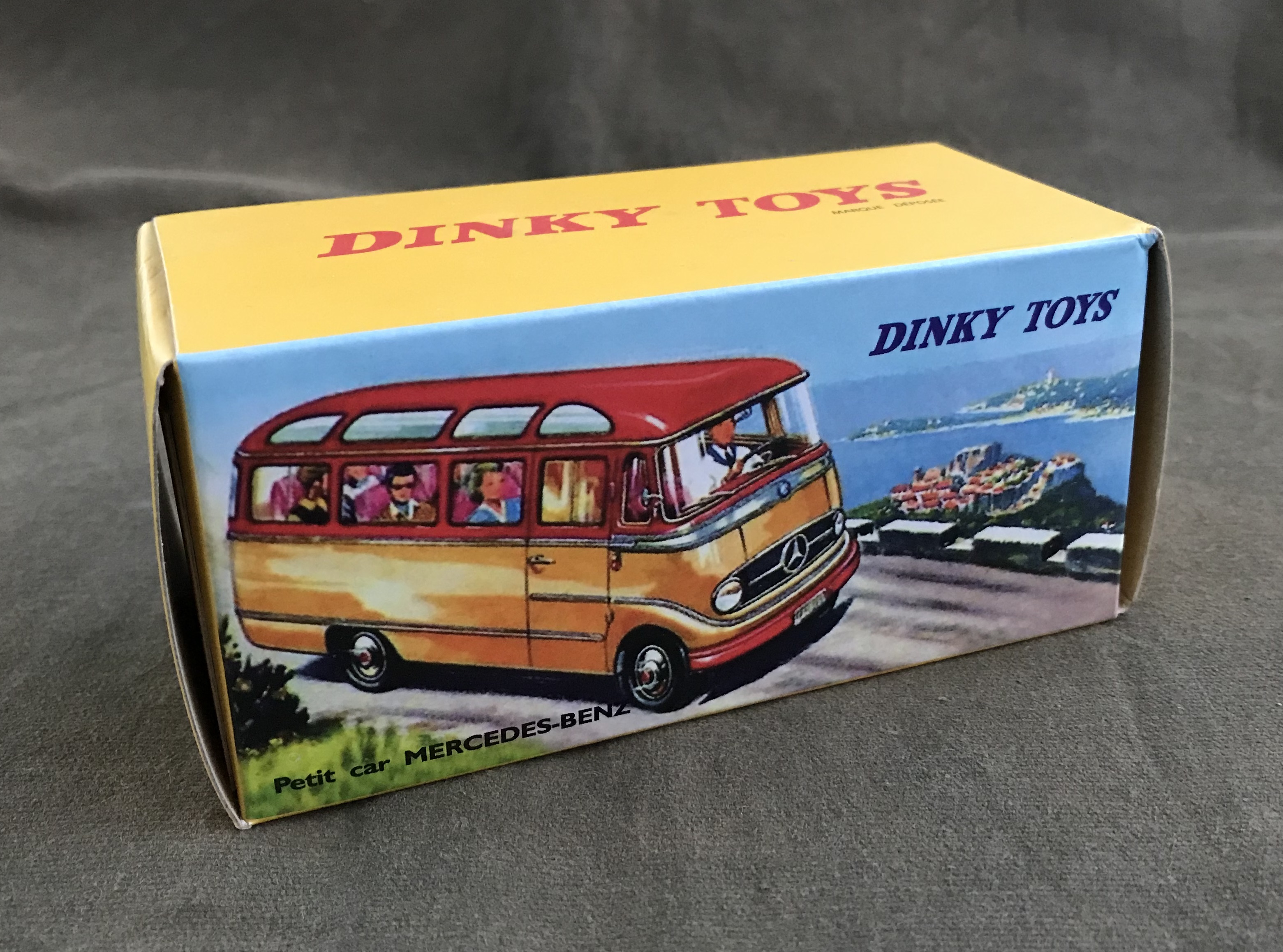
Dinky Toys (Editions Atlas) № 541
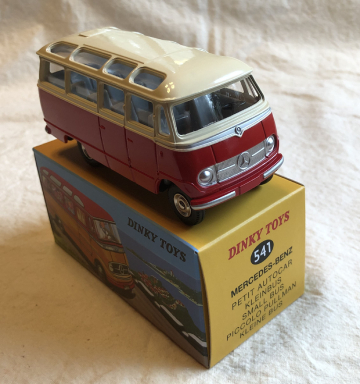
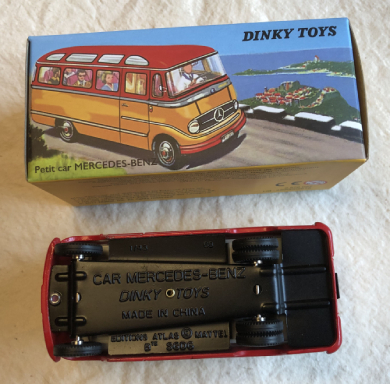
Well executed knock-off (Atlas
/ Mattel / China) includes original style packaging
Photos: Jeff Miller / December 27, 2019 / iPhone 8
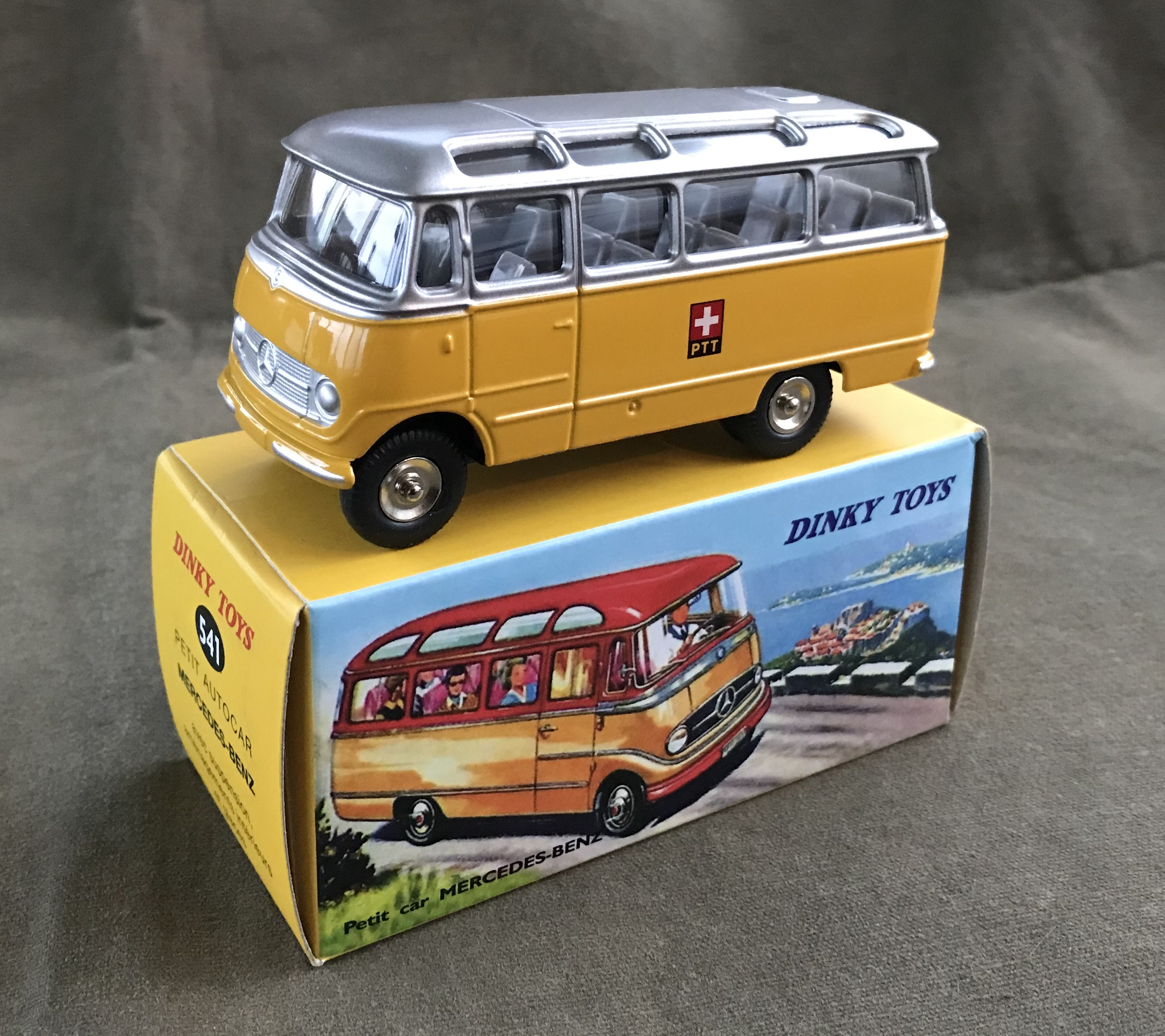
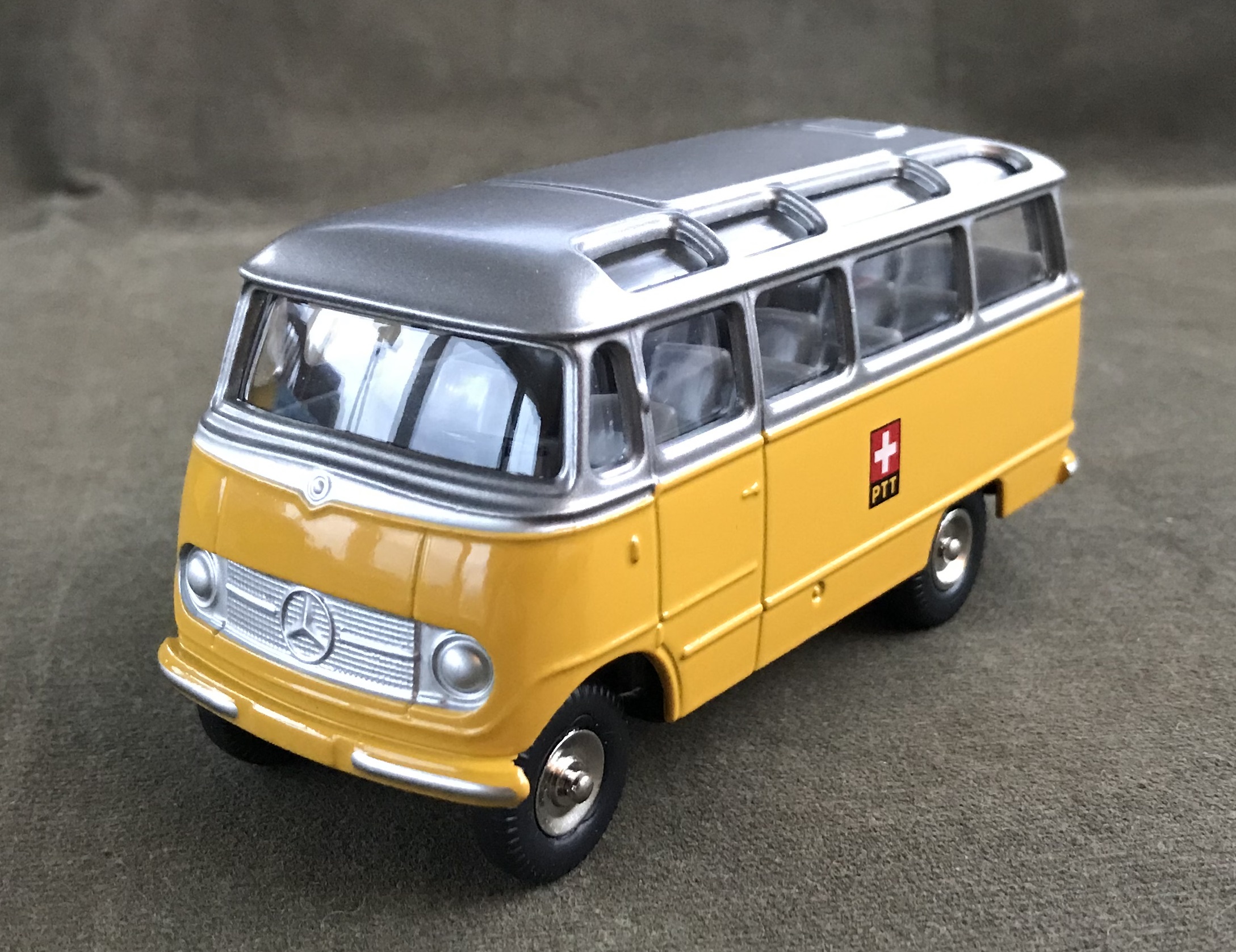
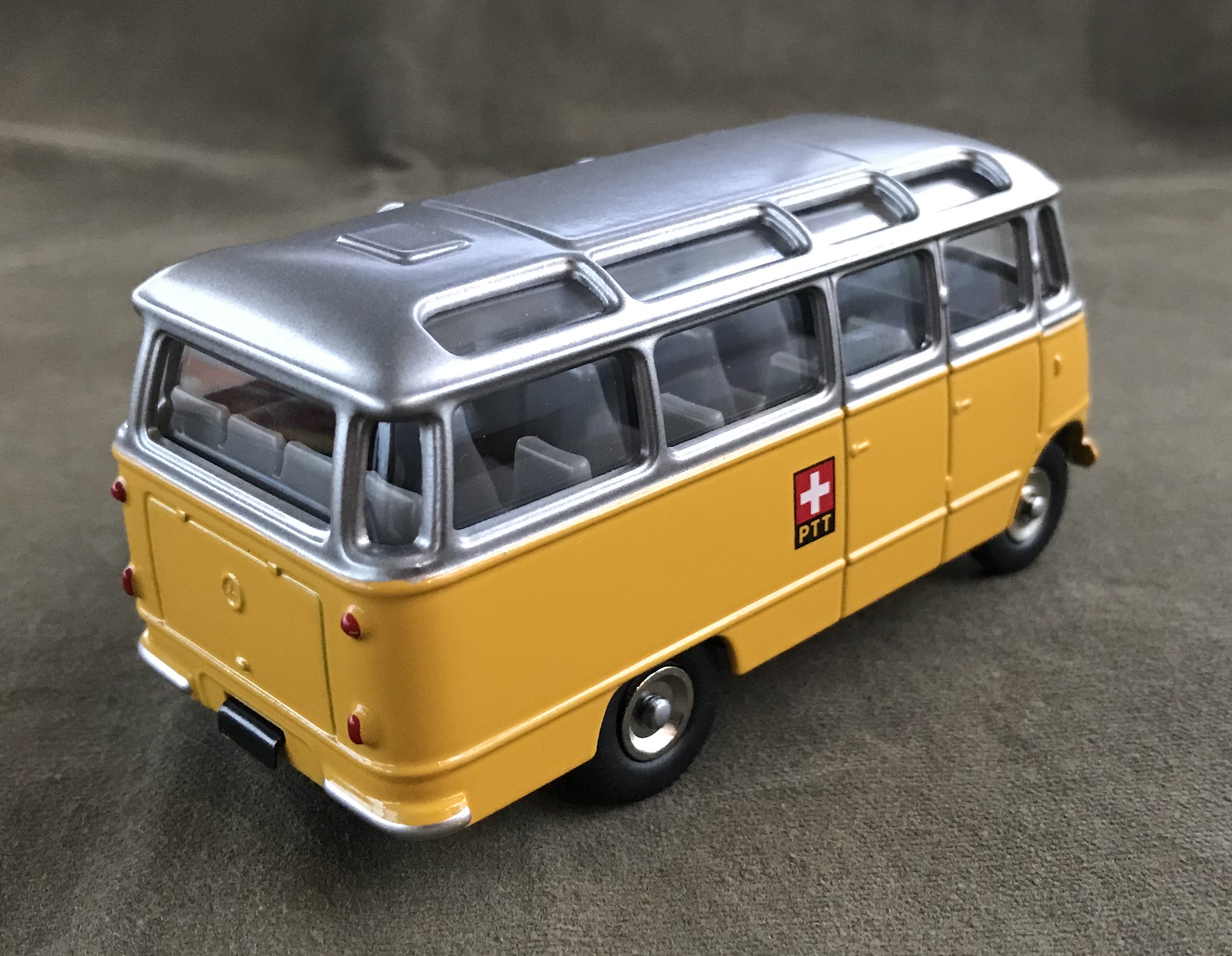
Dinky Toys (Editions Atlas) № 541 Swiss Postal Telegraph and Telephone (PTT) livery
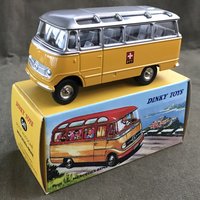
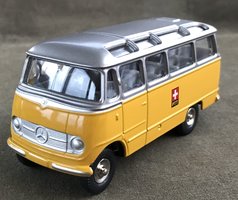
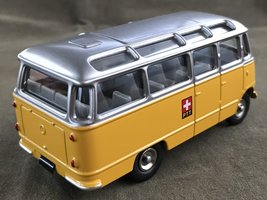
Dinky Toys (
Editions Atlas) № 541 (1:43 die-cast) / Mercedes-Benz Type 319 Omnibus
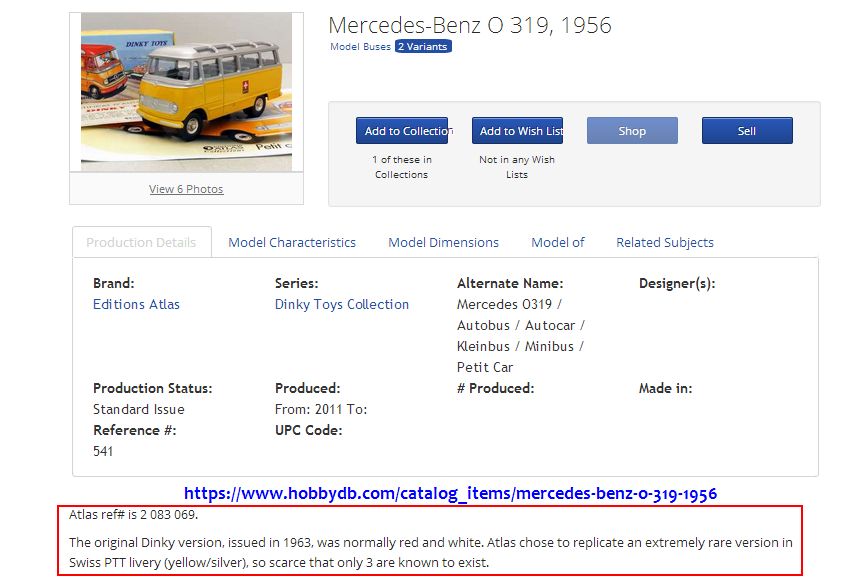
Dinky Toys (Editions Atlas) № 541 in the Swiss PTT livery. Original,
French-made examples are extremely rare. Allegedly, Dinky produced this
variant around 1966 for the South African
market
(Ramsay's), but only three
are known to exist
(www.hobbydb.com).
The original box art features a yellow vehicle, which looks closer to the Swiss PTT
variant than the more common red body and cream roof.
|
Was the French-made Dinky 541 actually ever produced in the Swiss PTT livery?
Help validate whether Meccano (France) ever made Dinky 541 in the Swiss PTT livery.
If you have data, facts, photos, opinions, theories, or other references (books, etc.)
about the existence (and appearance) of an original French Dinky № 541 in this livery, please
contact the editor!
|
Photos: Jeff Miller / December 29, 2018 / iPhone 7 / uploaded: January 4-5, 2019
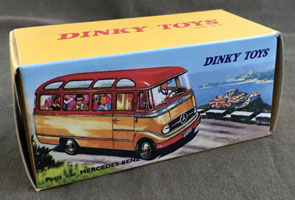
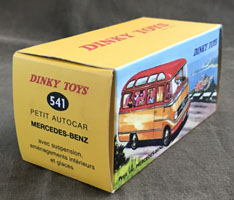
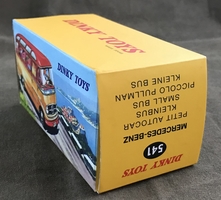
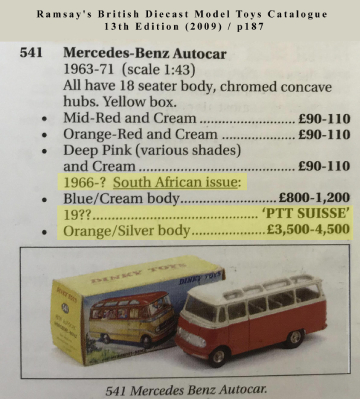
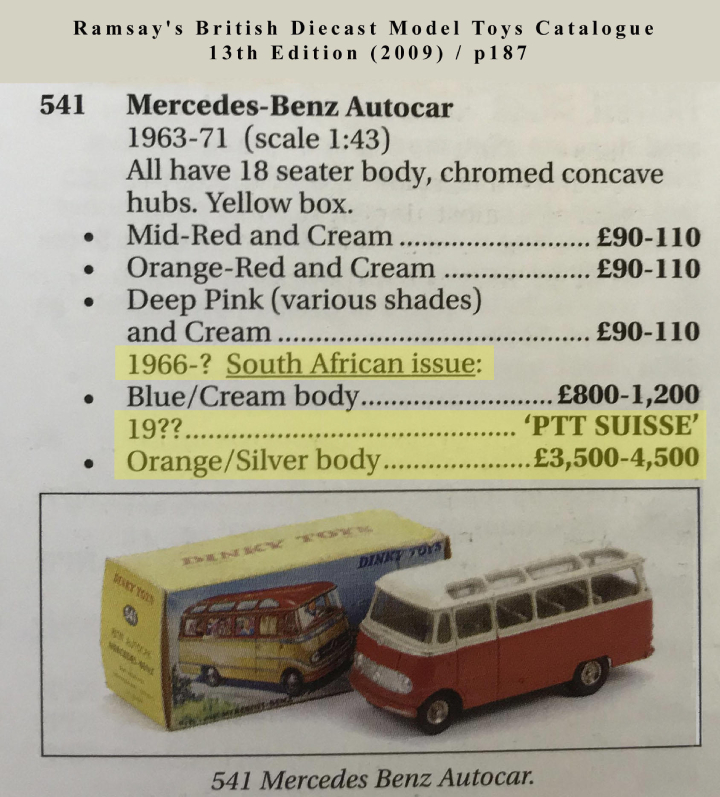
Excerpt from
Ramsay's British Diecast Model Toys Catalogue (13
th Edition / 2009 / p. 187)
The Ramsay catalogue lists the "PTT Suisse"
variant as a "19??" South African issue (note value).
Photo: Jeff Miller / Ramsay's 13th Edition courtesy: Tom
Thomas (Dinky Toys vendor from Grand Island, NY) / January 7, 2019
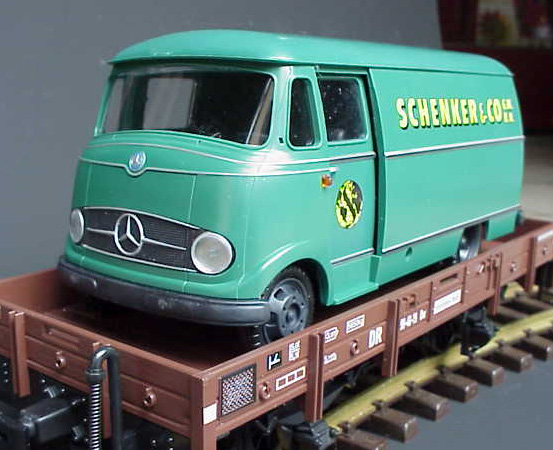
LGB (Märklin) (Germany)
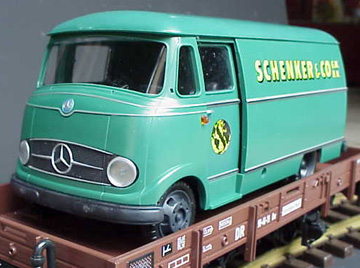
LGB № 40104 / Deutsche Reichsbahn (DR / East Germany) gondola
with Mercedes-Benz Type 319 Schenker van
NZG / Premium ClassiXX (Germany)
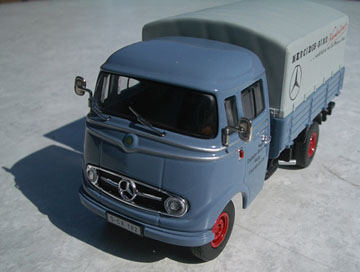
This is a 1:43 scale Type L319D truck with a removable tarp
over the cargo bed. The L319D was a speedy forward-control (i.e. "cab over", no
extended engine hood) light duty delivery vehicle, which had a payload of 1.75
tonnes. Introduced in 1956, it was part of the second phase of Daimler-Benz
postwar truck development. It carried DB through the early 1960s in the
light van class and offered either a 68-bhp gasoline engine or a 50-bhp diesel.
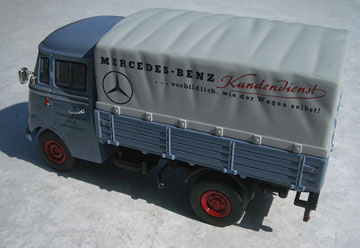
Hartwig Mueller of Dortmund, Germany recalls the full scale
vehicle from his days as a Mercedes-Benz salesman in Bremerhaven:
This special blue-grey "Pritsche" (meaning: pick-up) would have
belonged to the "factory fleet" of Daimler-Benz Untertuerkheim during the late
1950s and early 1960s showing the corporate identity of the vehicle. As of June
5, 2005 this scale
model was still available through authorized Mercedes-Benz
agents. The L319 was produced in Sindelfingen where the passenger vehicles
were made. Following an invitation, I had the chance to visit the manufacturing
facility of this nice little truck, belonging in Germany to the category
of "Eindreivierteltonner": "One and three quarter tons vehicle." It really
moved almost like a normal passenger car and had all goodies of our sedans
like Kugelumlauflenkung, shifting from the steering wheel, soft connection
between engine and chassis (the famous sub-frame or so called, "Fahrschemel"),
same steering wheel, same gear shift, almost the same pedals and very good
characteristics on the road. A problem: The diesel engines had very little
power, yet I never noticed anybody buying a "Benziner" meaning, "gasoline engine."
Editor's note: According to Mercedes-Benz Classic magazine
(Issue: 2-2004) 6% of the Type 319 trucks were non-diesel.
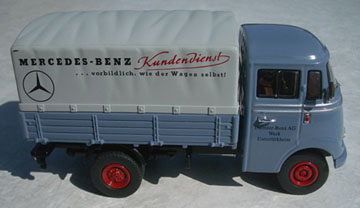
This handsome 1:43 scale model was sold through an authorized
Mercedes-Benz agent (in Dortmund-Unna Germany) and was manufactured by "Premium
ClassiXX" (sic). Photos and text courtesy:
Hartwig Mueller June 5, 2005
NZG / Premium ClassiXX (Germany)
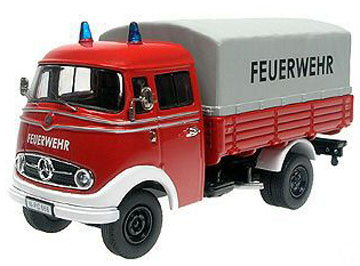
Mercedes-Benz Type L319 Kasten / box van, "fire-brigade."
Produced by NZG / Premium ClassiXX at 1:50 scale. NZG № 11054. The
brilliance of the Daimler-Benz design is seen by comparing this model to the
photos of the blue-grey Type L319D "Pritsche" (pick up) provided by
Hartwig Mueller. These vehicles were designed on a single platform, which could
be called into any number of configurations depending on the customer's
wishes. The most significant option came from the catalog of Daimler-Benz
engines with a wide range of power outputs. Versatility was the name of the game.
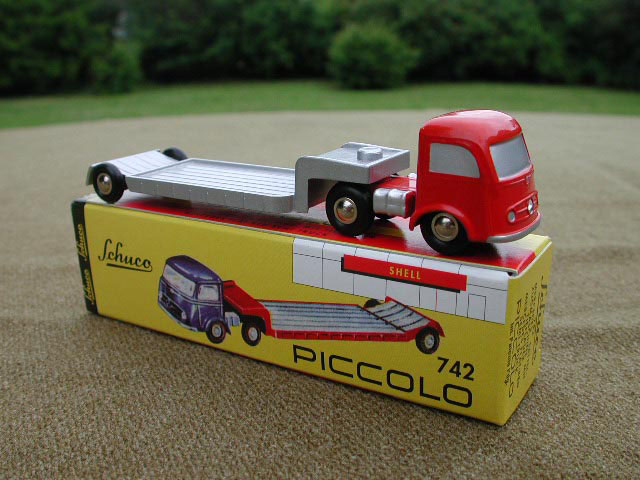
Schuco (Germany) – "Piccolo" series
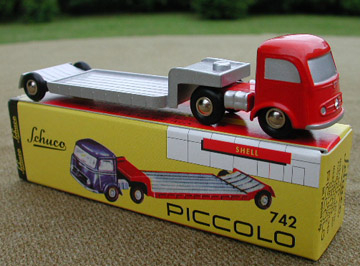
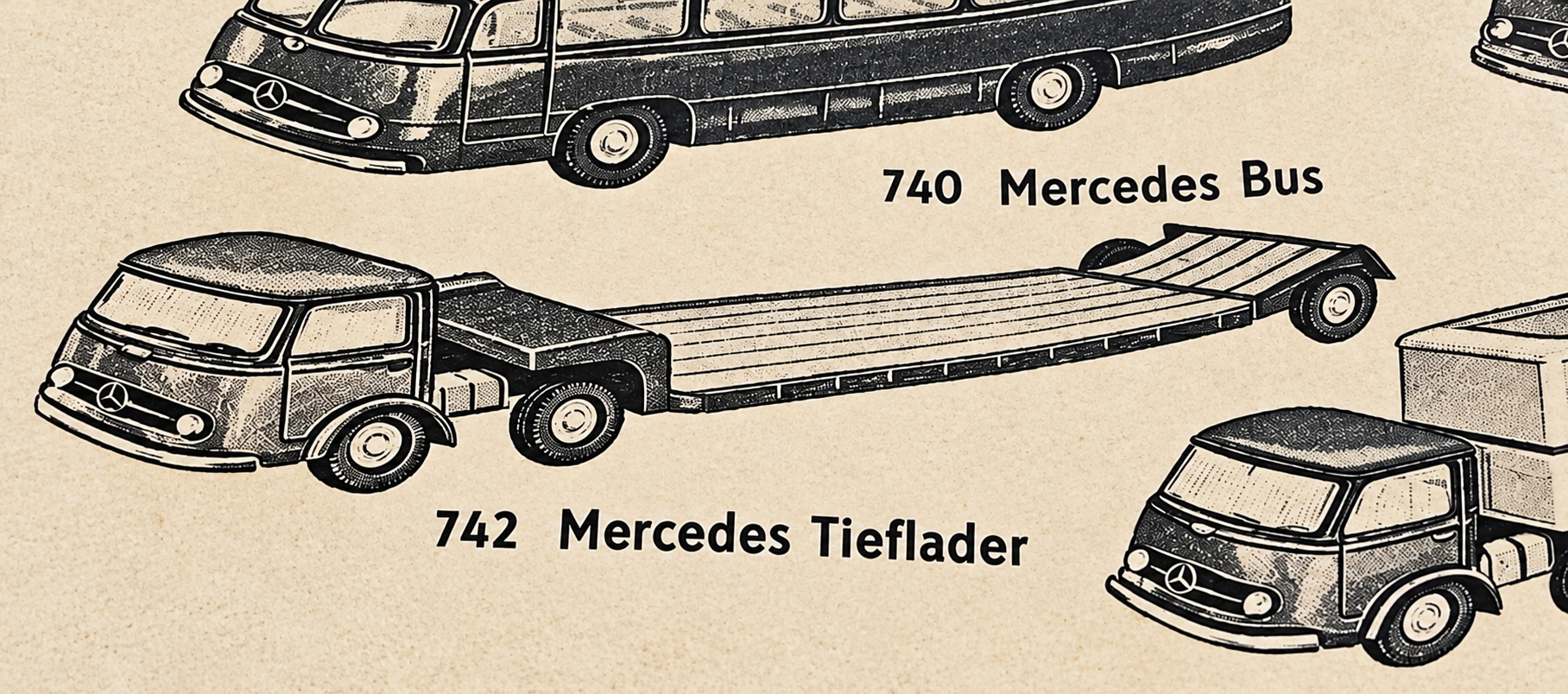
Schuco Piccolo № 742 – Mercedes-Benz "Tieflader" (low loader)
A Mercedes-Benz LKW (articulated tractor-trailer) of the
Ponton era. This is № 742 in the Schuco Piccolo range, and probably
represents a Type LP-321 lorry. A tiny (1:90 scale) solid die-cast
truck makes a nice addition to any scale model collection.
Photo: Jeff Miller / Nikon Coolpix 990 / June 5, 2004
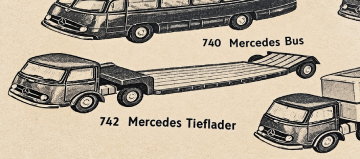
Pamphlet: Schuco Auto-Modell 1:90 Piccolo
/ № 8-1258/750 / Printed in Western Germany
Schuco (Germany) – "Piccolo" series
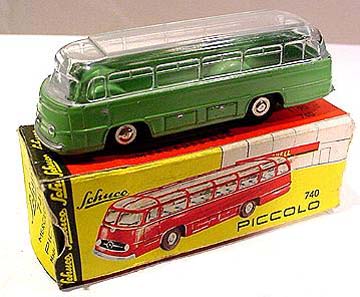
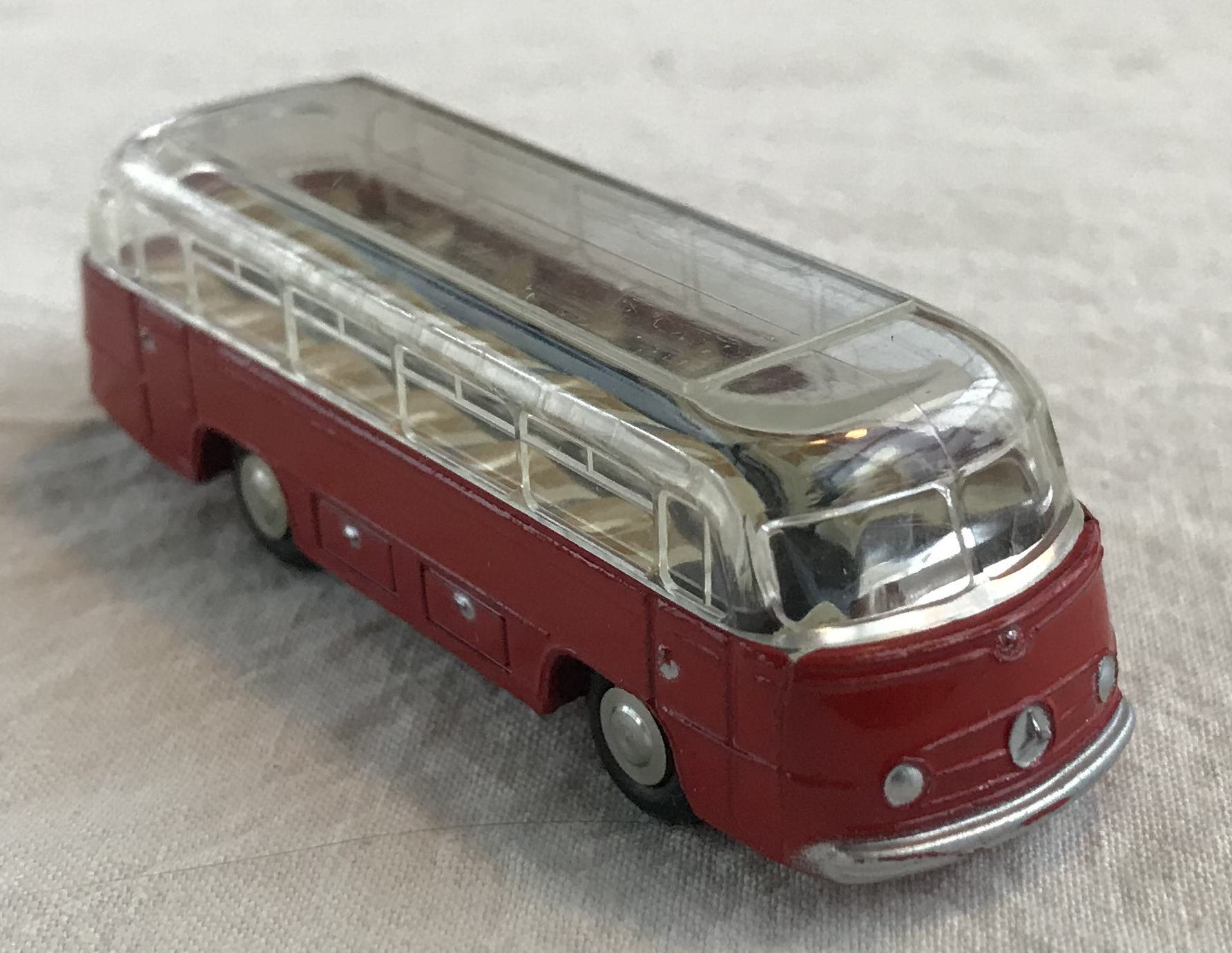
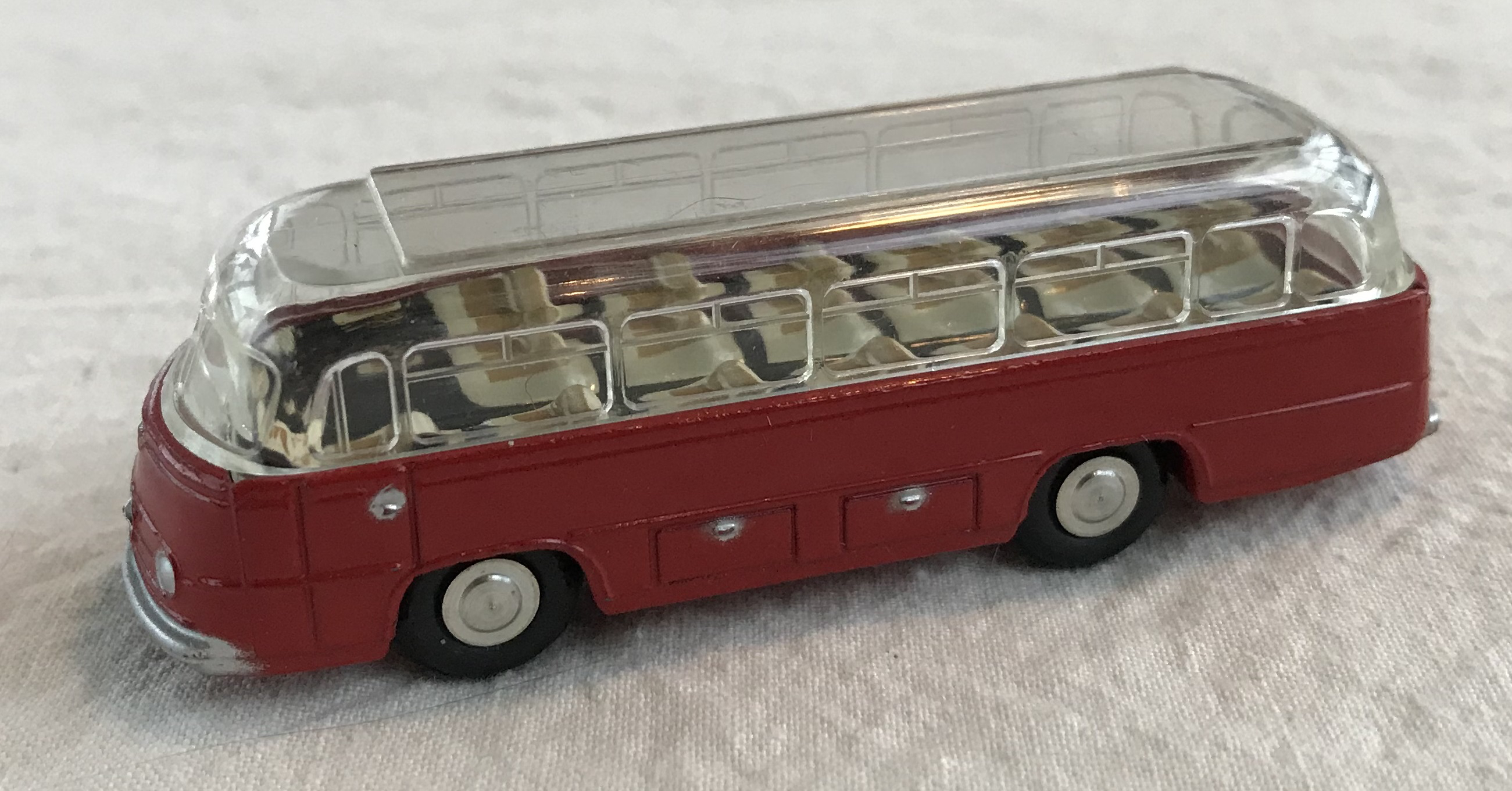
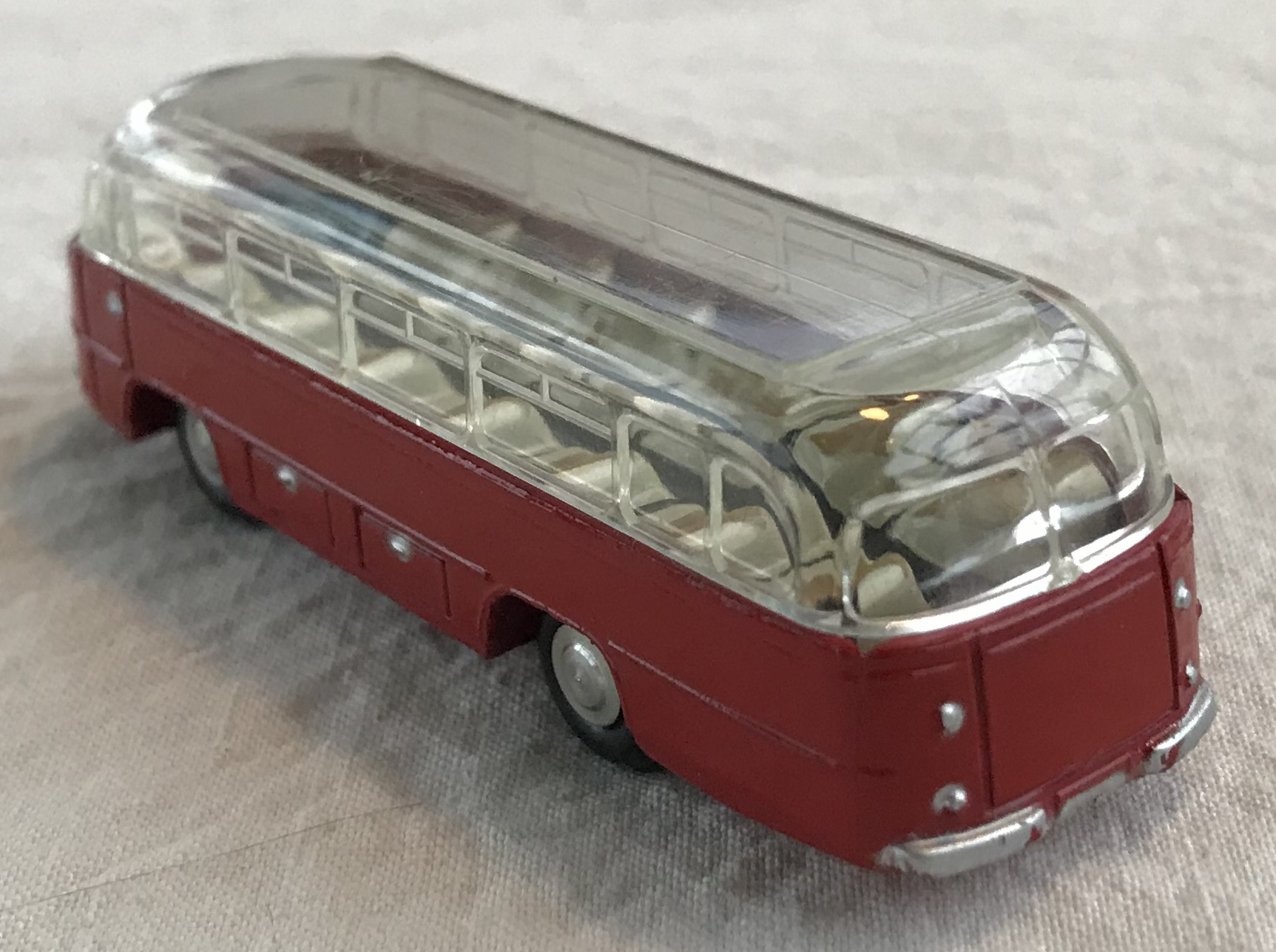
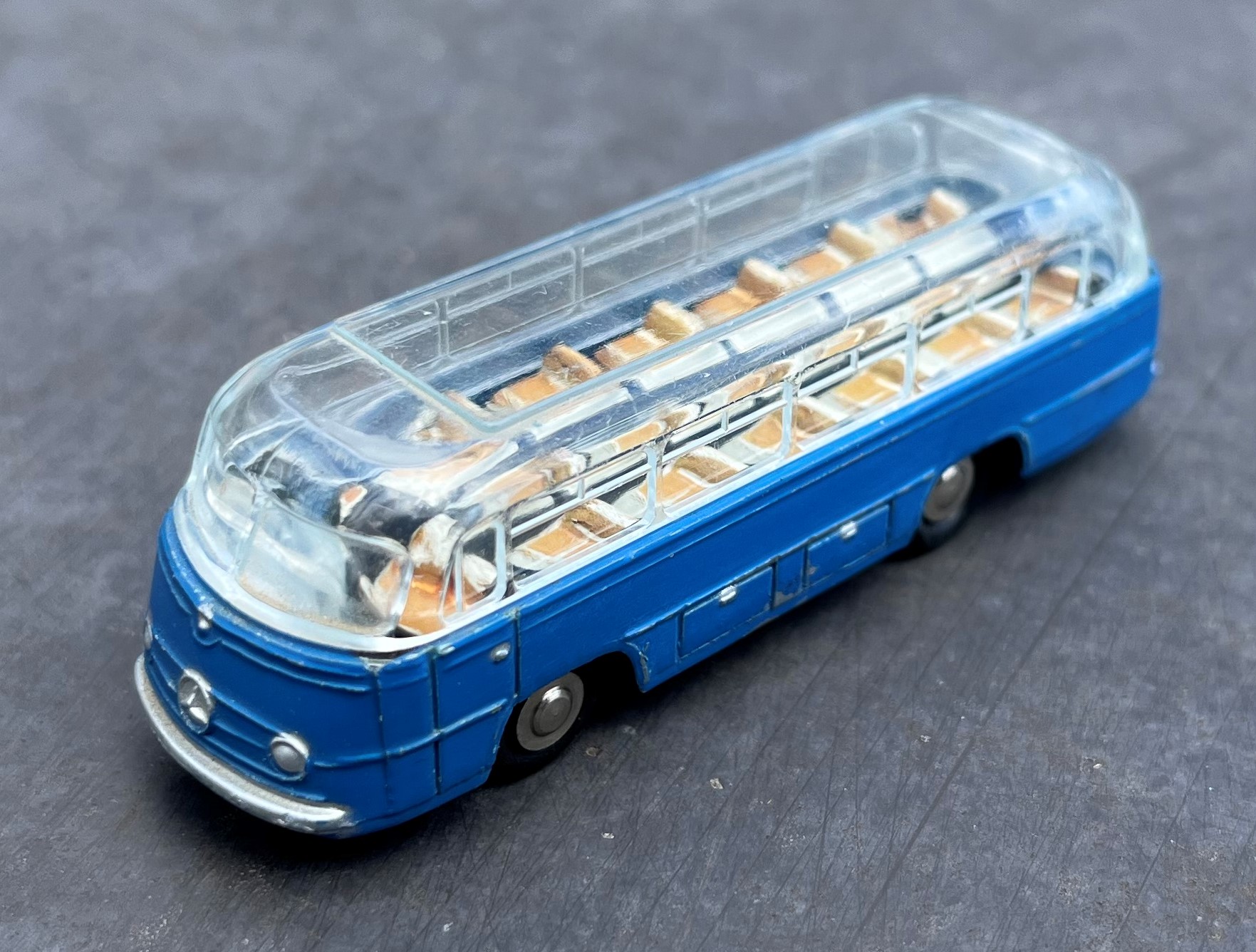
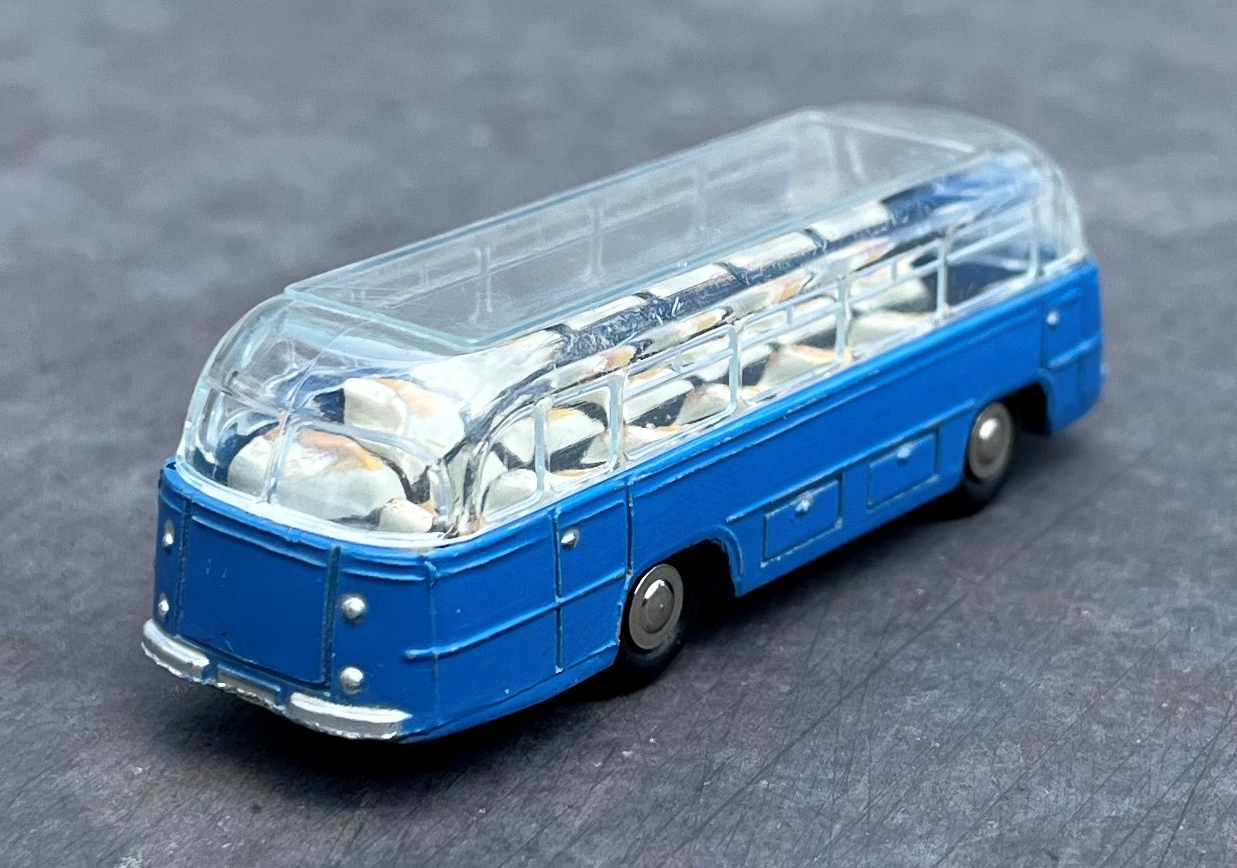
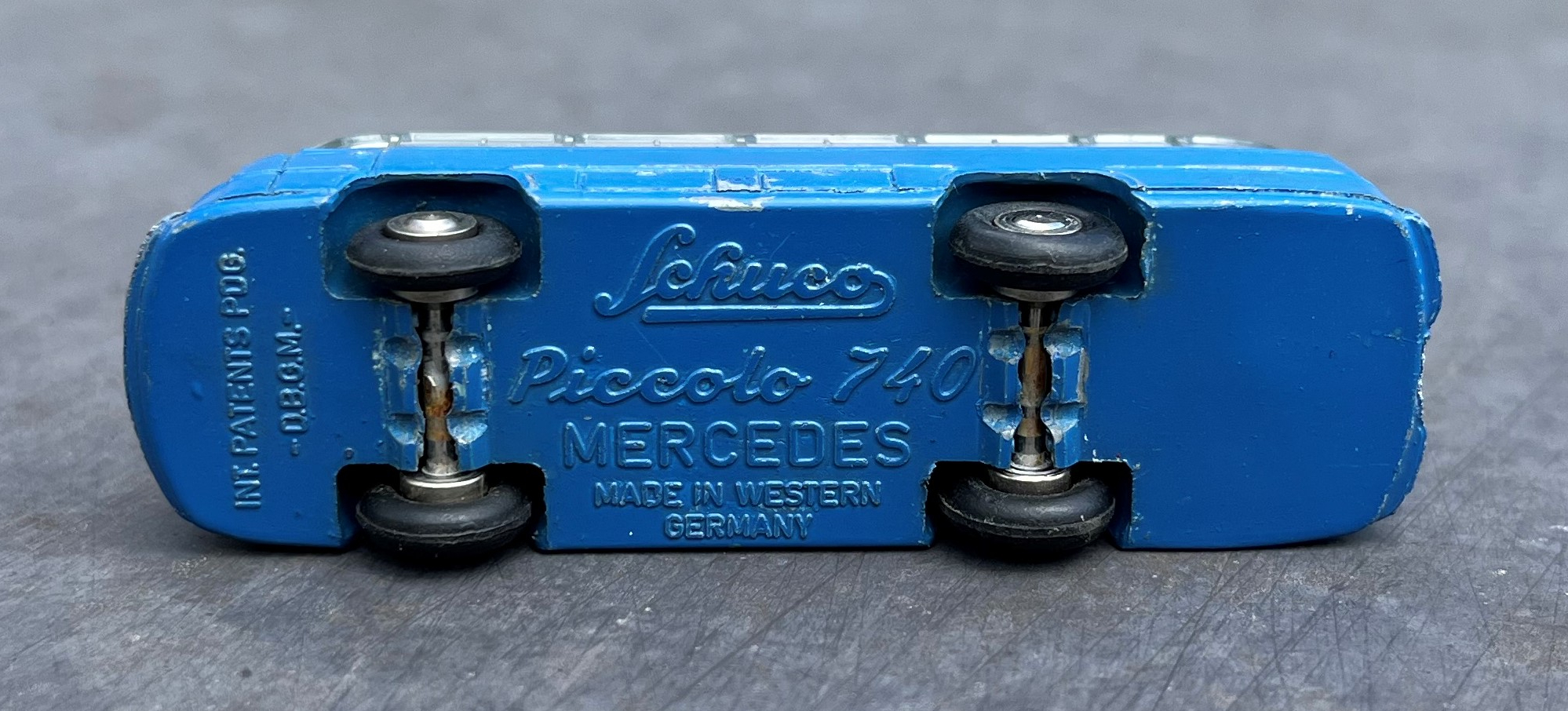
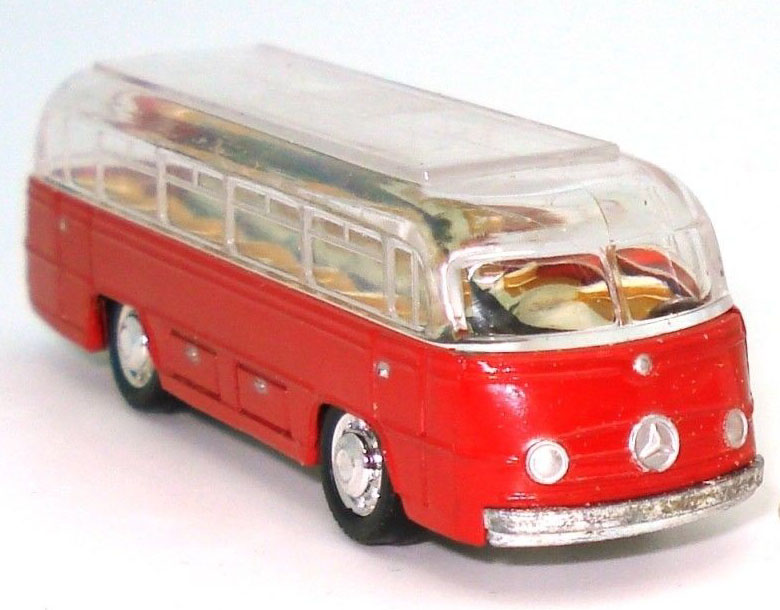
Schuco Piccolo № 740 – Mercedes-Benz coach with
box
Model number 740 in the Schuco Piccolo (1:90 scale) series.
A Ponton era Mercedes-Benz coach. The prototype for this model was likely the Type O 321H "Omnibus." This particular example is missing the
interior seats.
Schuco (Germany) – "Piccolo" series
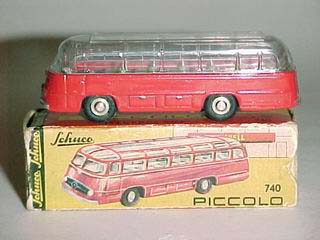
Schuco Piccolo № 740 – Mercedes-Benz coach with
box
Schuco (Germany) – "Piccolo" series
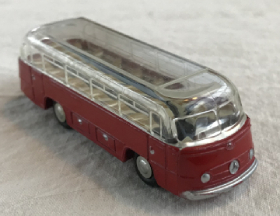
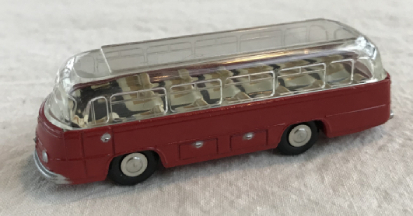
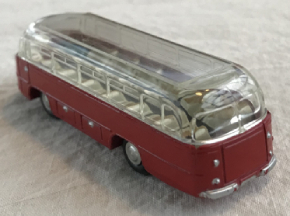
Schuco Piccolo № 740 – Mercedes-Benz coach
Photos uploaded May 19, 2019
Photos: Jeff Miller / iPhone 7 / May 19, 2019
Schuco (Germany) – "Piccolo" series
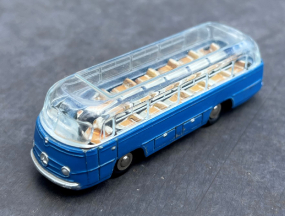
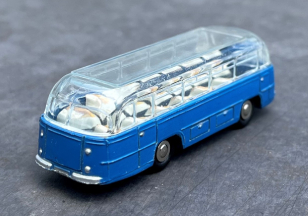
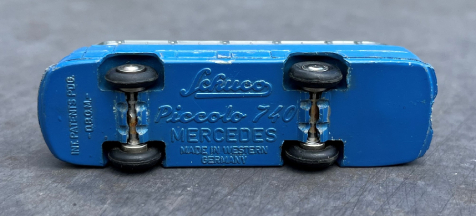
Schuco Piccolo № 740 – Mercedes-Benz coach
Photos: Jeff Miller / iPhone 13 / April 17, 2023
Photos uploaded October 22, 2026
Schuco (Germany) – "Modell" series
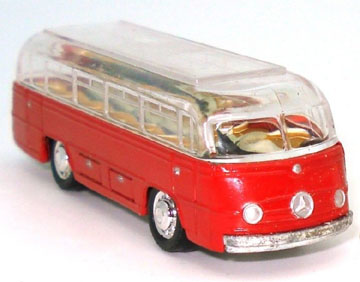
Schuco "Modell" series (1:125) № 317 900 / Mercedes-Benz O 321H Omnibus
/ Introduced 1971
Aside from the wheels, this appears to be identical to
the Piccolo series № 740.
Schuco (Germany) – "Piccolo" series
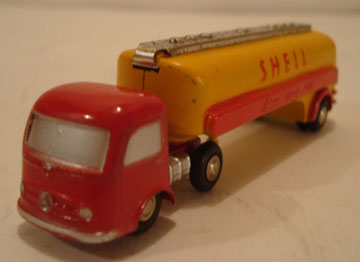
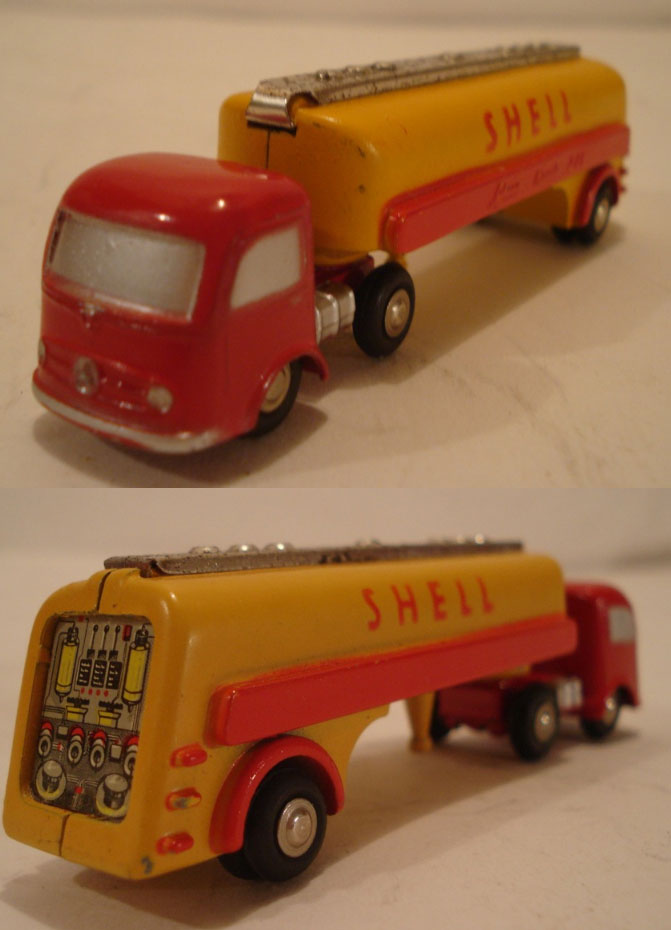
Schuco Piccolo № 744 / Mercedes-Benz Type LP-321 – variation with Shell tanker trailer
Heras (Waiblingen, Germany)
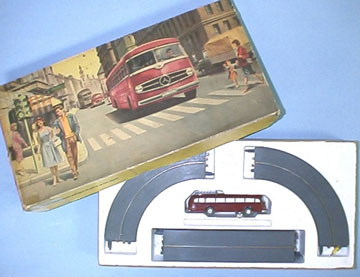
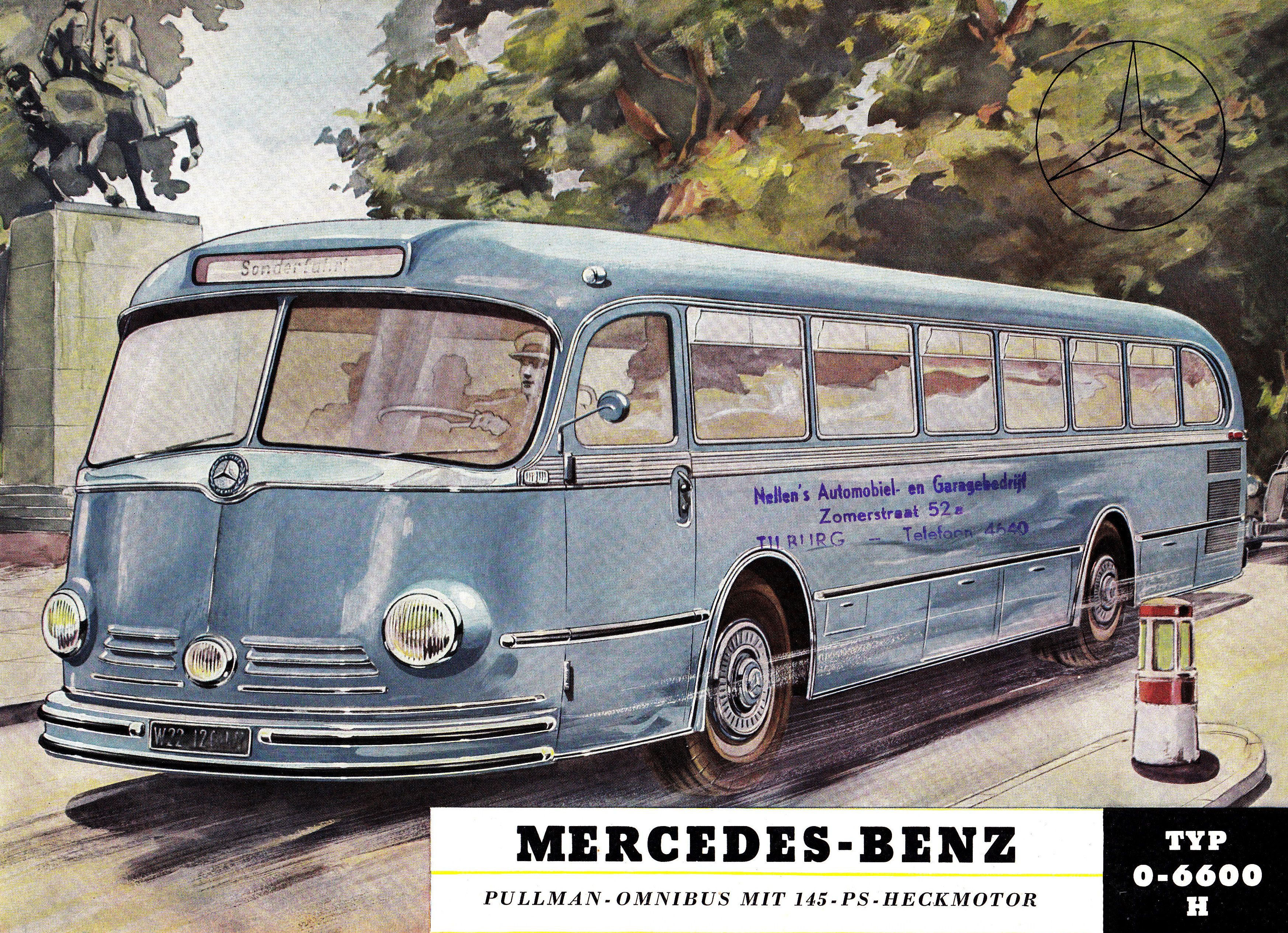
Heras package № 2070 — "Modellstrassenfahrzeuge"

Notice the large three pointed star in the center of the grille
on the illustration. Neither the full scale (Mercedes-Benz Type
O 6600 H "Omnibus") or the Heras model includes this detail. This is known as
"full artistic control – run amok." Purists typically scorn such blatant deviations from reality!
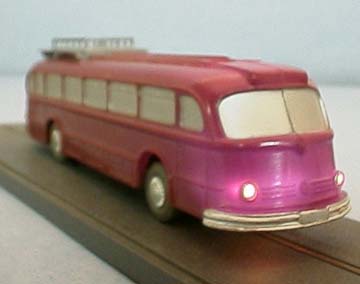
This bus is at the center of the Heras package № 2070 "Modellstrassenfahrzeuge."
It includes this motorized, 1:87 scale Mercedes-Benz coach and eight sections of track. A nice detail
is the luggage roof rack at the rear. The base plate reads, "HERAS Made in Germany Nr. 1070."
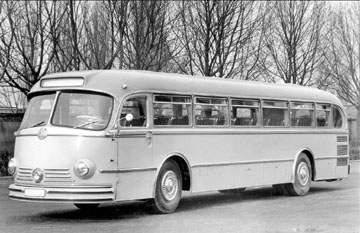
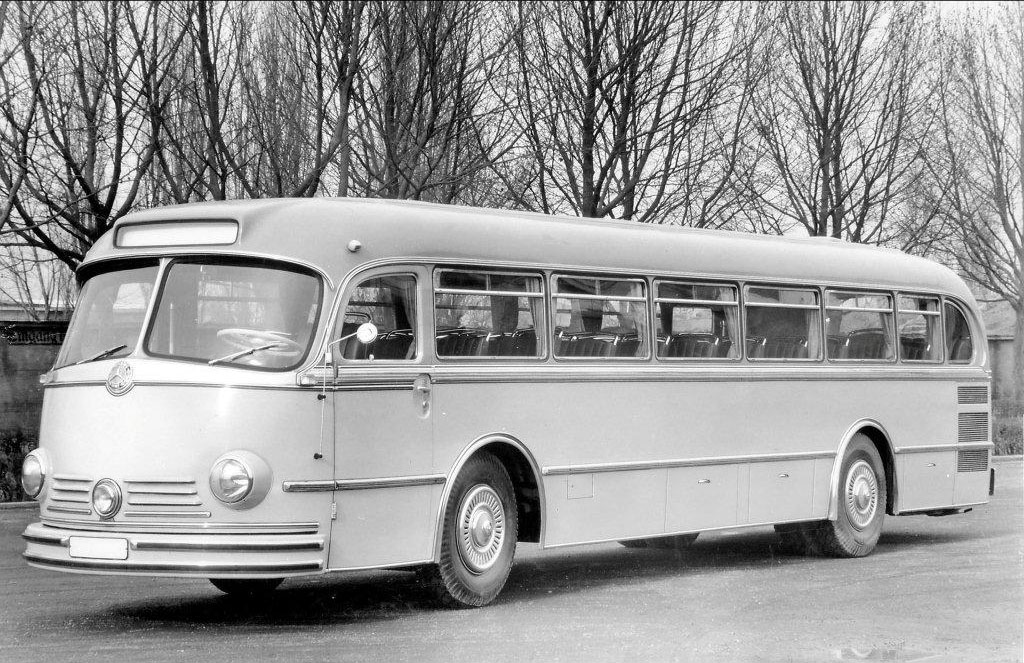
Mercedes-Benz Type O 6600 H "Omnibus"
The HERAS model may have been influenced by the Mercedes-Benz Type O6600H "Omnibus"
produced by Daimler-Benz starting in 1951.
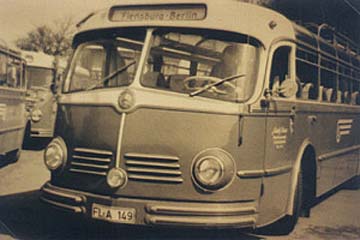
Mercedes-Benz Type O 6600 H "Omnibus"
The center of the grille on the full scale model features a single fog light. The traditional,
cloisonné style badge with
three-pointed star is located higher up, under the windshield.
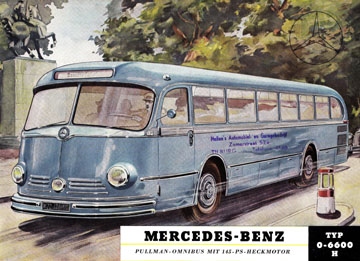
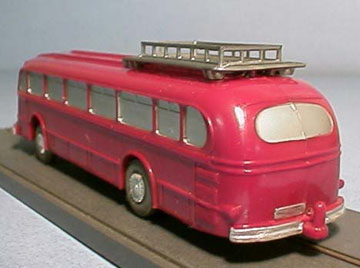
The Mercedes-Benz Type O 6600 H used a pioneering design,
which placed the engine in the rear of the bus. This was a more efficient
use of space and reduced the noise level in the interior.
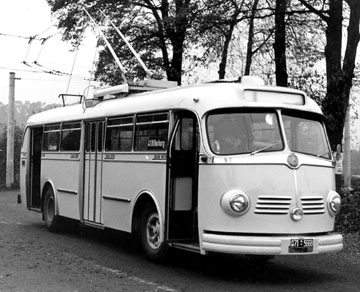
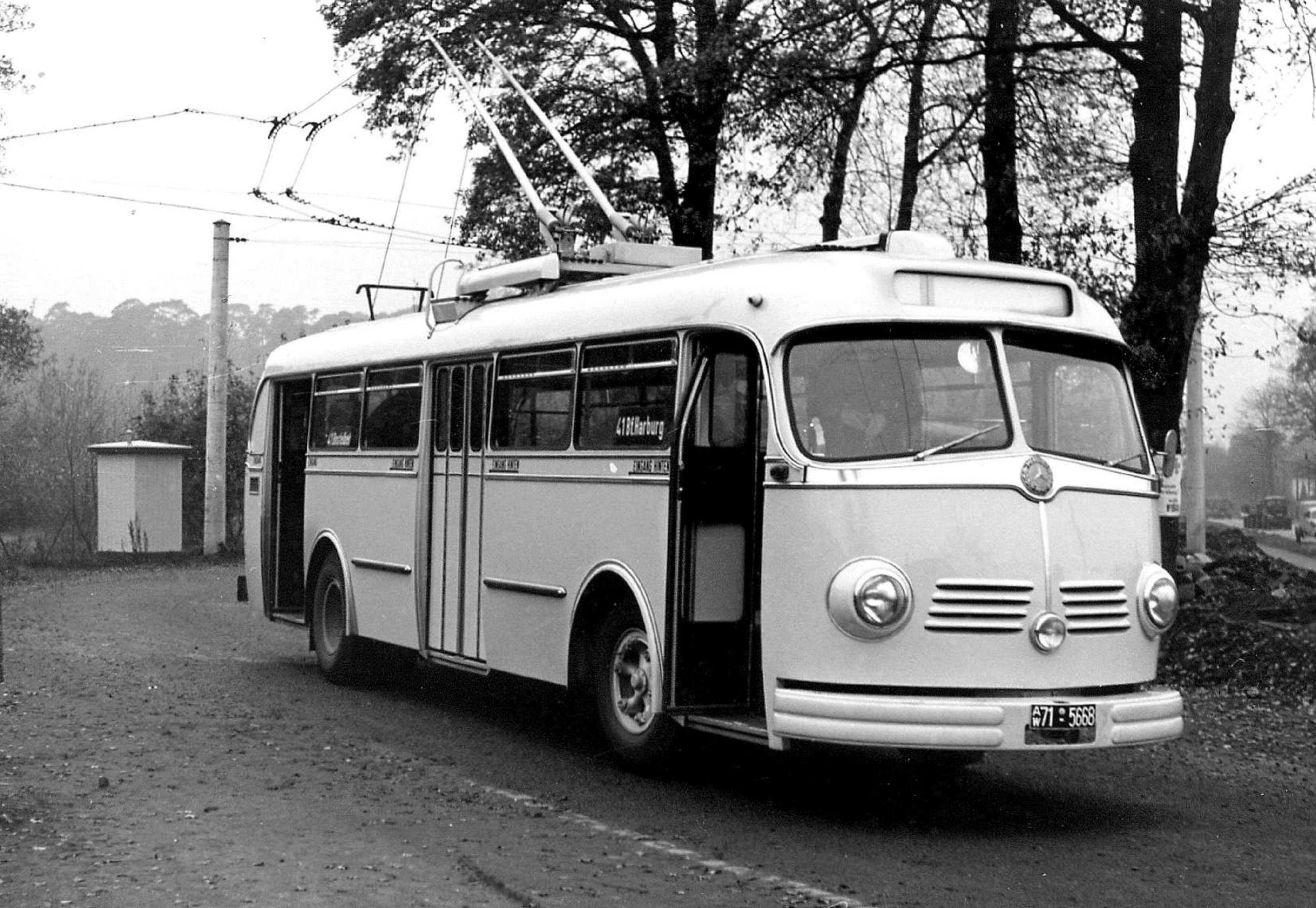
1951 Type O 6600 H with pantograph
Lesney (England) – Matchbox series
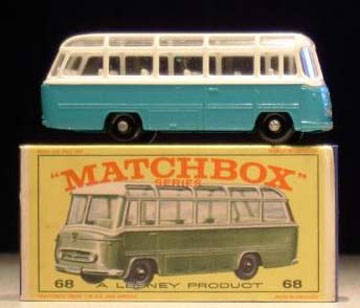
Matchbox № 68 Mercedes Coach (Lesney / England). Released in
September 1965. Length: 73 mm. The turquoise color variant (a.k.a. Sea Green
in Matchbox reference guides) is rare, and elevates its value over the later
orange color variant.
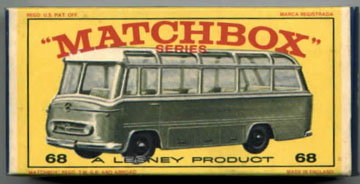
The box alone (with the green coach) can be valuable depending
on market conditions and other variables.
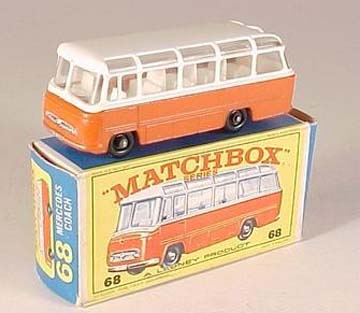
Lesney (England) Matchbox № 68 (of 75) "Mercedes Coach." The orange color
variation is common. The original Matchbox model (with green paint) was released by Lesney in 1965.
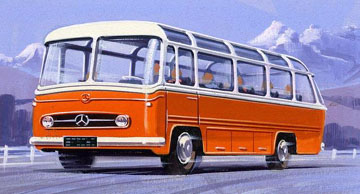
Lesney Matchbox № 68 – Mercedes Coach / Original Canadian
blister pack artwork
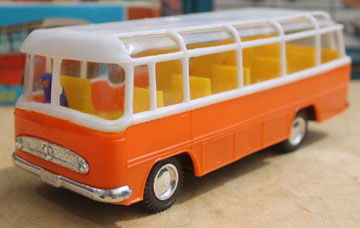
This plastic model from Hong Kong appears to be derived from
the same model Lesney (England) used as a prototype for Matchbox № 68.
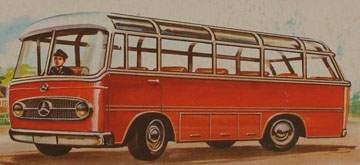
Packaging artwork. This example is from Hong Kong.
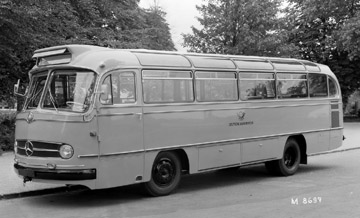
Mercedes-Benz Type O 321 H "Omnibus"
The prototype for Matchbox № 68 may have been the Mercedes-Benz
Type O 321 H "Omnibus." The O 321 H was first produced in 1954 by Daimler-Benz in
Mannheim. I am not yet 100% certain which full-scale bus the Matchbox model was
made to represent, but by 1965, when Lesney first released the Matchbox model,
Daimler-Benz was already using a more modern (angular) grille and body design on
their buses, such as the Type O 302, which featured rectangular head lights. Length
of the Matchbox toy is 73 mm. The Type O 321 H bus was 9.2 m. So the scale of
the Matchbox is approximately 1:64. From Latin, "Omnibus" can be translated to:
"transport for all." The Type O 321 H (where O = Oelmotor = diesel and H = heck = rear
= rear engine) was the first Mercedes-Benz bus to have a self supporting (frameless) body.
editor@mbzponton.org
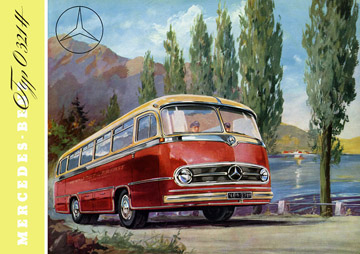
Mercedes-Benz Type O 321 H Coach
It also has a rear engine, and hence a flat front. As a result, the interior
is more spacious, comfortable and quiet because you are constantly "driving away
from" the engine noise. Previously, buses were designed from existing truck platforms,
which resulted in a louder, less comfortable ride. The O 321 H was designed from the
outset as a comfortable riding coach including a custom suspension, which according
to one brochure of the day allowed passengers to read a newspaper while in transit,
an activity that would not have been possible with the earlier truck suspensions.
The original O 321 H had a 5.1 liter, 110 hp diesel engine. Engine displacement and
power were increased later, but not by much. Almost 30,000 units were sold until 1964.
It was very popular in Europe, the Middle East, Africa and South America. Reference:
Mercedes-Benz Classic magazine. Issue: 1-2003.
If any readers have more information about which bus model was used as
inspiration for the Matchbox #68
"Mercedes Coach", please
contact the editor at
editor@mbzponton.org.
Corgi (England)
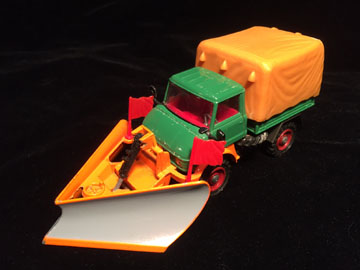
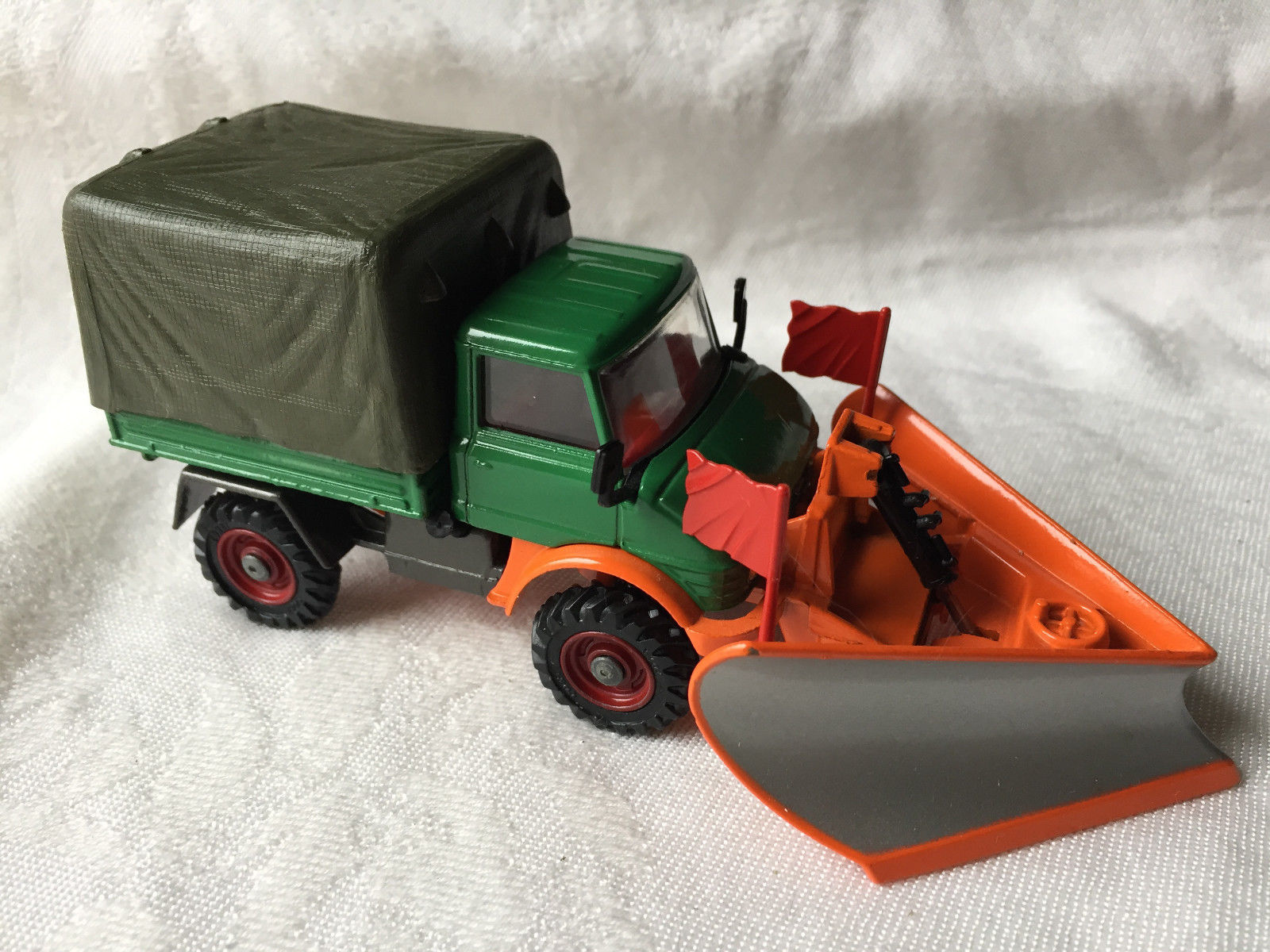
Corgi (England) № 1150 / Mercedes-Benz UNIMOG Type U406 with snow plow and
canopy-covered plank bed (pritsche)
Some examples of this model have a
dark green canopy.
Daimler-Benz began producing the Type U406 at the Gaggenau truck manufacturing
plant in 1963.
Photo: Jeff Miller / December 23, 2014 / iPhone 6
Corgi (England)
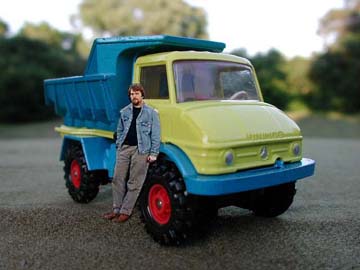
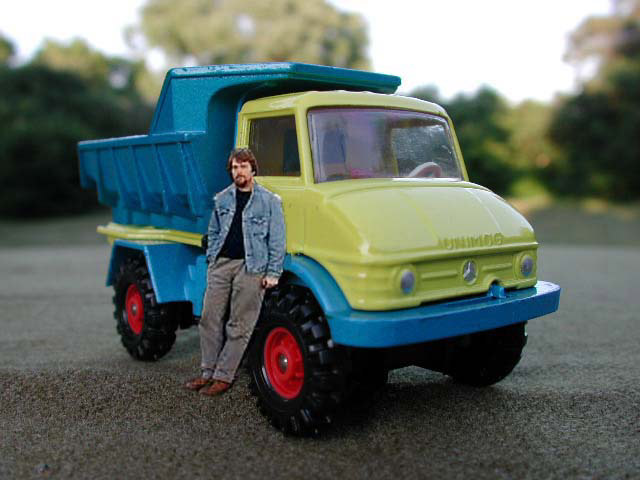
Corgi (England) № 409 / Mercedes-Benz UNIMOG Type U406 Tipper
Corgi (England) № 409, "UNIMOG Tipper." A 1:43 scale
die-cast model of a Mercedes-Benz UNIMOG Type U406 "tipper" (dump truck). Corgi
made this toy from 1971 to 1975 and was modeled after the Type U406, which
began production at Daimler-Benz (Gaggenau Works) in 1963. The photo illustrates how a
model car collection can "grow on you." Original, pre-modified
self-portrait of the editor taken December 1993.
Mercedes-Benz Pontonobilia
Created: June 20, 2001 / Jeff Miller
Last Update:
October 23, 2026
© www.mbzponton.org
Return to the Ponton Photo Gallery
Return to the Pontonobilia page