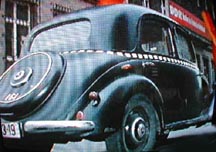
A 1966 film based on the spy novel by Len Deighton
Mercedes-Benz Type 170D (W136) taxi.
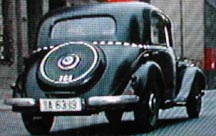
These first Mercedes-Benz scenes supposedly take place in dreary East Berlin.
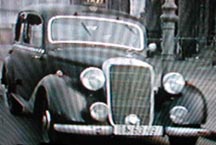
Michael Caine (playing Harry Palmer) takes this taxi from "Checkpoint Charlie" to meet the aging Communist who is in charge of the Berlin Wall (Colonel Stok - played by Oscar Homolka / 1898 - 1978) who allegedly wants to defect to the west.
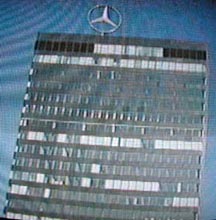
This Daimler-Benz, A.G. (DBAG) building can be seen in various scenes throughout the film.
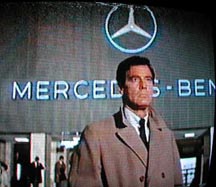
This scene is at the West Berlin airport. No, it is not Michael Caine. It is Paul Hubschmid (1917 - 2001) as "Johnny Vulkan."
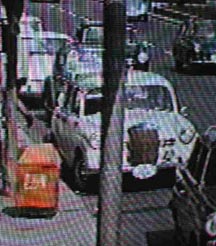
A busy West Berlin street scene with a Type 180/190 (W120/W121) Mercedes-Benz Ponton sedan. This vehicle, with export tag and fog lamps, appears again later in the film parked in the same spot. Many of these scenes are brief, lasting only a few seconds.
The film is good for spotting period cars of various marques such as Opel, and VW. Also stay alert for the German and American Fords such as the Taunus sedan, and the 1959 Galaxie hearse, which both appear later in the film. There is also a 1959 Cadillac convertible (Mega-heckflosse!), which is owned by Johnny Vulkan that is featured prominently throughout the film. There are actually three Mercedes-Benz in this photo. A W110 taxi is at the bottom right and another Ponton (1953 - 1962) is in traffic.
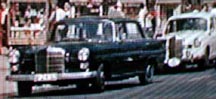
Here are the same cars parked in the same location later in the film.
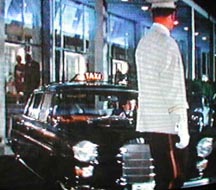
The ubiquitous Type 190D (W110) taxis are working hard in this film, and the soundtrack is favorable for listening to the diesel engine in these brief cameo appearances!
In this scene, Michael Caine's character (Harry Palmer) has a spontaneous (well, not exactly) rendezvous with the alluring femme fatale Samantha Steel, played by Eva Renzi (1944 - 2005).
The Harry Palmer character was a bit like a "debauched James Bond" in each of the three movie adaptations of Len Deighton spy novels (the Ipcress File, Funeral in Berlin and Billion Dollar Brain).
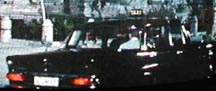
Note the long whip aerial (antenna) on the left rear fender. Undoubtedly for radio communications with the taxi dispatcher. The diesel engine does not have an electronic ignition system, and thus the radio does not need a noise suppression circuit for static-free operation.
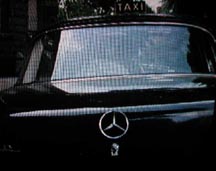
Perhaps the same vehicle was used for all the 190D taxis in the film. Depends on the budget, I suppose.
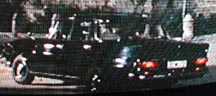
This one does not have the radio aerial however.
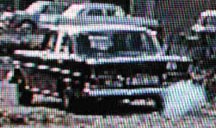
Oops!, does this Type W111 (220Sb) need a head gasket already? The year is only 1966. The puff of blue-white smoke appears when the car is started.
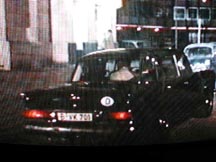
Another scene with the same Type W111 sedan. Poor lighting precludes positive identification of the model. The villain drives this car.
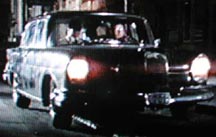
Actually, they are all villains in this film, but it is a matter of one's perspective. The vehicle's paint appears to be neglected too. The master-mind of the East Berlin escape plans, Kreutzman (played by Gnter Meisner / 1926 - 1994) is driving the car.
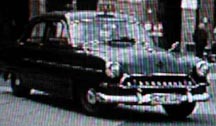
This vehicle has been identified as an Opel "Kapitan" (fourth generation 1954 - 1957). It is working as a taxi, and operated by one of the Israelis who is on Samantha Steel's side.
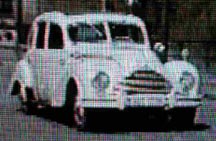
This is an "EMW" (Eisenacher Motoren Werke). The model has not been identified as yet, but it might be a model 340 sedan. It has a sliding roof which is clearly visible in another scene. In the film, this vehicle is owned and operated by the East German Polizei. The car burns a lot of oil! The predecessor to this model was a pre-war "BMW", but as the plant was left on the "wrong" side of the DDR/BRD border, the East Germans started production soon after the war. They sold their first cars and motorcycles as "BMW" which made the original BMW factory oh-so furious. They reached a settlement, and the East Germans changed the name to "EMW." This particular model was built from the pre-war blueprints (approximately) that the original BMW factory had made. The engine was a small six, rather under-powered for the car. Thanks to Pasi Salomäki of Finland who identified the Opel, and the EMW, and provided the history of the EMW's dubious origins.
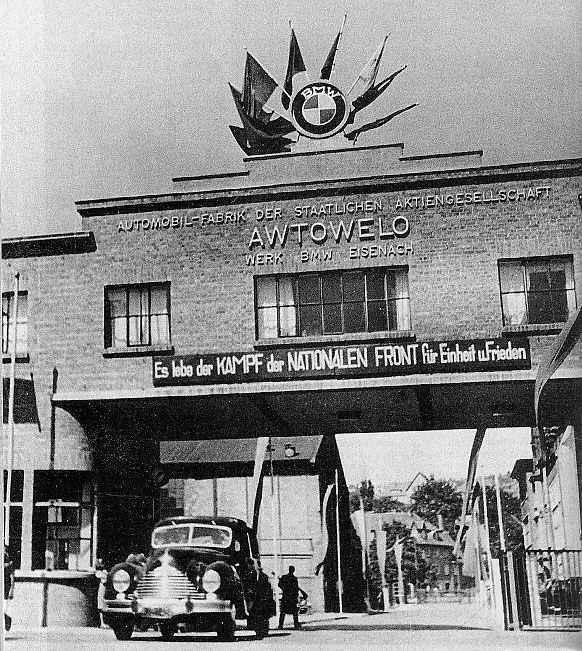
The sign above the Eisenach plant's main entrance, shown in this 1949 photo, trace 20 tragic years of German history. Beneath the BMW emblem, surrounded by flags, is a sign proclaiming "State Automobile Factory, Inc." "Awtowelo" is the Soviet government-run company that assumed control of the facility after the war. Under that name are the words "BMW Factory Eisenach." The banner reads, "Long Live the Struggles of the National Front for Unity and Freedom." That's a BMW 340 sedan in the foreground. The BMW 340 was made from 1949-1951. The EMW 340 was made from 1952-1956. (Roundel magazine, July 2004, p. 65).
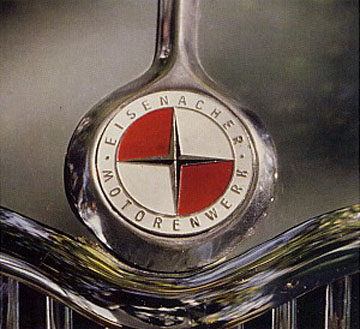
EMW badge
(Roundel magazine, July 2004, p. 66).
